Stock Analysis · Diebold Nixdorf Incorporated (DBD)
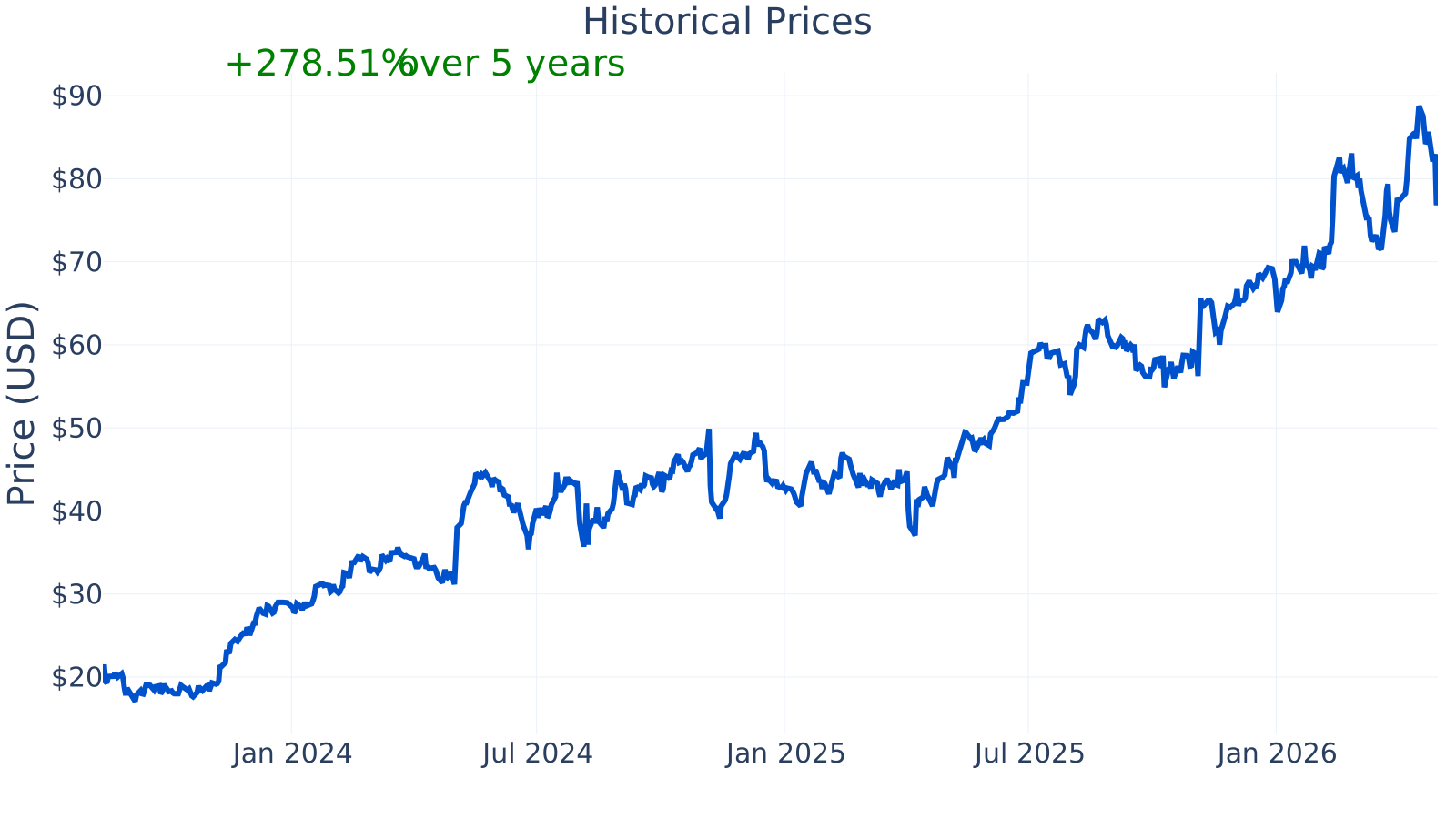
Overview
Diebold Nixdorf Incorporated is a technology company focused on “connected commerce,” meaning the hardware, software, and services that help banks and retailers run self-service and in-store transactions. In practice, this includes ATMs and related software for financial institutions, as well as store technology for retailers (for example, self-checkout and systems used to manage transactions and store operations). The company also provides ongoing services such as maintenance, monitoring, and software support, which are important because many customers need high uptime for machines that handle payments and cash.
Diebold Nixdorf typically describes its business around two main customer areas (banking and retail). In its filings, revenue is generally discussed as coming from product-related sales (equipment and software) and service-related activities (maintenance and managed services), with services often positioned as a recurring or longer-duration component compared with one-time equipment sales. Exact percentages by category can vary by period and contract mix, and are best taken from the most recent annual report segment disclosures.
Commonly described revenue sources include:
- Services (maintenance, managed services, support, software-related services)
- Products (ATM and retail self-service systems, software licenses, and related equipment)
- Software and solutions (platforms and applications sold to banks and retailers, sometimes bundled with services)
At a high level, recent annual results show a business with relatively stable total revenue in the mid-single-digit billions, where operating performance can shift meaningfully based on cost control, pricing, and the balance between higher-margin service work and lower-margin hardware deployments.
Across the last several years shown, total revenue has been relatively steady (roughly $3.5B–$3.9B). Operating income improved notably from a loss in 2022 to positive levels in 2023–2025, while interest expense declined substantially by 2025. Net income has been volatile, including an unusually large profit in 2023 followed by a small loss in 2024 and a return to profit in 2025, which suggests that items beyond day-to-day operations (such as one-time gains/losses or accounting impacts) may have influenced bottom-line results in some years.
Key Figures
| Metric | Value | Industry ⓘ |
|---|---|---|
| Date | May 04, 2026 | |
| Context | ||
| Sector | Technology | |
| Industry | Software - Application | |
| Market Cap ⓘ | $2.71B | |
| Beta ⓘ | 1.48 | |
| Fundamental | ||
| P/E Ratio ⓘ | 26.85 | 26.40 |
| Profit Margin ⓘ | 2.80% | 7.95% |
| Revenue Growth ⓘ | 6.00% | 15.60% |
| Debt to Equity ⓘ | 91.84% | 27.14% |
| PEG ⓘ | N/A | |
| Free Cash Flow ⓘ | $266.00M | |
Diebold Nixdorf’s market capitalization is about $2.7B. The stock’s beta of ~1.48 indicates it has historically moved more than the overall market, which can mean larger swings in both directions. The P/E ratio is ~26.85, close to the industry median shown (~26.40).
Profitability and balance-sheet metrics look more mixed. The latest profit margin is ~2.8%, below the industry median shown (~7.95%), which leaves less room for error if costs rise or revenue weakens. The latest revenue growth is ~6.0% year-over-year, also below the industry median shown (~15.6%). The company’s debt-to-equity is ~91.8%, materially higher than the industry median shown (~27.1%), which can raise the importance of consistent cash generation and refinancing conditions. On cash generation, free cash flow (TTM) is about $266M, which is a notable improvement versus prior periods that were negative.
Growth (medium)
Diebold Nixdorf operates in markets that are mature in some areas (such as traditional ATM fleets in developed regions) but still evolving due to ongoing needs for upgrades, security, software modernization, and services. Retail also continues to invest in store automation and self-service to improve labor efficiency and customer throughput. As a result, the company’s longer-term opportunity is often tied less to explosive unit growth and more to technology refresh cycles, attached software, and multi-year service relationships.
A key strategic logic for future growth is the mix shift toward services and software-like offerings, because these can be stickier than one-time equipment sales and can create repeatable revenue tied to uptime and compliance requirements. Another practical catalyst can be improved execution: when supply chains, project delivery, pricing discipline, and service efficiency improve, operating income can rise even without strong top-line expansion.
Revenue growth has been uneven: it moved from positive growth in 2023 into declines across several quarters in 2024 and early 2025, before turning positive again by late 2025 and early 2026 (about +6% most recently). That pattern suggests the business may be benefiting from a rebound or easier comparisons, but it also shows that growth has not been steady.
Free cash flow shows a clearer improvement trend, moving from meaningfully negative in 2023 (about -$388M) and still negative in early 2024 (about -$222M) to positive territory by 2025 (about $182M) and further improving to about $266M most recently. For a company with meaningful debt and a service-intensive operating model, sustained positive free cash flow can be an important indicator of financial flexibility.
Risks (high)
Diebold Nixdorf’s main risks tend to cluster around leverage, execution, and end-market dynamics. The company operates large service organizations and delivers complex deployments; operational missteps (project delays, cost overruns, service-level penalties, or weaker pricing) can pressure margins. In addition, banking and retail customers can reduce or delay capital spending during uncertain economic periods, which may affect equipment demand and some related implementation work.
Leverage stands out as a key risk. Debt-to-equity has trended down from levels above 100% in prior periods to about 91.8% most recently, but it remains well above the industry median shown (roughly 29.0%). Higher leverage can increase sensitivity to interest rates, refinancing conditions, and any downturn that reduces cash generation.
Profit margins have been volatile. The most recent profit margin is about 2.8%, which is below the industry median shown (about 8.4%). The chart also indicates periods of near-zero or slightly negative margins around 2024–2025, followed by gradual improvement. Lower and more variable margins can reflect a business that is still working through pricing, cost structure, or mix challenges.
On competitive positioning, the company operates in competitive global markets. In banking self-service, competitors include large ATM and banking-technology providers (for example, NCR Atleos in ATM-related offerings). In retail store technology and self-checkout, competitors include NCR Voyix and other point-of-sale and store-automation vendors. Competitive advantages in this industry often come from scale in service coverage, long-standing customer relationships, installed base, and the ability to bundle hardware, software, and services. Diebold Nixdorf has a long operating history and a broad footprint, but leadership can vary by geography and product line, and customers can use competitive tenders to negotiate pricing.
Valuation
The company’s current P/E ratio is ~26.85, close to the industry median shown (~26.40). That places the valuation near what the market is paying for a typical company in the same broad industry grouping, based on this single metric. The historical P/E line also indicates that the ratio can swing sharply over time, which often happens when earnings are volatile or affected by one-time items.
Whether this valuation is “high” or “low” depends heavily on durability of earnings and cash flow. With recent positive free cash flow but below-median profit margin and above-median leverage, the valuation context is closely tied to whether operational improvements persist and whether the balance sheet continues to strengthen. In other words, the multiple alone is not very informative unless profitability and cash generation remain stable across cycles.
Conclusion
Diebold Nixdorf is a connected-commerce provider serving banks and retailers with a mix of equipment, software, and services. The company’s recent profile combines improving free cash flow and better operating performance with meaningful leverage and profitability that remains below the industry median. Revenue growth has also been inconsistent, although it has recently returned to positive territory.
From a long-term, business-focused perspective, the key factual points to monitor over time are: (1) whether margins continue to improve and become less volatile, (2) whether positive free cash flow is sustained through different demand environments, and (3) whether leverage continues to decline relative to peers. The current valuation (as reflected by P/E) is broadly in line with the industry median shown, making the company’s future fundamentals—rather than a clearly unusual valuation level—the central driver of how the market may assess it over time.
Sources:
- SEC EDGAR — Diebold Nixdorf Incorporated Form 10-K (Annual Report)
- SEC EDGAR — Diebold Nixdorf Incorporated Form 10-Q (Quarterly Reports)
- Diebold Nixdorf Investor Relations — SEC Filings & Annual Reports (company-hosted)
- Diebold Nixdorf Investor Relations — Press Releases (company-hosted)
- Wikipedia — “Diebold Nixdorf” (basic company background)
This article is for informational purposes only and does not constitute financial advice. Some content is AI-generated. See Disclaimer


