Stock Analysis · Diebold Nixdorf Incorporated (DBD)
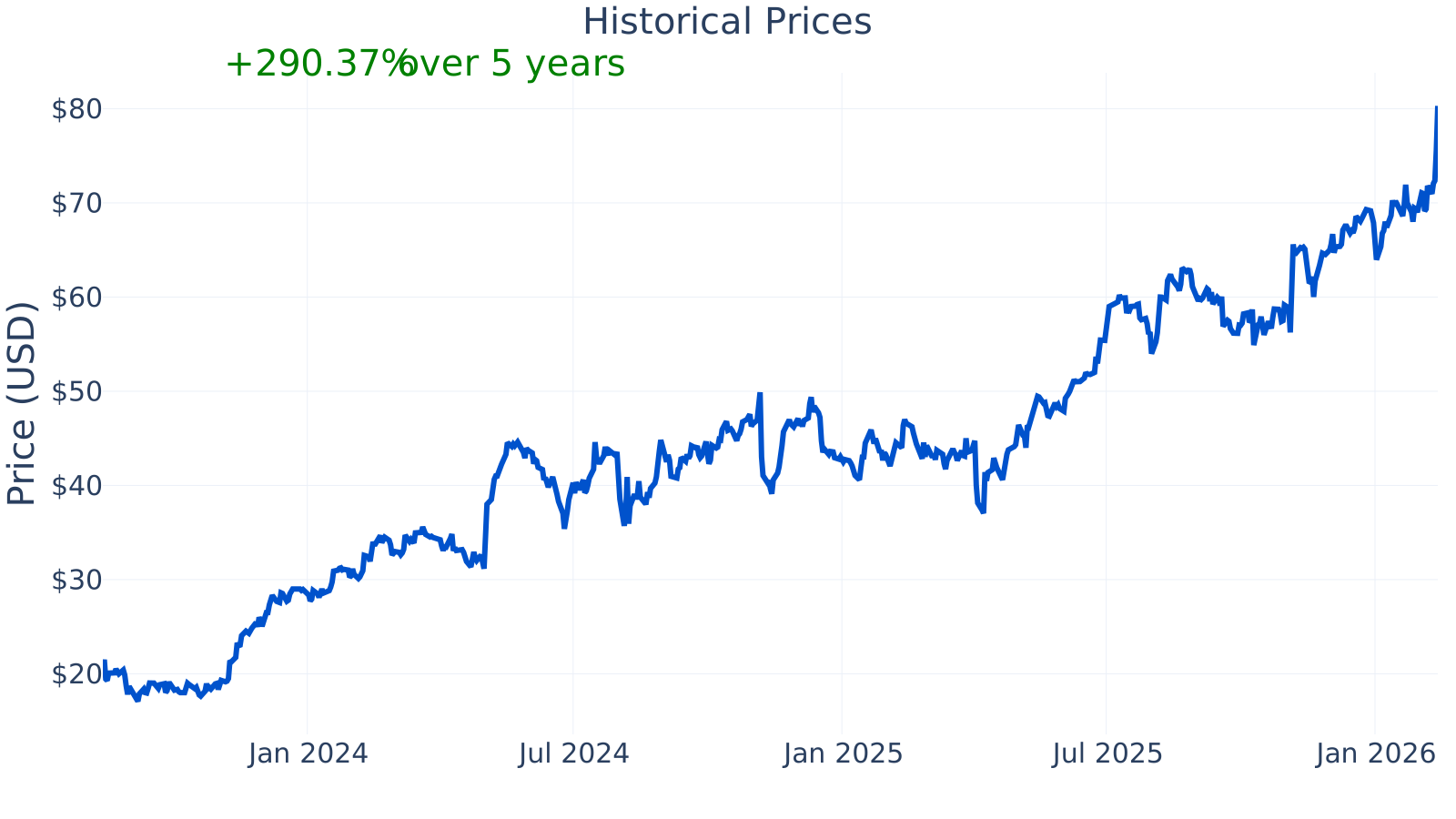
Overview
Diebold Nixdorf Incorporated (DBD) provides technology, software, and services that help banks and retailers run “self-service” and checkout operations. In practice, that includes ATMs and related software for financial institutions, as well as in-store systems for retailers such as self-checkout solutions, point-of-sale (POS) technology, and the ongoing services needed to keep these systems running. The business is typically a mix of (1) selling equipment and software and (2) recurring services such as maintenance, monitoring, and managed services.
Across its filings, the company generally describes two main operating segments: solutions for banking (ATM-related hardware/software and services) and solutions for retail (store automation and checkout-related technology and services). The overall revenue mix usually combines both “one-time” project work (like installing equipment) and “ongoing” support (like service contracts), which can matter for stability over time.
Main revenue sources are commonly described in the following buckets (largest-to-smallest can vary by year and contract timing, and exact percentages should be taken from the latest annual report segment disclosures):
- Services and managed services (maintenance, monitoring, outsourcing/managed operations)
- Hardware (ATMs, self-checkout and related store equipment)
- Software (platform software and applications tied to banking/retail solutions)
At a high level, recent years show revenue around the $3.5–$3.9B range, while profitability has been more variable—partly reflecting restructuring efforts, cost controls, financing costs, and the timing of large customer projects.
The profitability bridge over the last several years shows relatively stable revenue around the mid-$3B range, while operating income improved from a loss in 2022 to positive levels in 2023–2025. Interest expense also declined meaningfully by 2025 versus 2023, which can reduce pressure on bottom-line results when operating performance is steady.
Key Figures
| Metric | Value | Industry ⓘ |
|---|---|---|
| Date | Feb 16, 2026 | |
| Context | ||
| Sector | Technology | |
| Industry | Software - Application | |
| Market Cap ⓘ | $2.88B | |
| Beta ⓘ | 1.55 | |
| Fundamental | ||
| P/E Ratio ⓘ | 31.61 | 27.48 |
| Profit Margin ⓘ | 2.49% | 7.66% |
| Revenue Growth ⓘ | 11.70% | 15.80% |
| Debt to Equity ⓘ | 85.33% | 24.71% |
| PEG ⓘ | N/A | |
| Free Cash Flow ⓘ | $246.00M | |
Diebold Nixdorf’s market capitalization is about $2.88B. The stock’s beta (1.55) suggests it has historically moved more than the broader market, which can mean larger swings up and down. On valuation, the latest P/E ratio is ~31.6, above the industry median of ~27.5. Profitability is currently slimmer than the industry median, with a profit margin of ~2.49% versus an industry median near 7.66%. Revenue growth (year-over-year) is about 11.7%, below an industry median near 15.8%. Leverage is higher than typical for the peer set, with debt-to-equity of ~85% versus an industry median near 25%. Free cash flow over the trailing twelve months is positive at roughly $246M.
Growth (Medium)
Diebold Nixdorf operates in markets that are not purely “high-growth tech,” but can still expand steadily due to ongoing needs in bank self-service and retail automation. Banks continue to modernize ATM fleets and software for security, reliability, and new customer features. Retailers continue investing in front-end automation (including self-checkout and assisted checkout) to improve labor efficiency and customer throughput. In both areas, the installed base matters: once systems are deployed, customers typically require multi-year service and support, which can support recurring revenue.
A key question for long-term growth is whether the company can convert its product footprint into more recurring services and software-related revenue, while keeping costs controlled and execution consistent. Another important factor is whether customers accelerate refresh cycles (upgrading hardware and software) and sign longer-duration managed services contracts, which can make revenue less cyclical than hardware-only sales.
Year-over-year revenue growth was positive in late 2023, then weakened and turned negative through much of 2024 and mid-2025, before improving to about 11.7% by the most recent point shown. This pattern indicates growth has not been consistent, and results may be sensitive to project timing, customer spending cycles, and execution.
Free cash flow shows a notable swing from negative (about -$388M in 2023 and -$222M in 2024) to positive (about $182M by 2025) and currently around $246M on a trailing basis. For a company with meaningful debt and restructuring history, sustained positive free cash flow can be an important operational milestone because it can support debt reduction, reinvestment, and financial flexibility—though the durability of this improvement matters more than a single period.
Risks (High)
This article is for informational purposes only and does not constitute financial advice. Some content is AI-generated. See Disclaimer


