Stock Analysis · Dicks Sporting Goods Inc (DKS)
Overview
DICK’S Sporting Goods, Inc. is a U.S. specialty retailer focused on sporting goods, athletic apparel, footwear, and related equipment. The company sells through a network of large-format stores and specialty concepts, supported by digital sales channels (website and mobile app) and services that are meant to increase customer loyalty (for example, memberships and other engagement programs described in its filings).
In its SEC filings, DICK’S describes its business primarily around retailing athletic and outdoor-related products across multiple categories rather than relying on a single product line. While the company reports sales by category in its annual report, the exact category mix can shift over time based on demand, promotions, and inventory levels.
At a high level, the company’s revenue comes from selling:
- Hardlines (sporting goods equipment and related items)
- Apparel (athletic and casual clothing)
- Footwear (athletic shoes and related products)
- Other (smaller categories and services, as defined in company reporting)
Overall, DICK’S model is a mix of physical retail (where many customers still want to see/try items, especially footwear and equipment) and e-commerce (which supports convenience and broader assortment).
Over the last several fiscal years shown, total revenue increased from about $12.3B (fiscal year ended 2022) to about $17.2B (fiscal year ended 2026). Over the same span, selling, general and administrative expenses rose in absolute dollars as the business scaled. Net income in the last year shown appears unusually large relative to operating income and prior years, which can happen when a one-time accounting item is present; investors typically confirm this by reading the company’s annual report discussion of non-recurring items.
Key Figures
| Metric | Value | Industry ⓘ |
|---|---|---|
| Date | Mar 16, 2026 | |
| Context | ||
| Sector | Consumer Cyclical | |
| Industry | Specialty Retail | |
| Market Cap ⓘ | $17.29B | |
| Beta ⓘ | 1.25 | |
| Fundamental | ||
| P/E Ratio ⓘ | 15.65 | 20.21 |
| Profit Margin ⓘ | 4.93% | 4.93% |
| Revenue Growth ⓘ | 59.90% | 4.60% |
| Debt to Equity ⓘ | 139828.07% | 103.28% |
| PEG ⓘ | 1.88 | |
| Free Cash Flow ⓘ | $399.70B | |
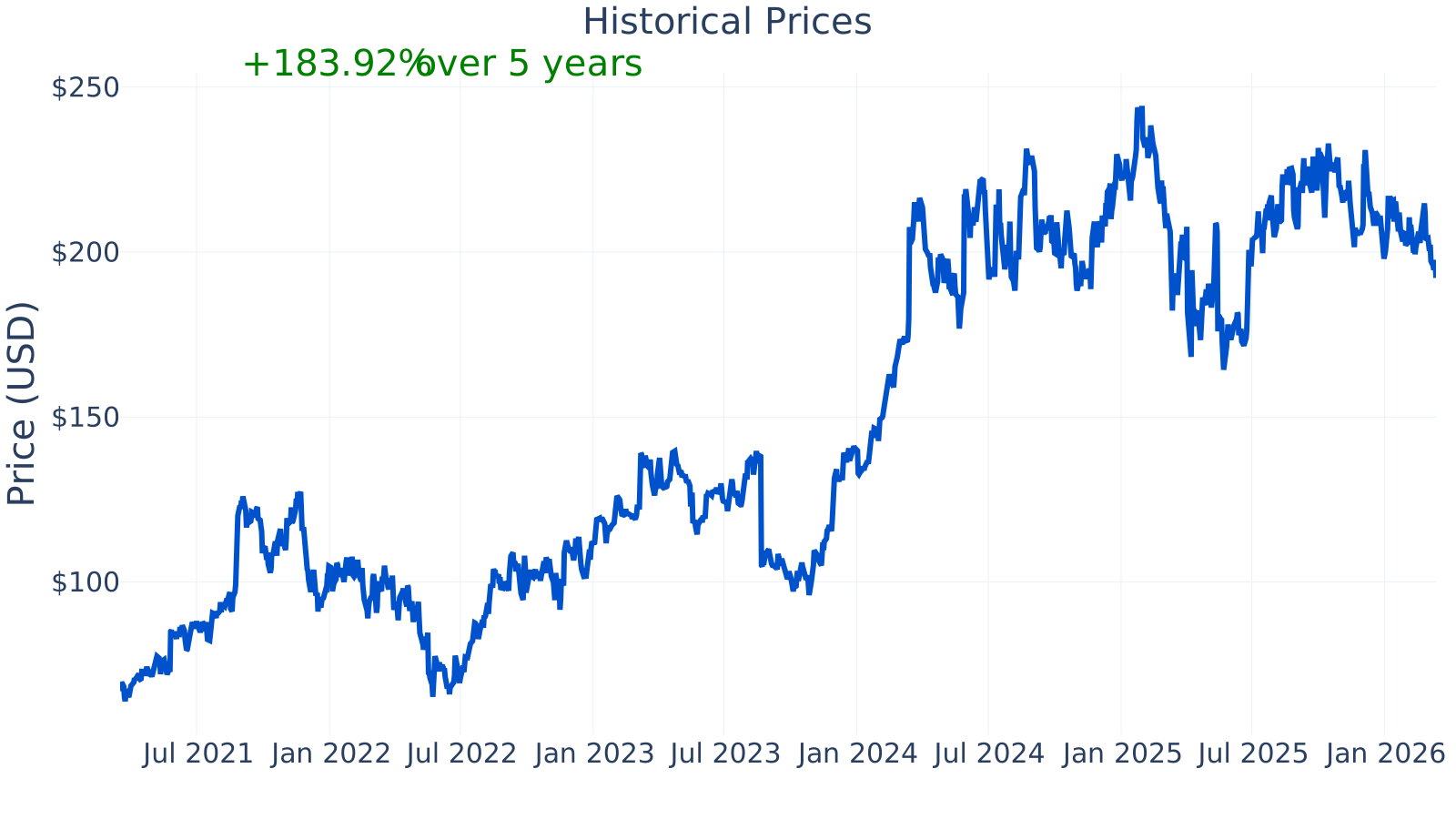
DICK’S is a mid-to-large sized public retailer with a market capitalization of about $17.3B. The stock’s beta of about 1.25 indicates it has tended to move more than the overall market (higher ups and downs). The company’s P/E ratio is about 15.6 versus an industry median near 20.2, while profit margin is about 4.93%, roughly in line with the industry median shown. One item that stands out is debt-to-equity, listed at about 139,828% versus an industry median near 103%; that magnitude is often driven by balance-sheet structure (for example, a very small equity base due to share repurchases) rather than “debt level” alone, and it typically warrants a closer look in the 10-K balance sheet and footnotes. Free cash flow is shown as about $399.7B, which is far above the company’s scale and may reflect a data mapping anomaly or a non-recurring reporting effect; it is worth cross-checking against the company’s statement of cash flows in the latest filing.
Growth (Medium)
The sporting goods and athletic retail market tends to grow with consumer spending, participation in sports and fitness, and long-running trends such as casual athletic wear (“athleisure”). For a retailer like DICK’S, long-term growth is usually less about a single breakthrough product and more about executing well on merchandising, store productivity, brand partnerships, and an effective omnichannel experience (stores plus online).
A straightforward way to think about DICK’S growth strategy (as described across its filings) is:
- Strengthening the store base with formats and in-store experiences designed to drive traffic and conversion
- Expanding digital capabilities so customers can shop seamlessly across online and stores
- Building loyalty/engagement programs that increase repeat purchases and improve marketing efficiency
- Balancing inventory and promotions to protect margins through demand cycles
Year-over-year revenue growth was very strong in some periods and modest in others. The latest point shown is about 59.9%, which is much higher than the industry median shown (about 4.6%). Because retailers can experience short-term spikes due to timing, comparisons, or acquisitions/one-time shifts, it helps to review multiple years and the company’s explanation in its quarterly/annual filings to understand whether growth is broad-based (more customers, more units) or more temporary (pricing, timing, category swings).
Free cash flow can be important for long-term business resilience because it is a rough measure of how much cash remains after operating needs and capital spending. Earlier values shown (roughly $0.5B to $1.3B range) look more consistent with the scale of the company, while the latest value shown is extremely large relative to revenue and likely needs verification in the company’s cash flow statement. For long-term analysis, consistency of cash generation across cycles is typically more informative than a single outsized figure.
Risks (Medium)
DICK’S operates in retail, which comes with several structural risks. Demand can be sensitive to the economy and consumer confidence, and product categories can be seasonal. Retailers also face ongoing execution risk: buying the right inventory, avoiding excessive markdowns, managing shrink (theft and loss), and controlling labor and occupancy costs. In addition, competition is intense both from online-first sellers and from large multi-category retailers.
Competitive advantages in this type of business are usually practical rather than “patent-like.” DICK’S scale, brand relationships, store footprint, and omnichannel capabilities can support purchasing leverage and customer convenience. However, many competitors can sell similar national brands, so differentiation often depends on service, in-store experiences, exclusive products/assortment choices, and operational consistency.
Key competitors commonly discussed for U.S. sporting goods and athletic retail include:
- Large general retailers with sports offerings (broad competition on price and convenience)
- Online marketplaces and direct-to-consumer channels (competition on selection and delivery)
- Specialty sporting goods retailers (competition on assortment depth and expertise)
- Brand-owned stores and websites (brands selling directly to customers)
The debt-to-equity series generally sits above the industry median for much of the period shown (often around 140%–215% versus an industry median near ~95%–124%), and then jumps dramatically at the latest point. A sudden extreme change like this often reflects balance sheet mechanics (equity shrinking, classification changes, or one-time items) rather than a normal operating shift; the most reliable way to interpret it is to read the latest 10-K/10-Q balance sheet and related footnotes.
Profit margin has trended down from very high levels in 2021–2022 (roughly 9%–12%) toward about 4.93% at the latest point, which is close to the industry median shown. This pattern can occur when retail conditions normalize after unusually favorable periods, when promotions increase, or when costs rise. For long-term evaluation, the key question is whether margins stabilize at a sustainable level through different consumer environments.
Valuation
Valuation is often summarized by the price-to-earnings (P/E) ratio, which compares the stock price to the company’s earnings. For retailers, P/E can move quickly if profits rise or fall, so it is typically interpreted together with business stability, margin trends, and cycle risk.
Across the period shown, DICK’S P/E ratio is frequently below the industry median, though it varies meaningfully over time. The latest P/E in the table is about 15.6 compared with an industry median around 20.2. A lower P/E can reflect the market assigning a more cautious outlook (for example, concerns about consumer demand or margin normalization), or it can reflect company-specific factors. A higher P/E can reflect expectations of steadier growth or stronger durability. Interpreting today’s valuation mainly comes down to whether earnings and cash generation appear repeatable through normal retail cycles, which can be assessed by reviewing multi-year results and management’s discussion in filings.
Conclusion
DICK’S Sporting Goods is a large U.S. sporting goods retailer with a business model built around national brand merchandising, a sizable store base, and an integrated digital channel. The company’s recent history shown includes rising revenue over multiple years, but also evidence that profitability and growth rates can vary by period, which is typical for retail.
The main long-term topics to track are (1) whether revenue growth remains sustainable without heavy discounting, (2) whether profit margins stabilize near a durable level, and (3) balance-sheet dynamics—especially the unusually high debt-to-equity reading and the need to confirm the latest cash-flow figure in official filings. Relative valuation metrics shown (such as P/E versus the industry median) provide useful context, but they are most meaningful when paired with a clear view of how steady the company’s earnings power is across economic conditions.
Sources:
- DICK’S Sporting Goods, Inc. — Annual Report (Form 10-K), “Business” and “Management’s Discussion and Analysis of Financial Condition and Results of Operations” sections
- SEC EDGAR — DICK’S Sporting Goods, Inc. filings (Forms 10-K, 10-Q, 8-K)
- DICK’S Sporting Goods Investor Relations — Earnings releases and presentations (public company-posted materials)
- Wikipedia — “Dick’s Sporting Goods” (basic company background)
This article is for informational purposes only and does not constitute financial advice. Some content is AI-generated. See Disclaimer


