Stock Analysis · Deckers Outdoor Corporation (DECK)
Overview
Deckers Outdoor Corporation (DECK) is a footwear and apparel company best known for its consumer brands. The business designs products, works with manufacturing partners, and sells through a mix of wholesale partners (such as retailers) and direct-to-consumer channels (e-commerce and company-owned stores). The company’s results are largely driven by brand strength, product demand, pricing power, and its ability to manage inventory and marketing efficiently.
Deckers’ revenue is primarily generated by selling products under its brand portfolio. In company reporting, the largest contributors are typically its two biggest brands, with smaller contributions from other brands and categories.
Main sources of revenue (largest to smallest, percentages depend on the fiscal year’s brand mix as reported in the annual filing):
- UGG brand products (footwear, some apparel/accessories)
- HOKA brand products (performance running and related footwear/apparel)
- Other brands (smaller lines that vary over time)
- Direct-to-consumer vs. wholesale (Deckers reports sales by distribution channel in its annual filing)
From a business model perspective, Deckers tends to benefit when it can (1) keep its brands “on trend,” (2) grow direct-to-consumer sales without heavy discounting, and (3) protect margins through sourcing and freight management.
Over the last several fiscal years, total revenue increased meaningfully (from about $2.55B in fiscal 2021 to about $4.99B in fiscal 2025), while operating income and net income rose faster than sales. This pattern is consistent with improving operating efficiency and/or higher gross margin and pricing, since profits expanded more quickly than the top line.
Key Figures
| Metric | Value | Industry ⓘ |
|---|---|---|
| Date | Feb 07, 2026 | |
| Context | ||
| Sector | Consumer Cyclical | |
| Industry | Footwear & Accessories | |
| Market Cap ⓘ | $16.83B | |
| Beta ⓘ | 1.15 | |
| Fundamental | ||
| P/E Ratio ⓘ | 16.40 | 29.80 |
| Profit Margin ⓘ | 19.35% | 5.43% |
| Revenue Growth ⓘ | 7.10% | 6.90% |
| Debt to Equity ⓘ | 13.14% | 63.50% |
| PEG ⓘ | 1.57 | |
| Free Cash Flow ⓘ | $929.14M | |
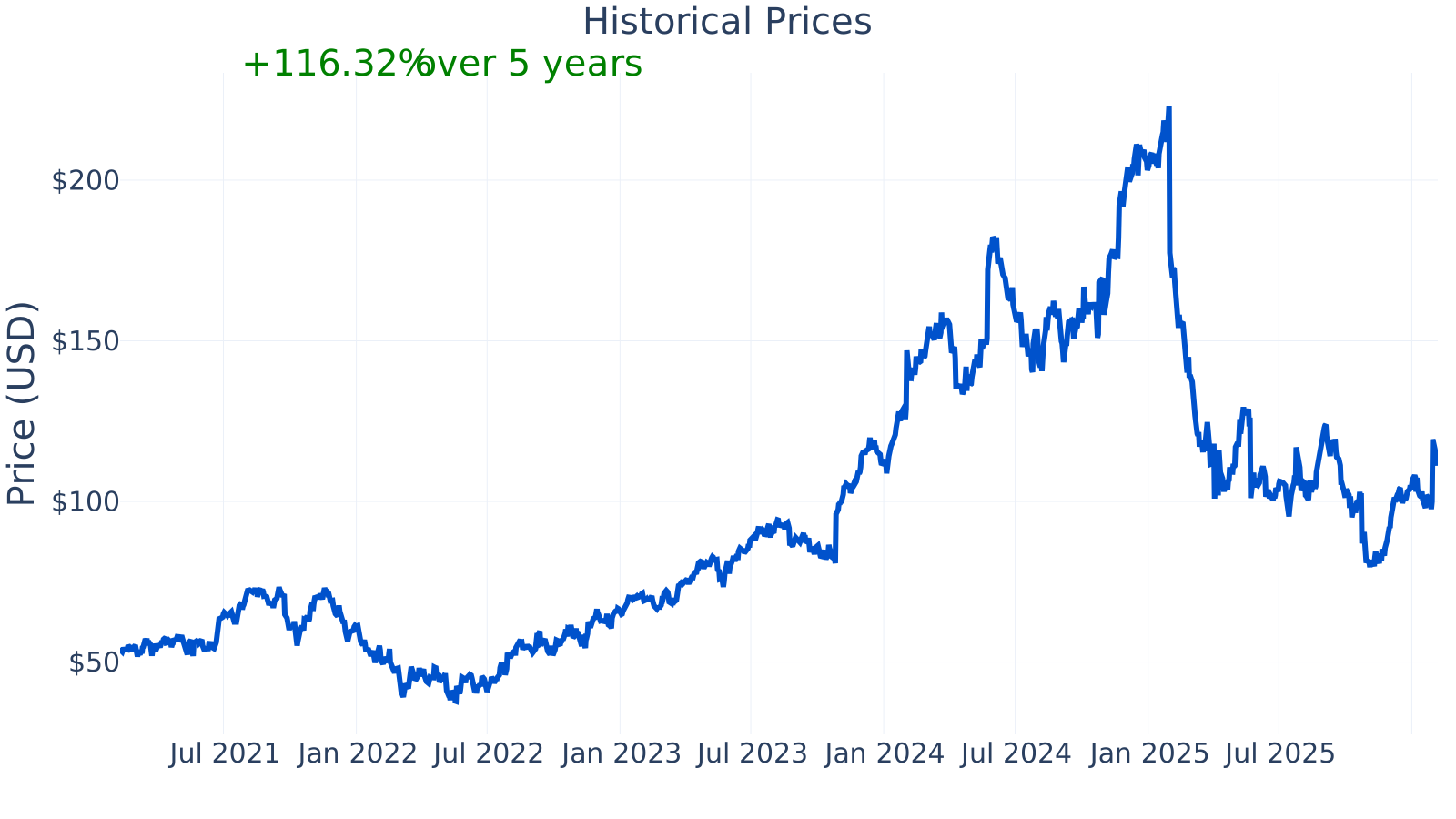
Deckers’ market capitalization is about $16.8B, and the stock’s beta of ~1.15 suggests it has historically moved somewhat more than the overall market. The company’s P/E ratio is ~16.4, below the industry median shown (~29.8). Profitability stands out: profit margin is ~19.4% versus an industry median near 5.4%. Recent year-over-year revenue growth is ~7.1%, close to the industry median (~6.9%). Balance sheet leverage is relatively low with debt-to-equity ~13% versus an industry median around 63%. Trailing twelve-month free cash flow is about $929M.
Growth (Medium)
Deckers operates in global footwear markets that are competitive and trend-driven, but also supported by long-term consumer demand for both lifestyle and performance shoes. Within that broad space, performance footwear has been an important growth area across the industry for many years, and Deckers participates through HOKA. At the same time, UGG is more exposed to fashion cycles and seasonal demand patterns, which can create periods of faster growth and periods of normalization.
Deckers’ strategy, as described in its filings, generally centers on investing behind its biggest brands, expanding distribution carefully, building direct-to-consumer capabilities, and managing product launches and supply chain execution. For future growth, the biggest practical “catalysts” typically come from brand momentum (products that resonate with consumers), international expansion, channel expansion (especially direct-to-consumer), and maintaining pricing discipline.
Year-over-year revenue growth has varied widely across quarters, ranging from very high growth rates in earlier periods (for example, above 20% in several quarters) to more recent mid-to-single-digit growth (around 7% in the most recent point shown). This suggests a shift from a rapid expansion phase toward a more normalized growth rate, which is common as a company becomes larger.
Free cash flow improved substantially from fiscal 2022 (about $121M) to fiscal 2024–2025 (about $944M–$958M), with the latest trailing figure around $929M. In plain terms, this indicates the business has been generating significantly more cash after operating needs and capital spending, which can support flexibility (such as reinvestment, buybacks, or balance sheet strength) depending on management decisions disclosed in filings.
Risks (Medium)
Deckers’ main risks are typical for branded consumer companies, with a few areas that matter more because the company is heavily reliant on the success of its top brands. If consumer preferences shift or a competitor captures attention, sales growth and margins can change quickly. Demand can also be impacted by broader economic conditions because footwear spending—especially premium or discretionary purchases—can soften when consumers become cautious.
Competition is intense across both lifestyle and athletic footwear. Large global brands and many smaller specialists compete on innovation, marketing, endorsements, retail relationships, and direct-to-consumer experience. Deckers’ competitive advantages have historically come from strong brand recognition (particularly for its major brands), product innovation cycles, and the ability to generate high profitability relative to many peers. However, the company is not “the” overall leader in global footwear; it competes against much larger players, and sustained share gains depend on continued brand execution.
Key competitive set (examples, depending on category and channel):
- Large athletic and lifestyle brands: Nike, adidas, Puma
- Performance/running-focused brands: ASICS, On Holding, Skechers (performance and lifestyle overlap), and other running specialists
- Lifestyle/comfort and fashion-oriented footwear: a wide range of global and private-label competitors
Operationally, Deckers faces risks tied to inventory planning, promotions/discounting in the broader retail environment, and supply chain execution (sourcing concentration, freight volatility, and vendor management). Like many consumer product companies, it is also exposed to foreign currency movements and international market execution where applicable.
Debt-to-equity has generally stayed low (often near the 10%–16% range for much of the period shown), with a temporary spike visible in late 2025 before returning closer to 13%. Compared with the industry median (often far higher across the period), Deckers appears less reliant on debt financing, which can reduce financial risk, though it does not remove demand or execution risk.
Profit margin trends upward over the multi-year period, moving from about 14%–15% earlier in the chart to roughly 19%+ more recently. The industry median shown declines over time and sits far lower in the most recent points. This gap indicates Deckers has recently been converting sales into profits much more efficiently than the median peer in its industry grouping, though margins can be cyclical if promotional pressure rises or product mix shifts.
Valuation
Deckers’ valuation is often discussed through earnings multiples such as the price-to-earnings (P/E) ratio, which compares the stock price to the company’s earnings per share. A lower P/E than peers can reflect lower expected growth, lower perceived durability of profits, or simply a different market view of risk and cyclicality.
The P/E ratio shown has moved materially over time—rising to around 30–31 at points in 2024, then declining to the low teens more recently (around 12.6 at the latest point shown). The industry median P/E shown fluctuates as well, and Deckers’ P/E is currently below the industry median displayed in the table (~16.4 vs. ~29.8). Interpreting whether this level is “high” or “low” depends on how durable the company’s current profit margins are and whether growth remains closer to mid-to-high rates or normalizes further.
One way to connect valuation to fundamentals is to compare today’s multiple with profitability and balance sheet strength. Deckers combines high profit margins and low leverage with moderate recent revenue growth. If margins stay elevated and cash generation remains strong, lower multiples can still coincide with solid business performance; if margins compress due to competition or discounting, valuation can change quickly even if revenue continues to grow.
Conclusion
Deckers Outdoor Corporation is a branded footwear company whose recent years show a clear combination of (1) meaningful revenue expansion over multiple fiscal years, (2) sharply higher operating and net income, and (3) strong free cash flow generation. The company also shows relatively low debt levels compared with the industry median and profit margins that are materially above the industry median in the figures presented.
At the same time, the business operates in highly competitive, trend-sensitive categories where brand momentum matters. Key uncertainties are whether the company can sustain its current margin profile, keep its major brands relevant, and grow without relying on discounting as competition responds. Valuation multiples have also varied significantly over the period shown, which is consistent with shifting market expectations about growth durability and cyclicality.
Sources:
- SEC EDGAR — Deckers Outdoor Corporation filings (Form 10-K, Form 10-Q)
- Deckers Outdoor Corporation — Investor Relations materials (annual report content and shareholder communications, when provided)
- Deckers Outdoor Corporation — Public earnings call transcripts or prepared remarks hosted by the company (when available)
- Wikipedia — “Deckers Outdoor Corporation” (basic company background only)
This article is for informational purposes only and does not constitute financial advice. Some content is AI-generated. See Disclaimer