Stock Analysis · Dave Inc (DAVE)
Overview
Dave Inc. (DAVE) is a financial technology company best known for the “Dave” personal finance app. The product is built around helping consumers manage everyday cash-flow needs, with tools intended to reduce overdraft fees, help with budgeting, and provide short-term liquidity options. In practice, the business looks less like a traditional bank and more like a mobile-first consumer finance platform that combines financial products, user engagement, and data-driven underwriting.
From a business-model perspective, Dave’s revenue typically comes from a mix of service fees tied to its financial products (for example, short-term cash access features), interchange-related revenue connected to card spending, and other platform-related revenue streams described in its SEC filings. The exact mix can shift over time as product emphasis changes.
Main revenue streams (high-level categories commonly described in company filings):
- Service-based fees tied to short-term liquidity / cash access features (often a major driver for consumer fintech apps)
- Card-related revenue (such as interchange economics driven by user spending behavior)
- Other platform and partnership-related revenue (varies by period based on product and partner mix)
Across 2021–2025, total revenue increased from about $153.0M (2021) to $511.9M (2025). Over the same period, the company moved from losses to profitability, with net income improving from about -$20.0M (2021) and -$128.9M (2022) to about $57.9M (2024) and $195.9M (2025). That improvement suggests the business scaled revenue faster than operating costs over time, although operating expenses also rose in absolute dollars as the company grew.
Key Figures
| Metric | Value | Industry ⓘ |
|---|---|---|
| Date | Mar 06, 2026 | |
| Context | ||
| Sector | Technology | |
| Industry | Software - Application | |
| Market Cap ⓘ | $2.95B | |
| Beta ⓘ | 3.87 | |
| Fundamental | ||
| P/E Ratio ⓘ | 21.56 | 25.64 |
| Profit Margin ⓘ | 35.34% | 7.42% |
| Revenue Growth ⓘ | 62.40% | 16.65% |
| Debt to Equity ⓘ | 21.32% | 24.02% |
| PEG ⓘ | N/A | |
| Free Cash Flow ⓘ | $288.34M | |
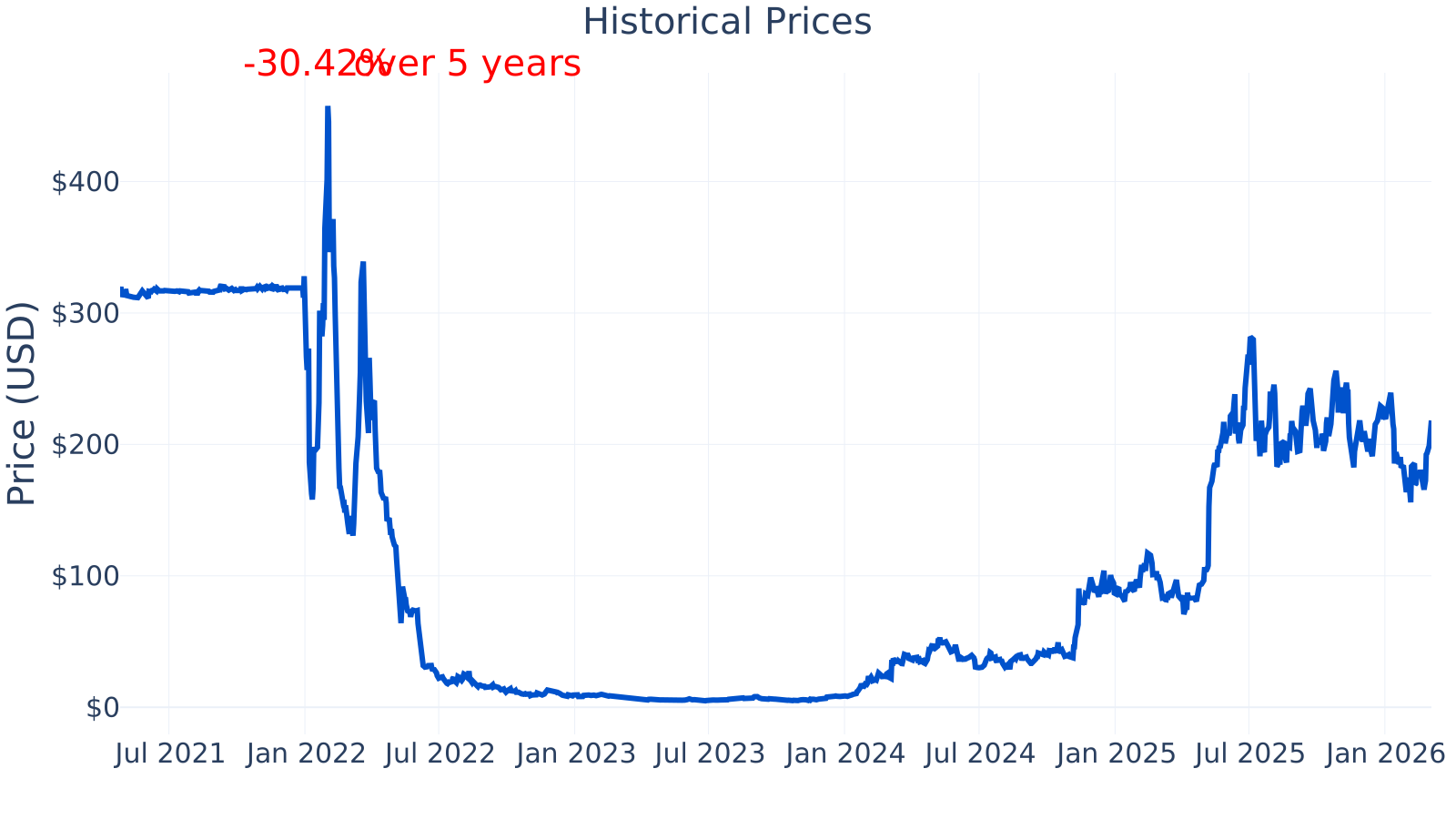
Dave’s market capitalization is about $2.95B. The stock has shown high price volatility historically, which is consistent with the listed beta of ~3.87 (a measure that indicates the stock has tended to move much more than the overall market).
On profitability, the latest profit margin shown is about 35.34%, which is meaningfully above the industry median of about 7.43% for the “Software - Application” peer group shown here. Revenue growth year-over-year is about 62.40%, also above the industry median of about 16.65%. Debt-to-equity is about 21.32%, slightly below the industry median of about 24.02%. The company also shows positive free cash flow (TTM) of ~$288.3M, which is an important signal for self-funding operations without relying as heavily on external financing.
Growth (Medium)
Dave operates in consumer fintech, where long-term demand is influenced by ongoing shifts toward mobile-first banking experiences, real-time payments, and app-based money management. This is a competitive space, but it is also one where products can scale quickly if user acquisition and retention are strong and if underwriting and fraud controls remain effective.
The company’s recent financial profile points to a phase of rapid expansion. Year-over-year revenue growth has generally been positive across the periods shown, with a notable acceleration in parts of 2025 before moderating in the most recent quarter shown (ending 2025-12-31).
Another notable growth-related development is the change in cash generation. Free cash flow moved from negative in 2022 and 2023 to positive in 2024 and increased again in 2025, which often indicates improving unit economics, better cost discipline, and/or favorable working-capital dynamics as the business matures.
Potential catalysts for future growth (in general terms, consistent with how consumer fintech platforms scale) include expanding the product set for existing users, increasing card engagement, improving monetization per active user, and sustaining credit performance and fraud outcomes as volumes rise. The durability of growth depends heavily on user quality, risk controls, and the ability to maintain trust while operating in a regulated environment.
Risks (High)
Dave’s high beta and the historical stock-price swings suggest a market perception of elevated risk. This can come from the company’s relatively short public-company track record, sensitivity to consumer credit conditions, and uncertainty around how sustainable growth and margins may be across economic cycles.
Competition is a central risk. Consumer fintech is crowded, with alternatives ranging from large banks’ mobile apps to well-funded fintech platforms. Competitors can replicate features quickly, and customer switching costs can be limited if users treat these apps as interchangeable utilities. Dave’s defensibility is more likely to come from a combination of brand trust, user experience, underwriting and fraud prevention capabilities, partnerships, and the economics of its user base rather than from classic software lock-in.
Regulatory and compliance risk is also important. Products that provide short-term liquidity, facilitate transactions, or rely on banking partners can face changing rules, supervisory expectations, and operational requirements. Changes to how fees can be charged or how products must be structured can affect revenue and margins.
Balance-sheet leverage looks moderate in the latest figure shown, but the historical pattern matters: the debt-to-equity ratio was much higher earlier in the timeline and has declined substantially more recently.
Profitability has improved sharply over time, moving from negative margins in 2022–2023 to strongly positive margins more recently. The key risk is whether current margins represent a stable run-rate or a period-specific outcome that could change with credit performance, customer acquisition costs, or product mix.
Valuation
Valuation is often discussed using earnings multiples such as the price-to-earnings (P/E) ratio. Dave’s latest P/E ratio shown is about 21.56, compared with an industry median of about 25.64 in the peer set provided. This places the stock below the median multiple for that industry group on this metric, at least at this point in time.
The historical P/E series shown includes periods where the ratio is not meaningful (often when earnings are negative or distorted), and then later becomes measurable as profitability improves. In that context, the current multiple can be interpreted alongside two competing facts: (1) the company has recently shown strong revenue growth and a large improvement in margins and cash generation, and (2) the business model is exposed to consumer behavior, competition, and regulatory constraints, which can justify more conservative multiples depending on how sustainable the recent profitability proves to be.
Conclusion
Dave Inc. is a consumer fintech platform that has shown substantial revenue expansion from 2021 through 2025 and a notable shift from losses to profitability and positive free cash flow. Recent metrics show revenue growth and profit margin that are well above the industry median figures provided, while leverage (debt-to-equity) appears moderate in the latest reading after being much higher historically.
At the same time, the risk profile remains elevated: the stock has historically been volatile, the competitive environment is intense, and the operating model depends on maintaining strong product economics while navigating regulatory requirements and consumer credit and fraud dynamics. The current valuation metrics presented (including a P/E below the provided industry median) need to be viewed in light of how recent profitability and cash generation hold up across time, especially given the company’s earlier periods of negative margins.
Sources:
- SEC EDGAR — Dave Inc. filings (Form 10-K, Form 10-Q, Form 8-K)
- Dave Inc. — Investor Relations materials and press releases (company website)
- Wikipedia — “Dave (company)” (basic company background)
This article is for informational purposes only and does not constitute financial advice. Some content is AI-generated. See Disclaimer