Stock Analysis · Dave Inc (DAVE)
Overview
Dave Inc. (DAVE) is a financial technology company focused on everyday banking tools for consumers, with an emphasis on helping members manage cash flow between paychecks. Its offering has historically included a mobile app experience, spending and budgeting features, and short-term liquidity products designed for small-dollar needs. In practice, the business aims to earn revenue when members use these services and when Dave can connect members to partner products.
Based on the company’s disclosures, revenue is primarily tied to consumer-facing financial services and partnerships rather than selling physical goods. The main revenue drivers are typically described along these lines (exact category names can vary by filing period):
- Transaction-based and service-related revenue tied to member activity within the platform (often including short-term liquidity-related fees and related servicing economics).
- Interchange and card-related revenue associated with debit card spending and banking activity, generally earned through network/banking arrangements.
- Referral and partner revenue from connecting users to third-party offers (for example, when a member is routed to an external financial product through the app).
From a profitability standpoint, the company’s income statement trend shows a clear shift over the last several years: revenue expanded meaningfully from 2021 through 2024, while the business moved from operating losses to operating income and positive net income in 2024. Gross profit also increased over that period, indicating that scaling revenue has not required a proportional increase in direct costs.
The 2021–2024 picture shows revenue rising from about $153 million to about $347 million, with gross profit increasing as well (about $130 million to about $317 million). Operating results improved substantially, moving from negative operating income in 2021–2023 to positive operating income in 2024, alongside positive net income in 2024.
Key Figures
| Metric | Value | Industry ⓘ |
|---|---|---|
| Date | Feb 08, 2026 | |
| Context | ||
| Sector | Technology | |
| Industry | Software - Application | |
| Market Cap ⓘ | $2.47B | |
| Beta ⓘ | 3.90 | |
| Fundamental | ||
| P/E Ratio ⓘ | 18.09 | 27.79 |
| Profit Margin ⓘ | 29.87% | 6.02% |
| Revenue Growth ⓘ | 63.00% | 15.80% |
| Debt to Equity ⓘ | 25.85% | 25.15% |
| PEG ⓘ | N/A | |
| Free Cash Flow ⓘ | $236.75M | |
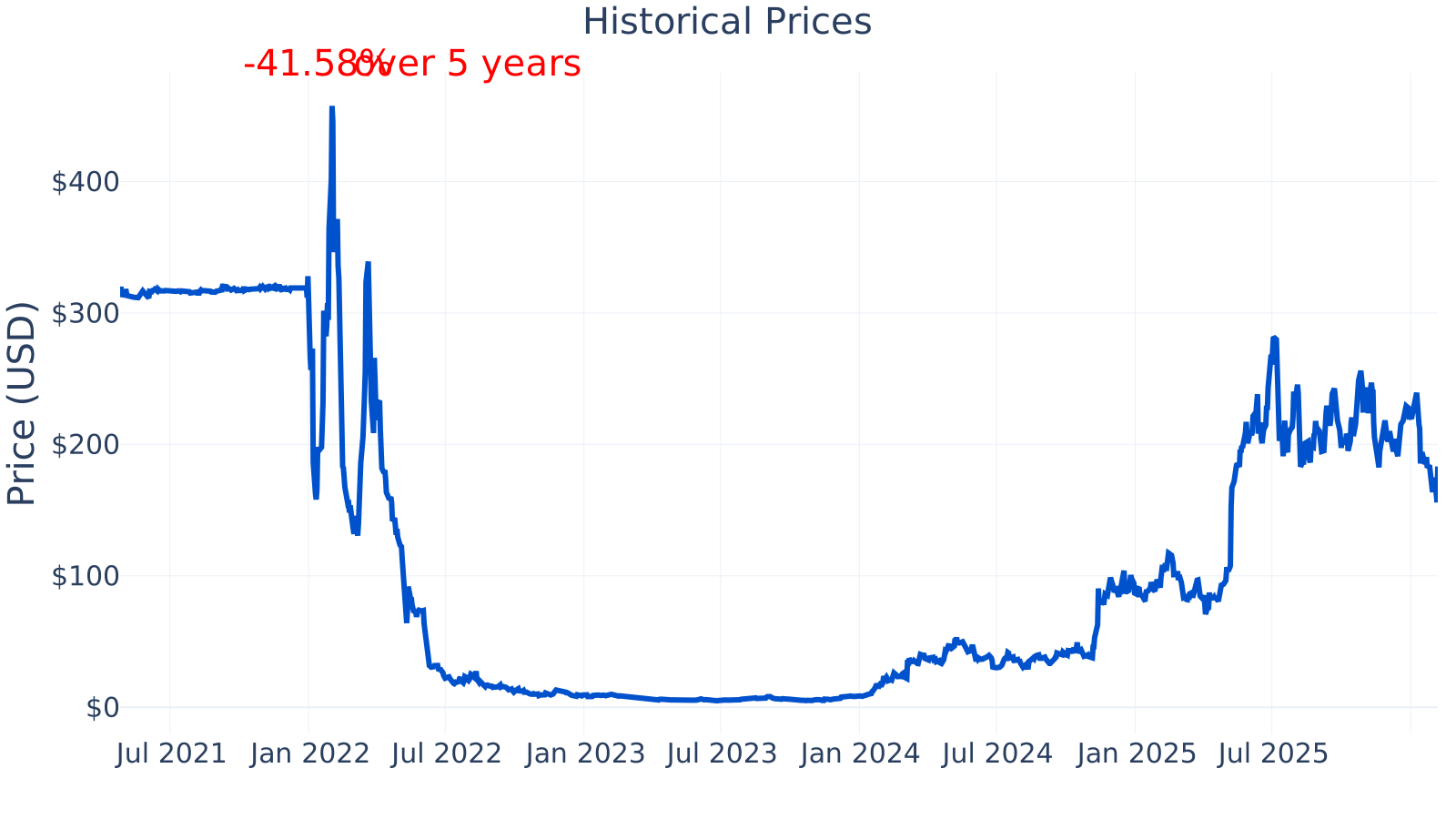
Dave’s equity value is in the small-cap range (about $2.47 billion market capitalization). The stock has also shown high sensitivity to market moves (beta near 3.9), which often corresponds to larger-than-average price swings.
On fundamentals, several metrics stand out versus the industry median provided: profitability and growth are currently stronger than the median, while leverage is roughly in line. Profit margin is about 29.9% versus an industry median near 6.0%, and year-over-year revenue growth is about 63% versus an industry median near 15.8%. Debt-to-equity is about 25.8%, close to the industry median near 25.2%. Free cash flow over the last twelve months is positive (about $236.8 million).
Growth (Medium)
Dave operates in consumer fintech and digital financial services, an area that benefits from ongoing shifts toward app-based money management and increased comfort with digital banking experiences. Demand in this space is often driven by convenience, speed of onboarding, product transparency, and the ability to meet short-term financial needs. That said, consumer-focused fintech can be sensitive to employment trends, household financial stress, and regulatory changes.
A key part of the growth narrative is the company’s recent acceleration in revenue growth alongside improved profitability. Sustained expansion tends to depend on increasing active membership, deepening product usage per member, and maintaining healthy unit economics (for example, generating contribution margin after funding, servicing, and customer acquisition costs). Another potential catalyst for growth is continued scaling of products that convert engagement into recurring revenue streams (for example, card usage, subscription-like services if applicable, and partner monetization).
Revenue growth has been consistently positive across the periods shown and appears to be accelerating into 2025, reaching roughly the mid-60% range year-over-year in the most recent points displayed. This pattern suggests improving momentum rather than a one-time spike, although the durability depends on whether growth is coming from repeatable member activity.
Free cash flow shows a notable improvement trajectory, moving from negative territory in 2022 and 2023 to positive in 2024 and rising further by 2025. For many consumer fintech models, turning free cash flow positive can reduce reliance on external financing and give more flexibility to invest in product development and marketing.
Risks (High)
This article is for informational purposes only and does not constitute financial advice. Some content is AI-generated. See Disclaimer


