Stock Analysis · Datadog Inc (DDOG)
Overview
Datadog, Inc. is a software company that helps organizations monitor and secure the technology they run in the cloud and in their own data centers. In simple terms, it gives teams a single place to detect outages, troubleshoot performance slowdowns, track application behavior, observe user experience, and manage logs (machine-generated records). These tools are typically used by engineering, IT operations, and security teams to keep digital services reliable and fast.
Datadog primarily earns revenue by selling subscriptions to its software platform. Customers generally pay based on usage and the products they enable (for example, infrastructure monitoring, application performance monitoring, log management, and security-related modules). The company reports revenue as one main line item (subscription revenue) rather than breaking it out by product in a way that consistently provides product-level percentages. As a result, a “largest-to-smallest by product share” split is not reliably available from standard filings.
Main sources of revenue (as disclosed in filings)
- Subscription revenue (the core business; typically the vast majority of revenue)
- Professional services and other revenue (implementation/support-type services; generally a small portion)
Over the last several years, total revenue has grown meaningfully (from about $1.03B in 2021 to about $3.43B in 2025). The visual also highlights that Datadog reinvests heavily in operating expenses—especially research and development—while still reaching positive net income in recent years, which is common for software firms balancing growth with profitability.
Key Figures
| Metric | Value | Industry ⓘ |
|---|---|---|
| Date | Feb 16, 2026 | |
| Context | ||
| Sector | Technology | |
| Industry | Software - Application | |
| Market Cap ⓘ | $43.90B | |
| Beta ⓘ | 1.29 | |
| Fundamental | ||
| P/E Ratio ⓘ | 403.87 | 27.48 |
| Profit Margin ⓘ | 3.14% | 7.66% |
| Revenue Growth ⓘ | 29.20% | 15.80% |
| Debt to Equity ⓘ | 41.13% | 24.71% |
| PEG ⓘ | 0.94 | |
| Free Cash Flow ⓘ | $1.00B | |
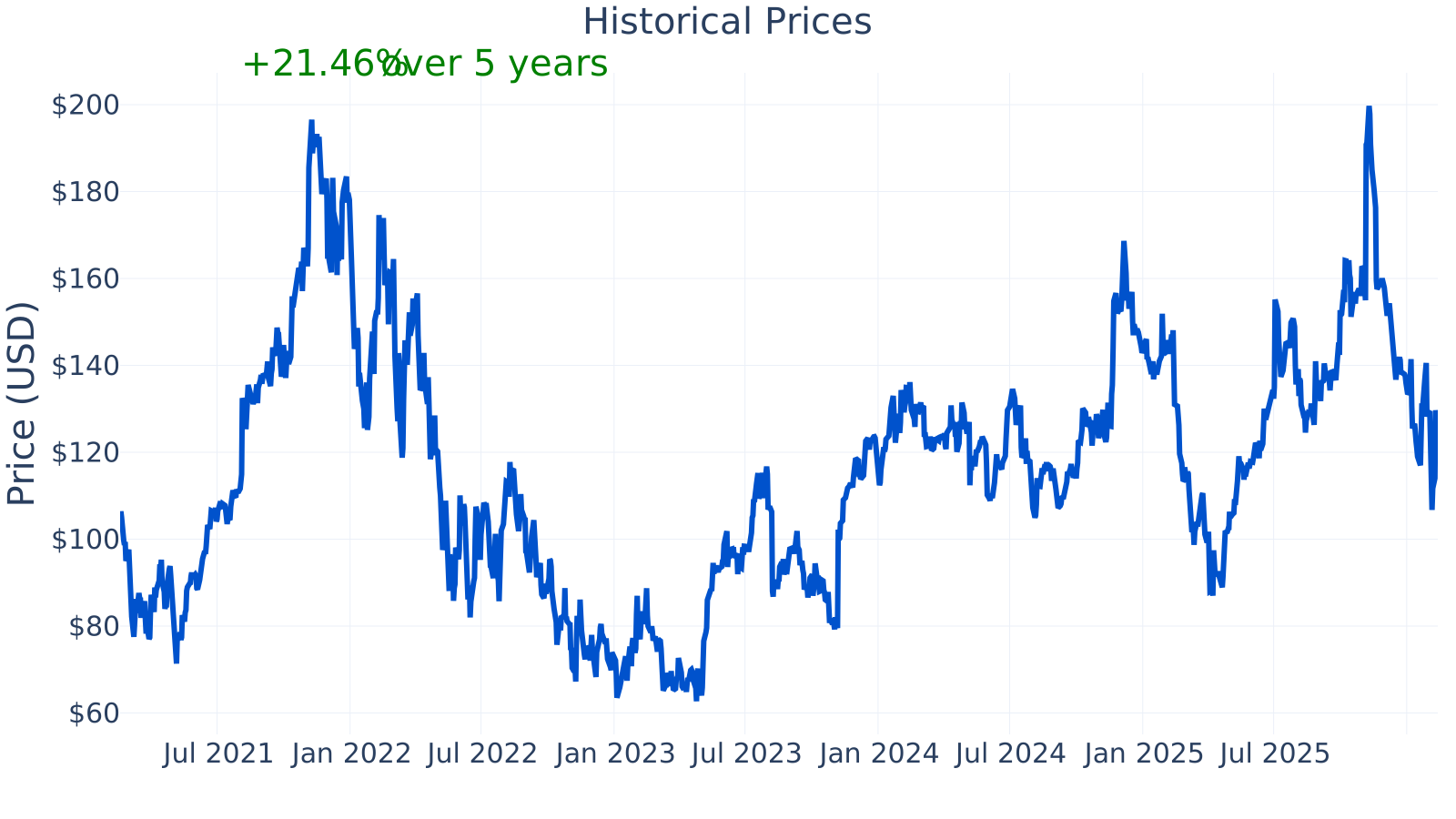
Datadog’s market capitalization is about $43.9B, and the stock’s beta (~1.29) suggests it has tended to move more than the broader market (higher day-to-day volatility). The company’s year-over-year revenue growth is ~29.2%, which is above the industry median (~15.8%) shown in the table. Profitability is positive but currently modest, with a net profit margin of ~3.14% versus an industry median ~7.66%. Leverage appears moderate for a software company: debt-to-equity ~41% compared with an industry median ~24.7%. Free cash flow over the last twelve months is about $1.00B, indicating the business has been generating cash after operating costs and capital spending. The table also shows a high P/E ratio (~404) compared with the industry median (~27.5), which is discussed further in the valuation section.
Growth (Medium)
Datadog operates in the ongoing shift toward cloud computing and modern software delivery, where organizations run many distributed services that change frequently. As systems become more complex, monitoring, troubleshooting, and security visibility become more important. This long-term trend supports demand for “single-pane-of-glass” platforms that consolidate metrics, traces, logs, and security signals.
Strategically, Datadog’s platform approach is designed to expand within existing customers over time: a company might start with infrastructure monitoring and later add log management, application performance monitoring, user experience monitoring, or security modules. This “land and expand” pattern can support durable growth if Datadog continues to deliver strong product value and controls customer churn.
Revenue growth has slowed from exceptionally high levels in 2021–2022 (above 50% and even higher at points) to the mid-to-high 20% range more recently, ending 2025 at roughly 29% year over year. A slowdown from hypergrowth to strong growth is a common maturation pattern in software; what matters longer term is whether growth remains healthy while profitability improves.
Free cash flow has increased substantially across the period shown—from about $108M (TTM at 2021-03-31) to about $894M (TTM at 2025-03-31). Rising cash generation can provide flexibility to invest in new products, support go-to-market efforts, and absorb cyclical slowdowns without relying as heavily on external financing.
Potential catalysts that can support future expansion (in a factual, non-predictive sense) include continued growth in cloud workloads, broader adoption of consolidated observability platforms, and increased emphasis on security monitoring. The key question for long-term business momentum is whether Datadog can sustain product innovation and customer expansion while keeping spending disciplined.
Risks (High)
Datadog’s main risks are tied to competition, customer spending cycles, and the challenge of maintaining rapid innovation. Observability and cloud monitoring are highly competitive categories, and large platform vendors can bundle similar capabilities into broader cloud or enterprise software contracts. In addition, because usage-based pricing can track customer activity, revenue growth can be sensitive to slowdowns in customer usage or reductions in cloud spending.
Competitive advantages often discussed for Datadog (based on how it describes its business in filings) include a broad, integrated platform; many product modules that can be adopted over time; and a focus on ease of deployment and unified workflows across monitoring and security signals. However, the category has well-funded competitors, so advantages must be continuously defended through product quality and execution.
Key competitors generally include large cloud providers and monitoring/observability specialists. In practice, buyers may compare Datadog with offerings from major cloud ecosystems and other software companies that provide application performance monitoring, log analytics, infrastructure monitoring, and security visibility tools. Competitive pressure can show up as pricing concessions, higher sales and marketing costs, or slower customer expansion.
The debt-to-equity ratio ends at roughly 41% (versus an industry median near 25%), and it has fluctuated over time. While not necessarily extreme, a higher leverage level than peers can reduce flexibility during downturns and can increase sensitivity to interest costs, depending on the company’s debt structure.
Net profit margin improved meaningfully from negative levels in 2021 to positive levels later, but it ends around 3.14%, below the industry median shown (about 8.4% at the most recent point). This suggests profitability is present but not yet robust, and future margins can be affected by how fast operating expenses grow relative to revenue—especially research and development and go-to-market costs.
Valuation
Datadog’s valuation metrics indicate the market is pricing in substantial expectations for future earnings growth. The latest P/E ratio is ~404, far above the industry median (~27). A very high P/E can occur when current earnings are relatively low compared with revenue (for example, due to heavy reinvestment), even if the business is growing quickly. It also means the stock price can be more sensitive to changes in growth rates or profitability than companies with lower multiples.
The historical P/E series shown is volatile (and some periods are not plotted due to very high or non-meaningful values). Where it is visible, Datadog’s P/E has often been far above the software industry median, reinforcing that it has commonly traded at a premium. In practical terms, for the valuation to remain supported over time, the company typically needs to keep delivering strong revenue growth and show a credible path to higher, more consistent profitability.
The table also includes a PEG ratio (~0.95), which attempts to relate valuation to growth; however, PEG can be highly sensitive to the growth assumptions and the earnings base used in the calculation. For companies transitioning from low margins to higher margins, traditional earnings-based multiples can be harder to interpret, so valuation discussions often consider multiple signals together (growth rate, cash generation, and margin trajectory).
Conclusion
Datadog is a cloud-focused software platform centered on monitoring, troubleshooting, and related security visibility—areas that tend to remain important as organizations run more complex, distributed systems. The business has demonstrated strong revenue expansion over multiple years, and free cash flow has risen substantially, which can be a sign of improving operating efficiency and financial flexibility.
At the same time, the company operates in a highly competitive market with powerful incumbents and well-funded specialists, and its recent net profit margin remains modest relative to the industry median shown. The valuation metrics presented (notably the very high P/E ratio versus peers) indicate that the stock price embeds high expectations, which can amplify sensitivity to any shift in growth rates or profitability trends.
Sources:
- U.S. SEC EDGAR — Datadog, Inc. filings (Form 10-K, Form 10-Q)
- Datadog Investor Relations — Shareholder letters / quarterly results materials and press releases
- Wikipedia — “Datadog” (basic company background)
This article is for informational purposes only and does not constitute financial advice. Some content is AI-generated. See Disclaimer


