Stock Analysis · Datadog Inc (DDOG)
Overview
Datadog, Inc. is a software company that helps organizations monitor and secure the technology they run in the cloud and in their own data centers. In simple terms, it gives teams a single place to detect outages, troubleshoot performance slowdowns, track application behavior, observe user experience, and manage logs (machine-generated records). These tools are typically used by engineering, IT operations, and security teams to keep digital services reliable and fast.
Datadog primarily earns revenue by selling subscriptions to its software platform. Customers generally pay based on usage and the products they enable (for example, infrastructure monitoring, application performance monitoring, log management, and security-related modules). The company reports revenue as one main line item (subscription revenue) rather than breaking it out by product in a way that consistently provides product-level percentages. As a result, a “largest-to-smallest by product share” split is not reliably available from standard filings.
Main sources of revenue (as disclosed in filings)
- Subscription revenue (the core business; typically the vast majority of revenue)
- Professional services and other revenue (implementation/support-type services; generally a small portion)
Over the last several years, total revenue has grown meaningfully (from about $1.03B in 2021 to about $3.43B in 2025). The visual also highlights that Datadog reinvests heavily in operating expenses—especially research and development—while still reaching positive net income in recent years, which is common for software firms balancing growth with profitability.
Key Figures
| Metric | Value | Industry ⓘ |
|---|---|---|
| Date | Feb 16, 2026 | |
| Context | ||
| Sector | Technology | |
| Industry | Software - Application | |
| Market Cap ⓘ | $43.90B | |
| Beta ⓘ | 1.29 | |
| Fundamental | ||
| P/E Ratio ⓘ | 403.87 | 27.48 |
| Profit Margin ⓘ | 3.14% | 7.66% |
| Revenue Growth ⓘ | 29.20% | 15.80% |
| Debt to Equity ⓘ | 41.13% | 24.71% |
| PEG ⓘ | 0.94 | |
| Free Cash Flow ⓘ | $1.00B | |
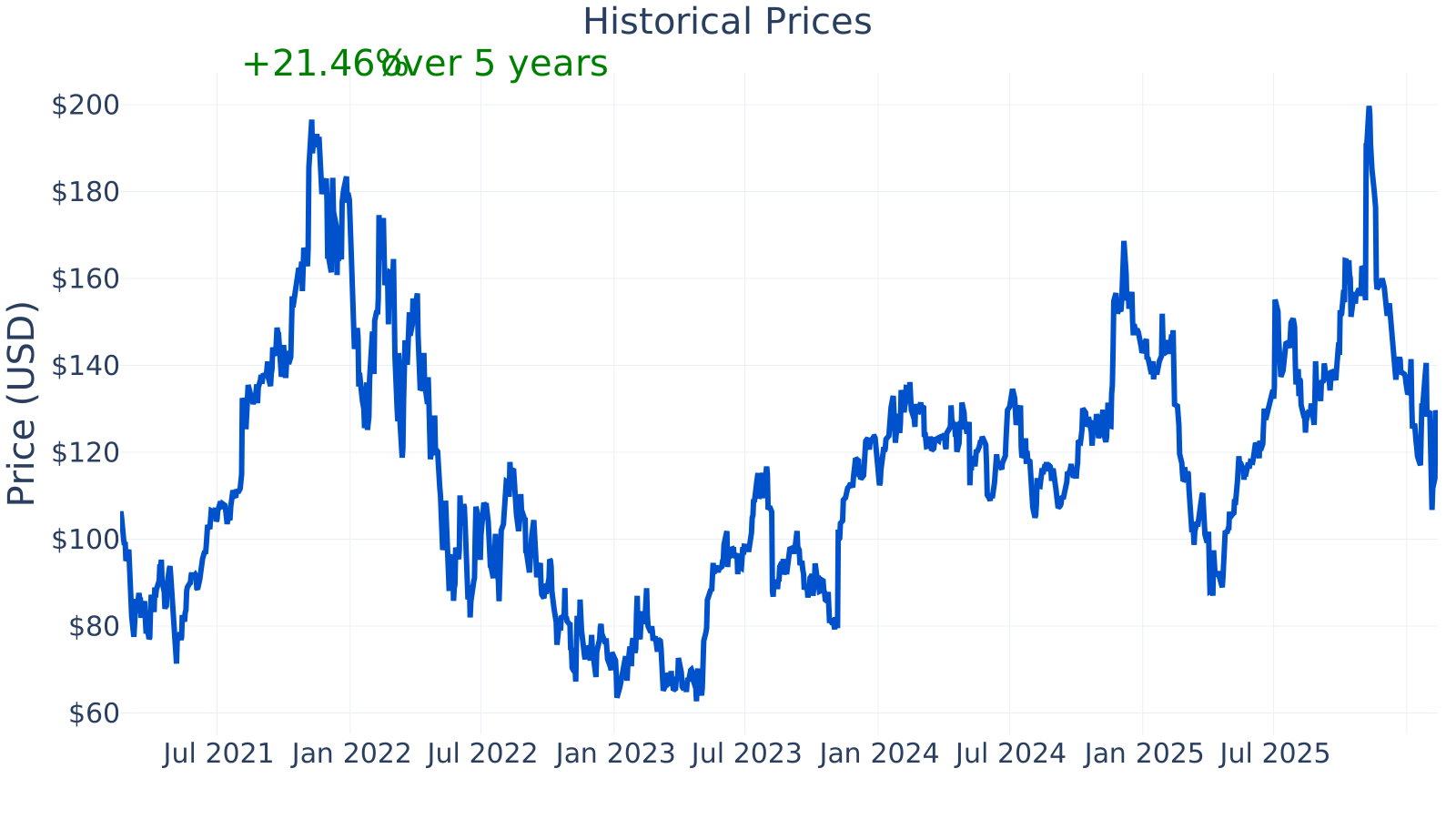
Datadog’s market capitalization is about $43.9B, and the stock’s beta (~1.29) suggests it has tended to move more than the broader market (higher day-to-day volatility). The company’s year-over-year revenue growth is ~29.2%, which is above the industry median (~15.8%) shown in the table. Profitability is positive but currently modest, with a net profit margin of ~3.14% versus an industry median ~7.66%. Leverage appears moderate for a software company: debt-to-equity ~41% compared with an industry median ~24.7%. Free cash flow over the last twelve months is about $1.00B, indicating the business has been generating cash after operating costs and capital spending. The table also shows a high P/E ratio (~404) compared with the industry median (~27.5), which is discussed further in the valuation section.
Growth (Medium)
Datadog operates in the ongoing shift toward cloud computing and modern software delivery, where organizations run many distributed services that change frequently. As systems become more complex, monitoring, troubleshooting, and security visibility become more important. This long-term trend supports demand for “single-pane-of-glass” platforms that consolidate metrics, traces, logs, and security signals.
Strategically, Datadog’s platform approach is designed to expand within existing customers over time: a company might start with infrastructure monitoring and later add log management, application performance monitoring, user experience monitoring, or security modules. This “land and expand” pattern can support durable growth if Datadog continues to deliver strong product value and controls customer churn.
Revenue growth has slowed from exceptionally high levels in 2021–2022 (above 50% and even higher at points) to the mid-to-high 20% range more recently, ending 2025 at roughly 29% year over year. A slowdown from hypergrowth to strong growth is a common maturation pattern in software; what matters longer term is whether growth remains healthy while profitability improves.
Free cash flow has increased substantially across the period shown—from about $108M (TTM at 2021-03-31) to about $894M (TTM at 2025-03-31). Rising cash generation can provide flexibility to invest in new products, support go-to-market efforts, and absorb cyclical slowdowns without relying as heavily on external financing.
Potential catalysts that can support future expansion (in a factual, non-predictive sense) include continued growth in cloud workloads, broader adoption of consolidated observability platforms, and increased emphasis on security monitoring. The key question for long-term business momentum is whether Datadog can sustain product innovation and customer expansion while keeping spending disciplined.
Risks (High)
This article is for informational purposes only and does not constitute financial advice. Some content is AI-generated. See Disclaimer