Stock Analysis · Daqo New Energy Corp (DQ)
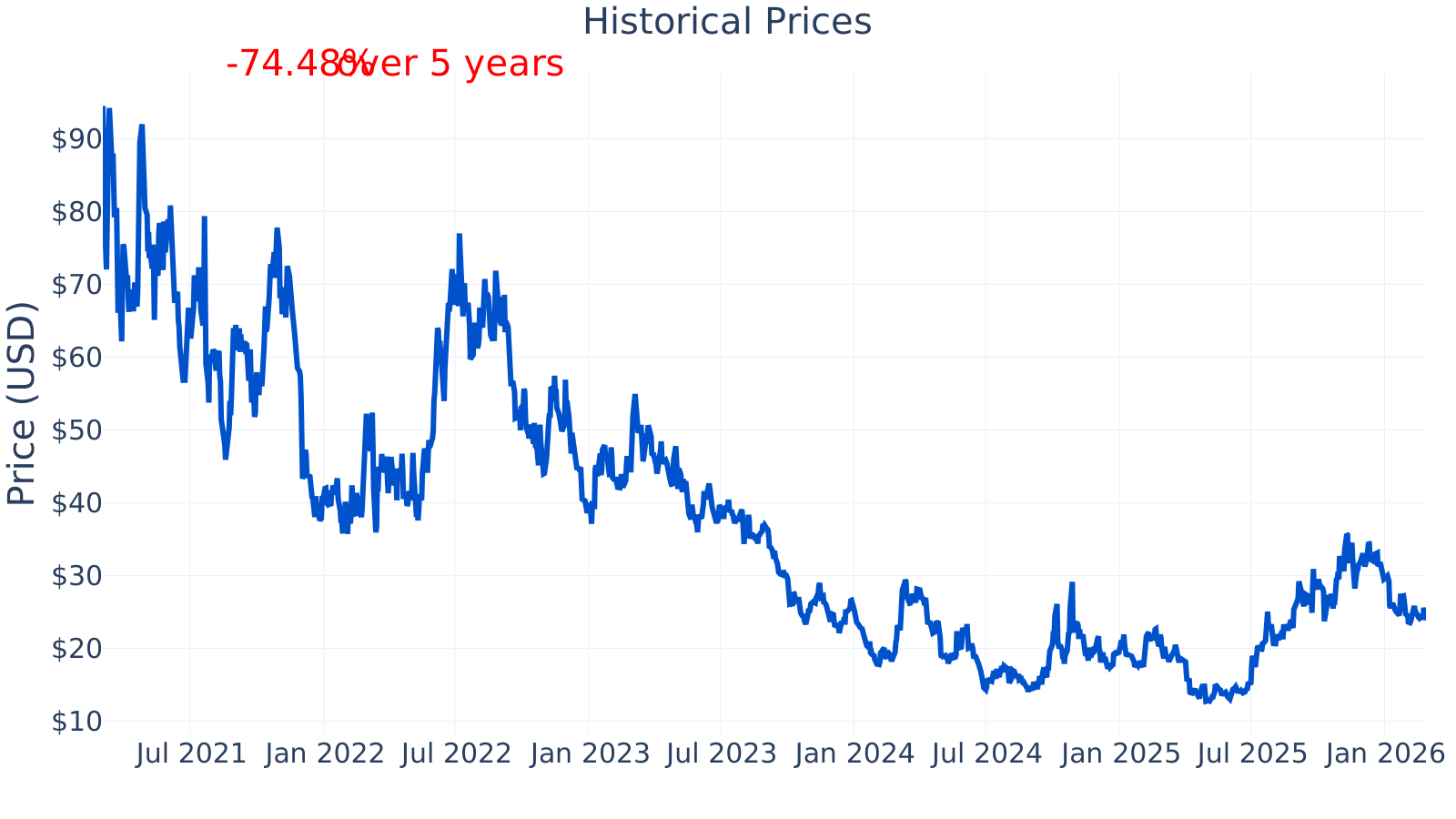
Overview
Daqo New Energy Corp (DQ) is a manufacturer of high-purity polysilicon, a key raw material used to make solar wafers and, ultimately, solar photovoltaic (PV) modules. In simple terms, the company sits “upstream” in the solar supply chain: it sells specialized silicon material to customers that turn it into components used in solar panels.
Because polysilicon is a commodity-like product, Daqo’s business results tend to be strongly influenced by industry supply-and-demand and selling prices. When polysilicon prices are high, the company can generate strong profits; when prices fall (often due to new industry capacity coming online), margins can compress quickly.
Based on company reporting, revenue is primarily generated from the sale of polysilicon (with possible smaller contributions from other silicon-related products or services depending on the period). A simple way to think about the revenue mix is:
- Polysilicon sales (primary driver; typically the overwhelming majority of revenue)
- Other / ancillary items (generally much smaller and not usually the main earnings driver)
One notable recent shift in the company’s income profile is visible when comparing full-year figures: revenue and profitability were very strong in 2022, then weakened substantially in 2023, and turned negative in 2024–2025 as the pricing environment deteriorated.
The cost and profit structure changes meaningfully over time: the company went from sizable net income in 2021–2023 (for example, net income of about $1.82B in 2022) to net losses in 2024–2025 (for example, about -$345M in 2024 and about -$171M in 2025). This pattern is consistent with a business that is highly sensitive to the cycle in polysilicon pricing.
Key Figures
| Metric | Value | Industry ⓘ |
|---|---|---|
| Date | Mar 02, 2026 | |
| Context | ||
| Sector | Technology | |
| Industry | Semiconductor Equipment & Materials | |
| Market Cap ⓘ | $1.62B | |
| Beta ⓘ | 0.68 | |
| Fundamental | ||
| P/E Ratio ⓘ | N/A | 48.57 |
| Profit Margin ⓘ | -25.63% | 7.37% |
| Revenue Growth ⓘ | 13.50% | 8.10% |
| Debt to Equity ⓘ | N/A | 25.99% |
| PEG ⓘ | 0.17 | |
| Free Cash Flow ⓘ | -$123.68M | |
Daqo’s market capitalization is about $1.62B and its beta is about 0.68, which describes how the stock has historically moved relative to the broader market. The latest profit margin shown is about -25.63%, below the industry median of about 7.37%, reflecting a period of losses. Revenue growth year-over-year is about 13.5% versus an industry median near 8.1%, while trailing free cash flow is about -$123.7M. The table also lists valuation and leverage items (including PEG and P/E), but P/E can become less meaningful when earnings are negative or volatile.
Growth (Medium)
Daqo operates in the solar energy supply chain, which is connected to the long-term trend of expanding renewable power generation. Over long time horizons, solar adoption has been driven by declining system costs, energy security goals, and decarbonization efforts. That said, being upstream in materials means Daqo’s near-term results can diverge from overall solar installation growth, because polysilicon pricing can swing widely depending on capacity additions and inventory cycles.
Strategically, companies in Daqo’s position typically pursue growth through a combination of manufacturing scale, cost control, process efficiency, and product quality (high-purity output that meets demanding customer specifications). In strong pricing environments, this model can generate substantial cash; in weak environments, the same fixed-cost structure can pressure profitability.
The year-over-year revenue growth profile shows pronounced cyclicality: very high growth in 2021–2022, followed by steep declines through 2023–mid 2025, and then a return to positive growth in late 2025 (about 23.4% and 13.5% in the last two points shown). A return to positive growth can be a sign of improving volumes, stabilization in pricing, or easier comparisons versus a weak prior year—though it does not, by itself, confirm that profitability has normalized.
Free cash flow also illustrates the cycle clearly. It was positive in 2021–2022 (about $211M and $191M), surged in 2023 (about $2.63B), then fell back in 2024 (about $365M) and turned sharply negative by 2025 (about -$595M). For a capital-intensive materials producer, negative free cash flow can occur due to a combination of weaker operating profits, working-capital swings, and ongoing investment needs.
Potential catalysts for a business like Daqo are usually tied to (1) polysilicon price stabilization or recovery, (2) industry capacity rationalization (slower additions or shutdowns by higher-cost producers), and (3) sustained demand from wafer and module manufacturing. However, these are industry-level forces that can be difficult to predict and may reverse quickly.
Risks (High)
The largest risk is commodity-cycle exposure. Polysilicon pricing can change rapidly when new capacity enters the market or when downstream demand slows. This can compress margins even if shipment volumes remain stable, because the selling price is a key driver of profitability.
A second major risk is competitive intensity. Daqo competes with other global polysilicon producers (including large manufacturers in China and elsewhere). Competitive advantages in this space typically come from low production costs, consistent quality, and operational scale. Leadership can shift over time as new plants are built and technology improves, so competitive positioning is not static.
Additional risks commonly disclosed for cross-border, China-linked operating structures can include regulatory and policy changes, trade restrictions and tariffs, customer concentration (if a small number of buyers represent a large share of sales), and currency and capital movement constraints. These factors can affect demand, realized pricing, and the ability to move cash within a corporate structure.
On leverage, the debt-to-equity ratio shown is extremely low in the most recent point (about 0.16%), well below the industry median (around 24%). Earlier points were higher (for example, roughly 33% in early 2021), but the overall direction suggests a balance sheet with relatively limited financial debt compared with many peers. Low leverage can reduce financial stress during down cycles, although it does not remove earnings volatility.
Profitability has swung dramatically. Daqo’s profit margin was very high during the favorable part of the cycle (roughly 39%–46% across multiple quarters in 2021–2022, above the industry median), then steadily weakened and turned negative in 2024, reaching deeply negative levels in 2025 (with values as low as about -66% at one point). Even after improving by the end of 2025 (to about -25.6%), the company remained below the industry median, highlighting that a pricing recovery had not fully translated into sustained profitability over the period shown.
In terms of market position, Daqo is a known participant in high-purity polysilicon, but it operates in a segment where scale and cost competitiveness matter more than branding. Competitors are other polysilicon manufacturers supplying the solar value chain; relative standing often depends on cost per kilogram, utilization rates, and the ability to keep product quality consistent while maintaining low operating costs.
Valuation
Valuation for a cyclical, commodity-linked company can be challenging because common multiples like P/E can become unstable or uninformative when earnings swing from large profits to losses. In periods where net income is negative, P/E may be negative or not meaningful, and comparisons to an industry median may not reflect underlying economics.
Historically, Daqo’s P/E ratio fell sharply from higher levels in 2021 (for example, about 55.8) to very low single digits through much of 2022–2023 (often around 2–5), while the industry median shown remained far higher in many periods. Later, the P/E series is displayed as 0 for multiple points, which typically happens when earnings are negative or otherwise not suitable for a standard P/E calculation. This pattern matches the profit-margin deterioration seen in 2024–2025.
In this context, interpreting the current stock price as “expensive” or “cheap” depends heavily on assumptions about where the industry is in the cycle and whether profitability normalizes. When margins are negative and cash flow is pressured, valuation often hinges more on balance sheet resilience and through-cycle earnings power than on a single-year multiple.
Conclusion
Daqo New Energy is an upstream solar-materials producer whose results have historically been highly sensitive to the polysilicon pricing cycle. The company demonstrated that it can generate substantial profits and cash flow during favorable conditions (notably 2022–2023), but recent periods show sharp deterioration, with negative profit margins and negative free cash flow by 2025.
From a long-term perspective, the underlying end-market (solar PV) is tied to a broad, multi-year global buildout of renewable energy. However, Daqo’s outcomes can still diverge from that trend because the polysilicon market is affected by supply expansions, utilization rates, and pricing dynamics that can overwhelm demand growth in the short to medium term.
Overall, the key facts to weigh are: strong cyclicality in revenue and profitability, very low debt-to-equity relative to the industry (a potential stabilizer during downturns), and valuation metrics that can be difficult to interpret when earnings are negative. Any long-horizon assessment typically depends on how one views the durability of the company’s cost position and the likelihood and timing of a sustained improvement in industry conditions.
Sources:
- SEC EDGAR — Daqo New Energy Corp filings (Form 10-K, Form 10-Q)
- Daqo New Energy Corp — Investor Relations materials and press releases
- Wikipedia — “Daqo New Energy” (basic company background)
This article is for informational purposes only and does not constitute financial advice. Some content is AI-generated. See Disclaimer


