Stock Analysis · DR Horton Inc (DHI)
Overview
D.R. Horton, Inc. (DHI) is a U.S. homebuilder. In simple terms, it buys land (or controls land through options), develops communities, builds homes, and sells them to homebuyers. The company also supports the sale by offering mortgage financing and title services through its financial services operations.
Because homebuilding is a large, operationally complex business, results tend to move with housing demand, mortgage rates, and construction and land costs. In stronger housing markets, builders typically benefit from higher volumes and/or better pricing; in weaker markets, they often use incentives (such as mortgage-rate buydowns) to support demand.
Main sources of revenue generally come from these activities (largest to smallest, based on how homebuilders typically report segments in filings):
- Home sales (homebuilding): the core business of building and selling new homes (usually the vast majority of revenue).
- Financial services: mortgage origination and title services tied largely to the company’s homebuyers.
- Other: items such as land and lot sales and rental-related activities, depending on the period and reporting lines.
The company’s recent income structure shows a large gap between total revenue and costs (gross profit), followed by operating expenses and taxes, resulting in meaningful net income—while profitability has also shown sensitivity to the housing cycle in recent years.
Over the periods shown, total revenue rose from about $27.8B (FY2021) to roughly $36.8B (FY2024), then declined to about $34.3B (FY2025). Net income followed a similar pattern, peaking around FY2022–FY2024 and then stepping down in FY2025 (about $3.6B). This illustrates how a homebuilder’s earnings can expand and contract as market conditions change.
Key Figures
| Metric | Value | Industry ⓘ |
|---|---|---|
| Date | Feb 07, 2026 | |
| Context | ||
| Sector | Consumer Cyclical | |
| Industry | Residential Construction | |
| Market Cap ⓘ | $45.49B | |
| Beta ⓘ | 1.45 | |
| Fundamental | ||
| P/E Ratio ⓘ | 14.22 | 12.00 |
| Profit Margin ⓘ | 9.95% | 8.48% |
| Revenue Growth ⓘ | -9.50% | -4.90% |
| Debt to Equity ⓘ | 23.12% | 34.53% |
| PEG ⓘ | 1.27 | |
| Free Cash Flow ⓘ | $3.48B | |
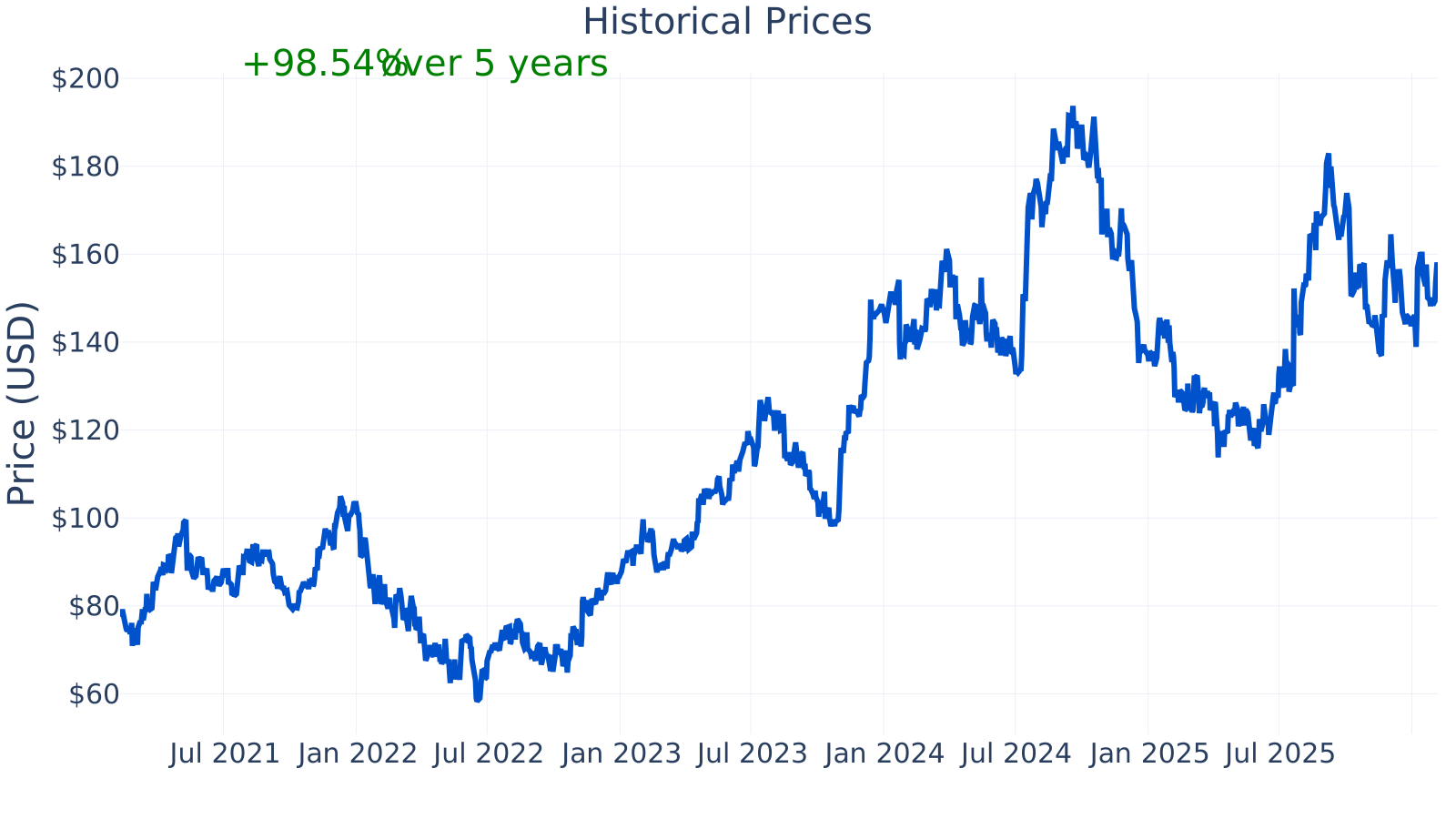
D.R. Horton is a large company by market value (about $45.5B) and the stock has tended to move more than the broader market (beta ~1.45). The current P/E ratio is ~14.2 versus an industry median ~12.0, while the company’s profit margin is ~9.95%, above an industry median ~8.49%. Recent year-over-year revenue growth is about -9.5% (industry median about -4.9%), reflecting a softer period for demand and/or deliveries. Balance-sheet leverage appears lower than many peers with debt-to-equity ~23% versus an industry median ~35%. Over the last twelve months shown, free cash flow is about $3.48B, which is an important buffer in a cyclical business.
Growth (Medium)
Homebuilding is tied to long-run housing needs—population trends, household formation, and the ongoing need to replace and expand the housing stock. That said, the industry is highly cyclical: affordability (driven heavily by mortgage rates and home prices), labor availability, and materials costs can quickly shift demand and profitability.
D.R. Horton’s strategy, as described in its filings, centers on operating at scale across many U.S. markets and offering homes at multiple price points (often emphasizing entry-level segments through its brands). Scale can matter in homebuilding because it may improve purchasing power with suppliers and subcontractors, increase community count, and spread overhead across more closings—though it does not eliminate the cycle.
The revenue growth pattern shown highlights this cyclicality: very strong year-over-year growth in 2021 and 2022, moderating through 2023–2024, and turning negative in 2025 (about -9.5% most recently). This kind of swing is common in residential construction as demand responds to financing conditions and affordability.
Free cash flow has also fluctuated. The series shows a dip into negative territory in 2022 (about -$0.28B), followed by a rebound into solidly positive territory in 2023–2025 (most recently about $3.48B). For a builder, cash flow can be volatile because land purchases, development, and inventory (homes under construction) require significant upfront spending, while cash comes back at closing.
Potential catalysts for future growth are typically linked to broader housing conditions (for example, improved affordability if mortgage rates fall, or stronger demand from household formation) and to company-specific execution (community count, build times, cost control, and maintaining returns on land and inventory). These factors tend to matter more than single-product breakthroughs, since homebuilding is an operations-and-cycle-driven industry.
Risks (High)
The main risk is that homebuilding is sensitive to the economy and interest rates. Higher mortgage rates can reduce affordability and demand; weaker employment conditions can lead to cancellations or slower sales; and changes in consumer confidence can shift buying decisions quickly. Even when demand is steady, construction costs (labor, materials) and land prices can pressure margins.
Another key risk is inventory and land exposure. Builders must plan years ahead by acquiring or controlling lots. If market conditions weaken, the company can face write-downs on land or may need to slow construction, both of which can affect earnings and cash generation.
Competition is intense and mostly regional, even for national builders. D.R. Horton competes with other large public homebuilders and many private builders. Major public peers commonly include Lennar, PulteGroup, NVR, and Taylor Morrison, among others. D.R. Horton is widely viewed as one of the largest U.S. homebuilders by volume, and its scale can be a practical advantage (purchasing, market coverage, brand portfolio, and operational systems). Still, homes are not a “winner-take-all” product, and buyers often compare communities on location, monthly payment, and features—so pricing pressure can appear quickly when demand softens.
Leverage looks relatively conservative versus peers in the period shown. The most recent debt-to-equity is about 23%, below the industry median around 35%. Lower leverage can provide flexibility during downturns (for example, to keep building selectively, support incentives, or withstand weaker cash flow), though it does not remove market risk.
Profitability has trended down from the elevated levels seen in 2021–2022. The most recent profit margin is about 9.95%, still above the industry median (~8.49%), but well below earlier peaks shown in the series (mid-to-high teens). This aligns with a normalization from unusually strong post-pandemic conditions and shows why long-term results often depend on cycle timing and cost discipline.
Valuation
One simple way to describe valuation is the price-to-earnings (P/E) ratio, which compares the stock price to the company’s earnings. For cyclical businesses like homebuilders, the P/E can move for two reasons at once: the market’s expectations change and earnings themselves can expand or contract sharply across the housing cycle.
The chart shows D.R. Horton’s P/E moving from very low levels around 2022 (roughly mid-single digits) to higher levels more recently. The latest P/E is about 14.2, compared with an industry median around 12.0. A higher-than-median P/E can reflect expectations for comparatively steadier operations, stronger margins, a stronger balance sheet, or different investor views on future earnings durability. At the same time, since recent revenue growth is negative and margins have been compressing from prior peaks, the current multiple also embeds assumptions about how earnings may evolve as housing conditions change.
In practice, valuation for a homebuilder is often discussed alongside balance-sheet strength, cash generation, and where current profitability sits relative to a cycle. Here, the combination of positive free cash flow and lower leverage than the peer median are supportive fundamentals, while recently declining revenue growth and margin normalization highlight the cyclical context that can influence how “expensive” or “cheap” a P/E ultimately proves to be over time.
Conclusion
D.R. Horton is a scaled U.S. homebuilder whose results are driven primarily by home sales, with additional contribution from mortgage and title services. The company has recently shown above-median profit margins versus its industry group and a lower debt-to-equity level than the peer median, alongside meaningful positive free cash flow in the latest period shown. These factors point to operational scale and financial flexibility—important traits in a cyclical industry.
At the same time, the business remains closely tied to housing affordability and macro conditions. The recent pattern of negative year-over-year revenue growth and declining margins from prior highs underlines that earnings can change materially across the cycle. The current P/E (about 14.2) sits above the industry median, which places added importance on how the next phase of the housing cycle and company execution affect future profitability.
Sources:
- U.S. SEC EDGAR — D.R. Horton, Inc. filings (Form 10-K, Form 10-Q)
- D.R. Horton Investor Relations — Annual Report materials and press releases
- Wikipedia — “D. R. Horton” (basic company background)
This article is for informational purposes only and does not constitute financial advice. Some content is AI-generated. See Disclaimer


