Stock Analysis · Crown Holdings Inc (CCK)
Overview
Crown Holdings Inc. (CCK) is a global packaging company focused on making metal packaging, especially beverage cans, along with other packaging products used by consumer brands and industrial customers. In simple terms, Crown produces the containers that many everyday products are sold in, such as canned drinks and certain foods, and it also provides related packaging equipment and services in some areas. The company operates at large scale, supplying high-volume customers where reliability, manufacturing efficiency, and long-term supply relationships matter.
From a business-model perspective, Crown’s revenue is tied to how many units its customers sell (for example, beverage volumes), and to input costs (especially aluminum and steel) that can move up and down. Because packaging is often an essential part of getting a product to market, demand tends to be steadier than for many discretionary products, but it is not immune to cycles in consumer demand and industrial activity.
Main sources of revenue (typical segment structure used by the company):
- Americas Beverage (beverage cans and related products)
- European Beverage (beverage cans and related products)
- Asia Pacific (mix of beverage cans and other packaging formats depending on market)
- Transit Packaging (industrial packaging such as protective/transport solutions)
The exact percentage contribution by segment can change from year to year and is detailed in Crown’s annual report segment disclosures.
Across recent years, the company’s results show a large share of revenue going to production costs, with profitability sensitive to operating efficiency and financing costs. Interest expense is a meaningful line item, which is important context when comparing operating performance versus bottom-line earnings.
Key Figures
| Metric | Value | Industry ⓘ |
|---|---|---|
| Date | May 01, 2026 | |
| Context | ||
| Sector | Consumer Cyclical | |
| Industry | Packaging & Containers | |
| Market Cap ⓘ | $10.99B | |
| Beta ⓘ | 0.75 | |
| Fundamental | ||
| P/E Ratio ⓘ | 15.63 | 17.11 |
| Profit Margin ⓘ | 5.65% | 5.65% |
| Revenue Growth ⓘ | 12.90% | 2.10% |
| Debt to Equity ⓘ | 205.87% | 133.74% |
| PEG ⓘ | 0.64 | |
| Free Cash Flow ⓘ | $1.10B | |
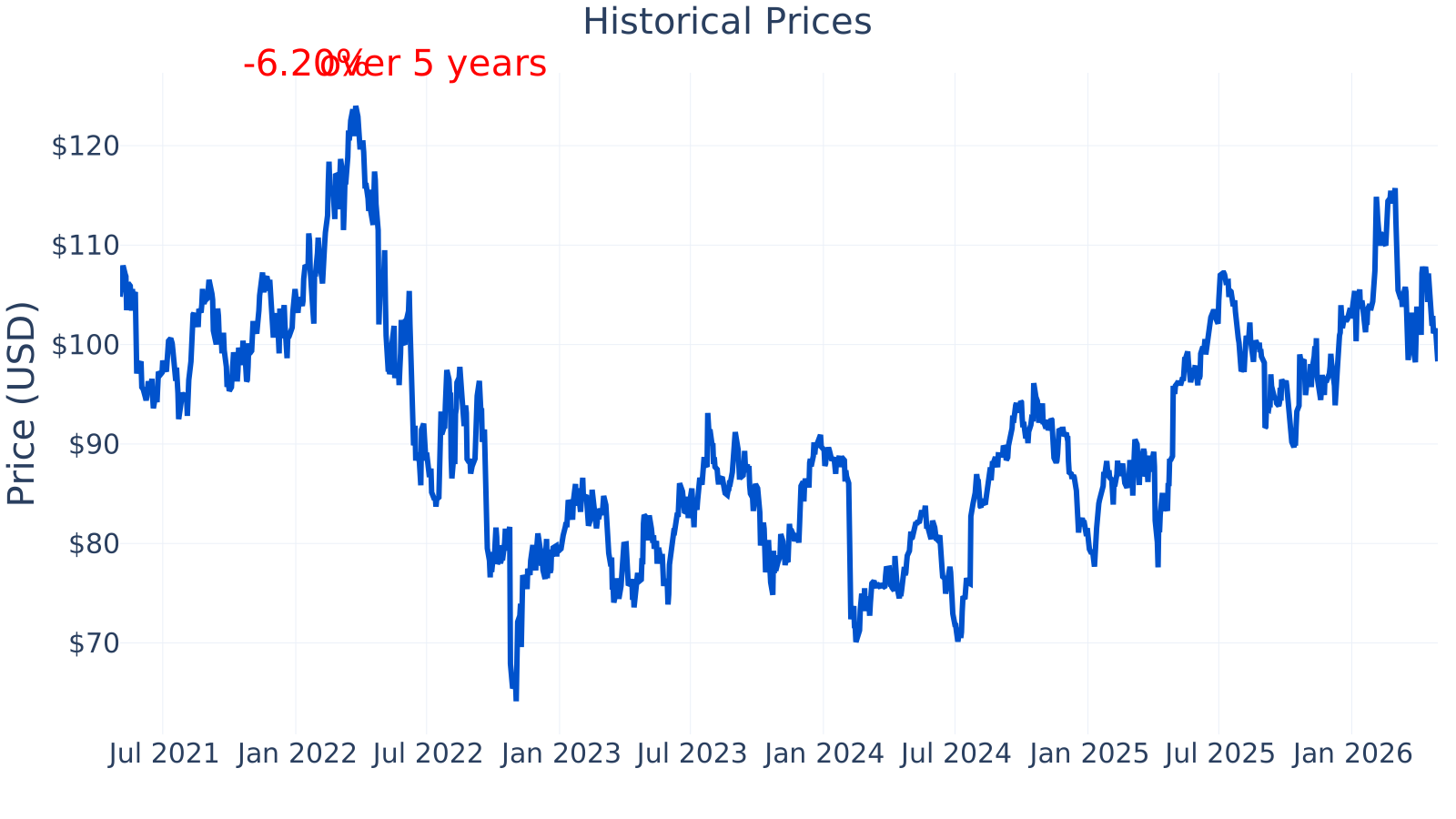
Crown’s market capitalization is about $11.0 billion, and the stock’s beta of 0.75 indicates it has historically moved less than the overall market. The current P/E ratio is 15.63 versus an industry median near 17.11. The profit margin is 5.65%, in line with the industry median shown. Recent year-over-year revenue growth is 12.9%, notably higher than the industry median near 2.1%. Debt levels are significant: debt-to-equity is about 206% versus an industry median near 134%. Trailing twelve-month free cash flow is about $1.10 billion, and the PEG ratio is 0.64 (a metric that compares valuation to expected growth, and which is sensitive to forecasting assumptions).
Growth (Medium)
Crown operates in the packaging and containers industry, where long-term demand is often shaped by population growth, consumption patterns (especially beverages), and brand owners’ packaging choices. Metal beverage cans have structural drivers that can support steady demand over time: they are widely recycled, have strong barrier properties (helping protect the product), and are well-suited to high-speed filling and distribution. That said, overall industry growth tends to be moderate rather than explosive, because packaging is a mature, high-volume manufacturing category.
A key question for future growth is whether the company can expand volumes and maintain pricing discipline while managing input-cost swings and keeping plants well-utilized. In practical terms, Crown’s strategy typically emphasizes scale manufacturing, long-term customer relationships, and capital investments that improve capacity or efficiency where demand supports it.
The year-over-year revenue growth trend shows a downturn through parts of 2023 and early-to-mid 2024, followed by a return to positive growth and a stronger latest reading (about 12.9%). This pattern can be consistent with a volume recovery, improved pricing/mix, or easier comparisons versus the prior year, and it highlights that even “everyday” packaging can experience cycles.
Free cash flow has been volatile over time, including a negative period (around early 2023) followed by a sharp improvement. More recently, trailing twelve-month free cash flow is roughly $1.10 billion, which indicates meaningful cash generation after operating needs and capital spending. For a capital-intensive manufacturer, sustained free cash flow matters because it supports reinvestment in plants, debt reduction, and other corporate uses.
Risks (High)
Crown’s risk profile is strongly influenced by its balance sheet and by the economics of large-scale manufacturing. The company uses debt financing, and its debt-to-equity level is above the industry median in the figures shown. Higher leverage can amplify outcomes: it may help returns when business conditions are favorable, but it can also reduce flexibility when volumes weaken or when interest rates and refinancing costs rise.
The debt-to-equity ratio has trended down meaningfully from very elevated levels earlier in the timeline (above 300%–400%) to about 206% most recently. Despite the improvement, it remains higher than the industry median (about 134%), keeping financing risk and interest expense as ongoing considerations.
Profitability is another key risk area. Packaging often involves multi-year customer relationships and large production footprints, but margins can still move with input costs, operational efficiency, and pricing dynamics. Even small changes in margin can have an outsized impact because the business runs on high revenue and comparatively thin net margins.
Net profit margin has fluctuated materially over the period shown, including negative margins in 2021–2022 and a return to positive levels thereafter. The most recent margin is about 5.65%, broadly in line with the industry median in the table, but the historical swings show that earnings can be sensitive to costs, non-recurring items, and financing impacts.
Competition is also important. Crown competes with other large packaging manufacturers across beverage cans and broader packaging categories. In beverage cans, competition tends to be based on scale, service levels, manufacturing footprint near customers, quality, and long-term contracting. The competitive environment can limit pricing power if capacity is abundant in a region or if customers negotiate aggressively.
Examples of well-known competitors in metal packaging and beverage cans include Ball Corporation (metal packaging) and Ardagh Metal Packaging (beverage cans), among other regional and diversified packaging producers. Crown is one of the major global participants, but it is not the only scaled provider, so competitive advantage is more about execution (cost, reliability, footprint, relationships) than about a unique product.
Additional risks include: customer concentration (large beverage and consumer brands), shifts in consumer demand (alcoholic vs. non-alcoholic mix, at-home vs. away-from-home), foreign exchange effects due to global operations, and regulatory or policy changes related to packaging waste and recycling requirements.
Valuation
Based on the latest figures shown, Crown’s P/E ratio (15.63) is below the industry median (17.11). Over the timeline, the P/E ratio has generally been in a mid-teens to low-20s range in many periods, with at least one outlier spike (not typical for steady-state comparisons). A P/E comparison is most useful when earnings quality is stable; for a manufacturer with variable margins and meaningful interest expense, it can be helpful to also consider balance sheet leverage and cash flow generation alongside earnings multiples.
In context, the combination of (1) recent above-industry revenue growth, (2) meaningful recent free cash flow, and (3) higher-than-median leverage creates a mixed picture: valuation metrics may look moderate versus peers, but the balance sheet adds sensitivity to downturns and to financing conditions. Whether the current valuation is “expensive” or “cheap” depends heavily on forward assumptions about volume stability, margin durability, and continued progress on leverage.
Conclusion
Crown Holdings is a large-scale packaging manufacturer whose performance is driven by beverage-can demand, manufacturing efficiency, input-cost dynamics, and financing costs. Recent metrics show stronger year-over-year revenue growth than the industry median and substantial trailing free cash flow, alongside profit margins that are currently in line with peers.
The main trade-off visible in the fundamentals is balance-sheet risk: leverage has improved over time but remains higher than the industry median, which can increase sensitivity to weaker demand or tighter credit conditions. From an industry standpoint, packaging is typically steadier than many consumer categories, but it is still cyclical in periods and competitive, with limited room for operational missteps. Overall, the long-term investment discussion tends to center on whether Crown can sustain cash generation and maintain pricing and utilization while continuing to manage debt and interest expense through the cycle.
Sources:
- U.S. SEC EDGAR — Crown Holdings, Inc. filings (Form 10-K, Form 10-Q)
- Crown Holdings — Investor Relations materials (Annual Report / SEC filings section)
- Wikipedia — “Crown Holdings” (basic company background)
This article is for informational purposes only and does not constitute financial advice. Some content is AI-generated. See Disclaimer