Stock Analysis · Crown Holdings Inc (CCK)
Overview
Crown Holdings Inc. (CCK) is a global packaging company that makes metal packaging products used mainly for beverages and food, along with other specialty packaging. In simple terms, it sits in the supply chain behind many everyday items people buy at grocery stores and convenience stores: the company sells the containers (for example, beverage cans) rather than the branded drinks or foods inside them.
Its business model is typically built around large production volumes, long-term customer relationships, and operational efficiency. Demand is influenced by consumer packaged goods consumption, customer product mix (such as soda, beer, energy drinks, canned foods), and input costs (like aluminum and steel), with pricing often including mechanisms intended to pass through some raw material cost changes to customers.
Based on publicly available company reporting, Crown generally describes revenue through its operating segments (for example, beverage can operations in different regions and other packaging businesses). A simple way to think about the sources of revenue is:
- Beverage cans (typically the largest contributor, across multiple geographic regions)
- Food cans / metal ends and closures (products used for canned foods and related packaging components)
- Other packaging / specialty businesses (smaller contributions compared with beverage cans)
Percentages can vary year to year and are best taken from the company’s most recent annual report segment footnote (net sales by segment/region). If you want, share the latest 10-K segment table and I can convert it into a clean “largest to smallest with percentages” list.
From the multi-year income flow shown above, total revenue moved from about $11.394B (2021) to $12.365B (2025). Profitability also appears to have normalized after a loss year: net income was about -$560M (2021), then positive at about $727M (2022), $450M (2023), $424M (2024), and $734M (2025). Interest expense is a meaningful recurring cost (roughly $253M–$452M across the years shown), which matters when rates rise or debt is refinanced.
Key Figures
| Metric | Value | Industry ⓘ |
|---|---|---|
| Date | Feb 16, 2026 | |
| Context | ||
| Sector | Consumer Cyclical | |
| Industry | Packaging & Containers | |
| Market Cap ⓘ | $12.78B | |
| Beta ⓘ | 0.72 | |
| Fundamental | ||
| P/E Ratio ⓘ | 17.37 | 22.22 |
| Profit Margin ⓘ | 5.97% | 5.56% |
| Revenue Growth ⓘ | 7.70% | 5.90% |
| Debt to Equity ⓘ | 198.87% | 137.29% |
| PEG ⓘ | 0.66 | |
| Free Cash Flow ⓘ | $1.10B | |
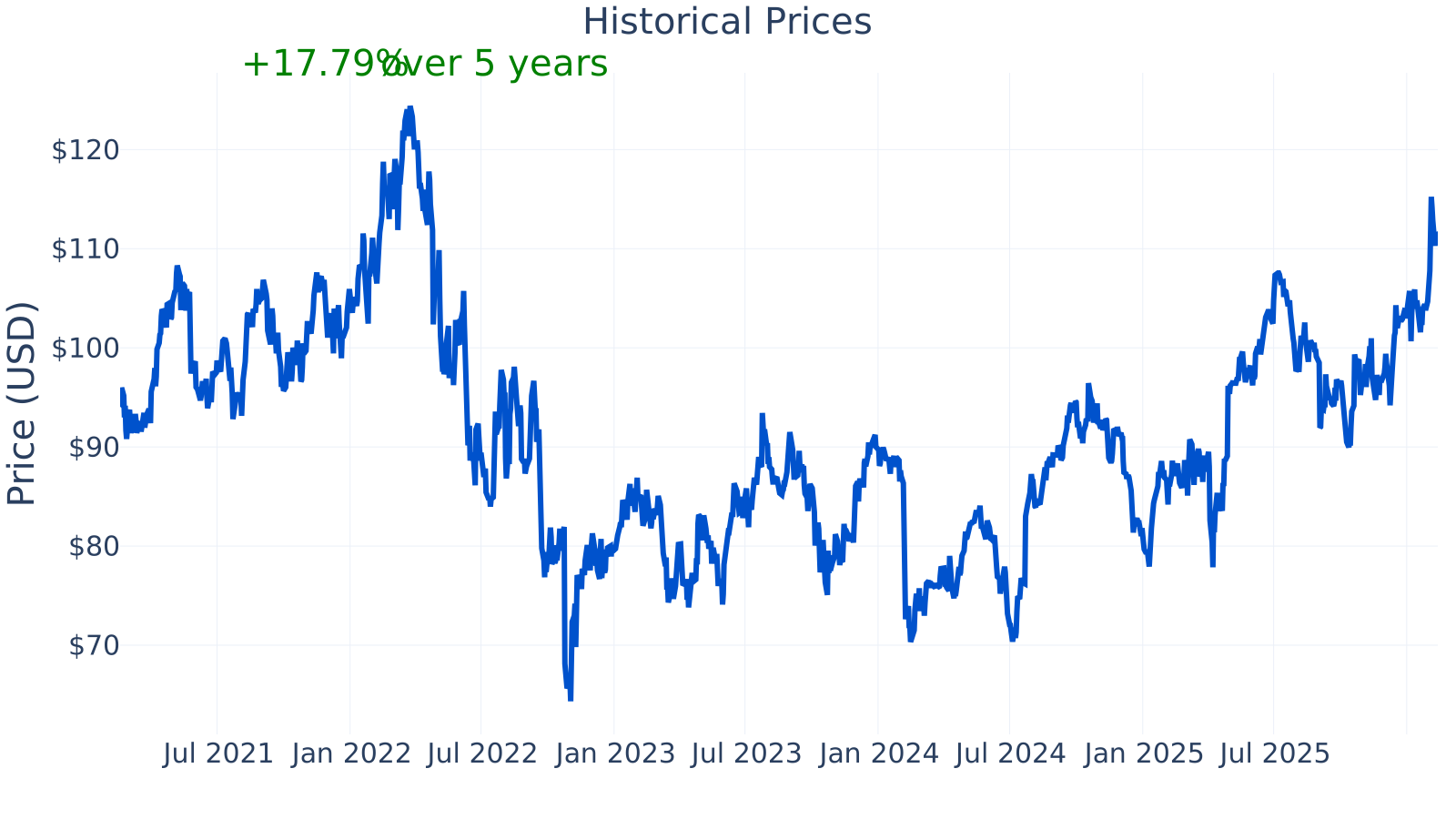
Crown’s market capitalization is about $12.78B. The stock’s beta of 0.72 suggests it has historically moved less than the overall market (though this can change over time). The company’s P/E ratio is ~17.37, below the industry median ~22.22 in Packaging & Containers (16 stocks in this peer set), while its profit margin is ~5.97%, slightly above the industry median ~5.56%. Recent year-over-year revenue growth is ~7.7% versus an industry median ~5.9%. Leverage is notable: debt-to-equity is ~199% compared with an industry median ~137%. Trailing twelve-month free cash flow is about $1.098B.
Growth (Medium)
Packaging is typically considered a steady, “everyday demand” industry rather than a fast-changing technology space. For Crown, long-term growth tends to be connected to beverage consumption trends, customer packaging choices (for example, shifting between plastic, glass, and aluminum), and the company’s ability to operate efficiently at scale. Metal packaging can benefit from recycling infrastructure and the ability to recycle aluminum repeatedly, which can support continued customer interest in cans for certain product categories.
The year-over-year revenue pattern shown above looks cyclical: strong growth in 2021–2022, a decline through much of 2023 and early 2024, then a return to positive growth into 2025 (ending around +7.7%). This kind of path can happen when volumes normalize after unusually strong periods, when pricing effects fade, or when customer demand shifts across regions and categories.
Free cash flow has also been uneven over time: roughly $925M (2021), then down to about $191M (2022), negative around -$86M (2023), and then improving to about $932M (2024) and $966M (2025). For a capital-intensive manufacturer, this line is important because it reflects (in simplified terms) how much cash remains after running the business and funding necessary investments. A rebound to near $1B suggests improved cash generation versus the 2022–2023 period, though the history also shows that cash flow can swing meaningfully depending on working capital and capital spending cycles.
Potential catalysts (in a descriptive, non-predictive sense) typically include improved plant utilization, new capacity ramp-ups tied to customer contracts, mix shifts toward higher value-added packaging formats, and sustained cost management. Because packaging demand can be relatively stable, incremental gains in efficiency and contract economics can matter a lot over long periods.
Risks (Medium-High)
This article is for informational purposes only and does not constitute financial advice. Some content is AI-generated. See Disclaimer


