Stock Analysis · Crowdstrike Holdings Inc (CRWD)
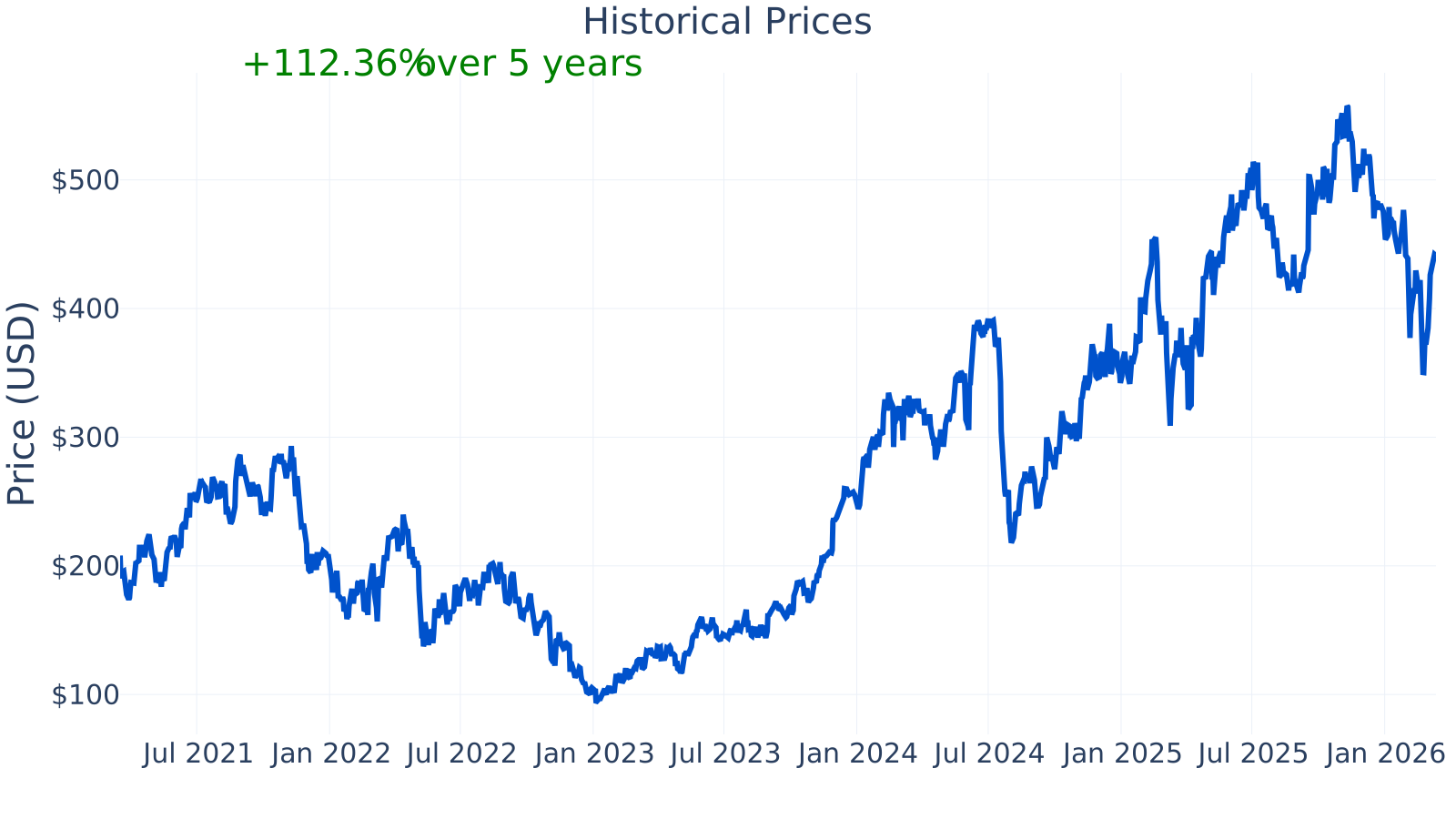
Overview
CrowdStrike Holdings, Inc. (CRWD) is a cybersecurity company. Its main product platform, Falcon, is designed to help organizations prevent, detect, investigate, and respond to cyberattacks across devices (like laptops and servers), cloud workloads, identities (user accounts), and other parts of modern IT environments. The platform is delivered primarily as cloud-based software, which typically means customers pay recurring subscription fees rather than making one-time purchases.
In its financial reporting, CrowdStrike’s revenue is primarily split into subscription revenue (recurring software subscriptions and related support) and professional services revenue (implementation, incident response, and other services). Subscription revenue is the clear majority of the business, while professional services are a smaller portion and often serve to support adoption of the platform.
Main sources of revenue (typical reporting categories):
- Subscription revenue (largest): recurring platform subscriptions and support
- Professional services revenue (smaller): services such as incident response and onboarding
From an operating cost perspective, the company has historically invested heavily in research and development (to expand the platform) and in sales and marketing (to acquire and expand customers). Revenue has grown strongly over the last several years, while profitability has fluctuated as spending levels change.
Over the last five fiscal years shown, total revenue increased substantially (from about $1.45B to about $4.81B). At the same time, research and development and selling/general/administrative expenses also rose notably, which helps explain why operating income and net income can swing between profit and loss even as the top line expands.
Key Figures
| Metric | Value | Industry ⓘ |
|---|---|---|
| Date | Mar 16, 2026 | |
| Context | ||
| Sector | Technology | |
| Industry | Software - Infrastructure | |
| Market Cap ⓘ | $112.04B | |
| Beta ⓘ | 1.12 | |
| Fundamental | ||
| P/E Ratio ⓘ | N/A | 27.17 |
| Profit Margin ⓘ | -3.38% | 7.12% |
| Revenue Growth ⓘ | 23.30% | 15.80% |
| Debt to Equity ⓘ | 18.52% | 24.92% |
| PEG ⓘ | 3.64 | |
| Free Cash Flow ⓘ | $1.24B | |
CrowdStrike’s market capitalization is about $112.0B, indicating it is a large, widely followed public company. The stock’s beta of ~1.12 suggests it has tended to move somewhat more than the overall market.
On fundamentals, the company’s latest year-over-year revenue growth is ~23.3%, higher than the industry median (~15.8%) for its peer group. The latest profit margin is about -3.38%, below the industry median (~7.12%), highlighting that accounting profitability remains a key area to watch even while the business generates meaningful cash. The company’s debt-to-equity is ~18.5%, below the industry median (~24.9%), indicating comparatively lower balance-sheet leverage among peers. Trailing twelve-month free cash flow is about $1.24B, which can matter for funding growth without relying as much on outside capital.
Growth (High)
Cybersecurity is generally considered a structurally growing area because organizations face persistent threats (ransomware, data theft, identity attacks) while also shifting more work to cloud services and remote/hybrid setups. That combination tends to increase the number of “places” that must be protected and the complexity of protection.
CrowdStrike’s growth strategy has commonly emphasized selling a single platform that can cover multiple security needs, with the aim that customers adopt additional modules over time. This “land and expand” approach can support growth because adding more capabilities to existing customers may be more efficient than relying only on new customer wins.
The company’s year-over-year revenue growth has remained positive and strong, though it has slowed from very high levels earlier in the period (around 60–70% in 2021) to the low-to-mid 20% range more recently (about 23% at the latest point). This pattern is common as companies scale to a larger revenue base, but the direction and stability of growth still matter because the valuation often assumes continued expansion.
Free cash flow has increased steadily over the period shown, from roughly $441M (TTM ending 2022-01-31) to about $1.24B (TTM ending 2026-01-31). This suggests the business has been able to convert a growing portion of its revenue into cash, even while accounting profitability has moved around from year to year. For long-term company building, sustained free cash flow can support continued product investment and operational flexibility.
Risks (High)
CrowdStrike operates in a highly competitive market where technology changes quickly and customers can reevaluate vendors after security incidents or product shifts. A major risk for any cybersecurity vendor is reputational: if customers believe a product fails to protect them, sales cycles can slow and renewal/expansion can become harder. In addition, large enterprise customers often negotiate pricing aggressively, and competitive pressure can reduce margins over time.
Another key risk is that strong revenue growth has not consistently translated into stable GAAP profitability. This can happen when a company invests heavily in R&D and go-to-market capacity. The tradeoff is not inherently negative, but it does mean long-term outcomes depend on whether spending ultimately produces durable customer retention, efficient scaling, and clearer profitability.
Profitability has been volatile over the period shown. The company improved from deeply negative profit margins in 2021 (around -16%) to modestly positive margins in parts of 2024 (roughly +3% to +5%), but more recently moved back into negative territory (about -3.4% at the latest point). Compared with an industry median near +7% at the latest point, this indicates CrowdStrike is currently less profitable on an accounting basis than many peers, even though cash generation has grown.
Balance-sheet risk appears more moderate than many high-growth software companies, but leverage and capital structure still matter as conditions change.
The debt-to-equity ratio declined significantly over time, from roughly 92% in 2021 to about 19% most recently, which is close to the industry median (~19%) at the latest data point. This downward trend suggests reduced reliance on debt relative to equity compared with earlier years.
Competitive positioning is also a central risk factor. CrowdStrike is often discussed alongside other major cybersecurity and platform vendors that cover endpoint, identity, cloud, and broader security operations. Commonly referenced competitors in overlapping areas include:
- Microsoft (broad security suite integrated into its ecosystem)
- Palo Alto Networks (network, cloud, and security operations platform offerings)
- SentinelOne (endpoint security platform competitor)
- Fortinet and Cisco (network/security infrastructure with expanding software offerings)
- Zscaler (cloud security / secure access service edge focus)
CrowdStrike’s competitive advantages often center on its cloud-delivered architecture, broadening module set, and data/telemetry collected across deployments. However, leadership in cybersecurity can be difficult to “lock in” because large platform vendors bundle features and smaller specialists innovate quickly. Market share and customer expansion trends are therefore important to monitor over time in the company’s filings.
Valuation
Valuation for a fast-growing software company is often discussed using earnings multiples (like P/E) and growth-adjusted metrics. For CrowdStrike, the picture can be less straightforward because GAAP net income has been negative in some periods, which can make P/E ratios unstable or not meaningful for long stretches.
In the period shown, the company’s P/E is mostly not displayed (often due to earnings being low or negative). One visible point shows a very high P/E (around 390 in late 2024), versus an industry median around ~31 near that time. A very high P/E typically implies the market price is embedding expectations of substantial future earnings growth and improved profitability. If those expectations are not met, valuation can compress even if revenue continues to rise.
The provided PEG ratio of about 3.64 also indicates that, relative to its growth rate, the valuation may be demanding (PEG ratios materially above 1 are often interpreted as reflecting higher expectations). Because profitability has been volatile, readers often supplement earnings-based valuation with cash flow trends and revenue growth durability when forming a longer-term view.
Conclusion
CrowdStrike is a large cybersecurity platform company with strong revenue growth over several years and a clear shift toward higher free cash flow generation. The business operates in an area with persistent long-term demand drivers, and its platform approach is designed to increase customer adoption over time.
At the same time, risks remain elevated: competition is intense, reputational and execution risks are meaningful in cybersecurity, and GAAP profitability has not been consistently positive recently. Valuation indicators can also look stretched at times when earnings are low or uneven, which can increase sensitivity to changes in growth and margin expectations.
Sources:
- CrowdStrike Holdings, Inc. — Form 10-K (Annual Report) filings (SEC EDGAR)
- CrowdStrike Holdings, Inc. — Form 10-Q (Quarterly Report) filings (SEC EDGAR)
- CrowdStrike Holdings, Inc. — Investor Relations materials and press releases (company website)
- SEC EDGAR — Company filings database (CrowdStrike Holdings, Inc.)
- Wikipedia — “CrowdStrike” (basic company background)
This article is for informational purposes only and does not constitute financial advice. Some content is AI-generated. See Disclaimer


