Stock Analysis · Criteo Sa (CRTO)
Overview
Criteo S.A. (CRTO) is a global advertising technology company. Its products help brands and retailers buy digital advertising and measure results, with a strong focus on performance-oriented ads (campaigns where the goal is typically a measurable action such as a purchase). In practice, Criteo works with large volumes of shopping and browsing signals and uses them to decide which ad to show to which audience, and where, across the open internet.
From a business-model point of view, the company sits between advertisers (brands and retailers that want sales), and publishers/platforms (websites and apps that have ad space to sell). Criteo’s value proposition is usually described around driving measurable outcomes (sales or incremental revenue) and helping commerce companies reach customers beyond their own websites.
In its SEC filings, Criteo reports revenue at a consolidated level; detailed public splits can vary by reporting period and disclosure. In general terms, revenue is primarily generated from advertising services tied to commerce and performance marketing.
Main revenue drivers (high-level):
- Retail media and commerce-focused advertising (ads that help retailers and brands promote products and drive transactions)
- Performance media for brands (campaigns optimized toward conversions rather than awareness)
- Onsite and offsite monetization solutions (tools that help retailers and publishers monetize traffic through ads)
The income statement structure also highlights that a large part of Criteo’s revenue is matched by a substantial “cost of revenue” line (common in ad-tech models where traffic acquisition or media costs are significant), leaving a smaller—but meaningful—gross profit pool to fund R&D, sales, and corporate expenses.
Across the periods shown, total revenue trends downward from 2021 to 2023 and then stabilizes around ~$1.93–$1.94B in 2024–2025, while gross profit increases over time (from ~$782M in 2021 to ~$1.05B in 2025). This suggests improved gross economics (a larger share of revenue retained after direct costs) even without strong top-line expansion.
Key Figures
| Metric | Value | Industry ⓘ |
|---|---|---|
| Date | Mar 09, 2026 | |
| Context | ||
| Sector | Communication Services | |
| Industry | Advertising Agencies | |
| Market Cap ⓘ | $1.01B | |
| Beta ⓘ | 0.38 | |
| Fundamental | ||
| P/E Ratio ⓘ | 7.48 | 33.27 |
| Profit Margin ⓘ | 7.44% | 2.25% |
| Revenue Growth ⓘ | -2.20% | 6.90% |
| Debt to Equity ⓘ | 13.03% | 30.22% |
| PEG ⓘ | 0.89 | |
| Free Cash Flow ⓘ | $208.50M | |
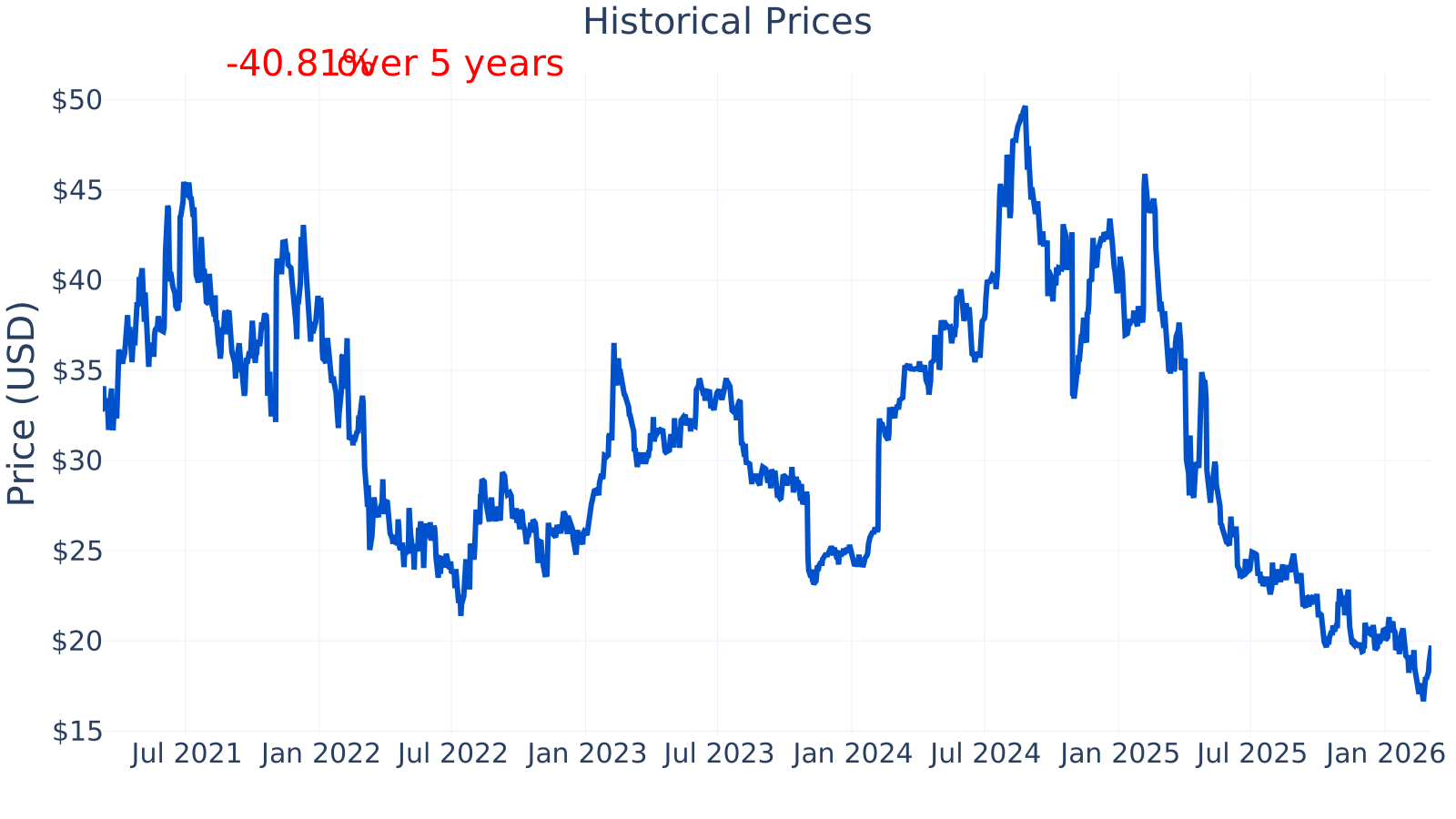
Criteo’s market capitalization is about $1.01B, and the stock’s beta of ~0.38 indicates that, historically, the share price has tended to move less than the broader market (though this can change over time and does not prevent drawdowns). The company’s P/E ratio is ~7.48 versus an industry median ~33.27, while its profit margin is ~7.44% versus an industry median ~2.25%. Year-over-year revenue growth is currently about -2.2% compared with an industry median ~6.9%. Financial leverage looks relatively modest with debt-to-equity ~13.0% (industry median ~30.2%). Trailing twelve-month free cash flow is ~$208.5M, indicating meaningful cash generation relative to its size.
Growth (Medium)
Digital advertising is a mature but still evolving industry. Growth tends to come from shifts in how ads are bought and measured (for example, changes in consumer privacy rules and identifiers), and from faster-growing sub-segments such as retail media (retailers monetizing their shopper traffic with ads). Criteo’s long-term logic is to position itself around commerce outcomes—helping retailers and brands drive measurable sales—rather than relying only on broad “brand awareness” budgets.
A key question for growth is whether Criteo can expand in areas where retailers and brands want more control and measurement, while also adapting to privacy constraints across browsers and mobile environments. Another potential catalyst is improving gross profit and operating efficiency: even if total revenue is flat, better unit economics and disciplined costs can translate into improved profitability and cash generation.
The year-over-year revenue pattern shows strong growth in parts of 2021, then a prolonged contraction through 2022 and early 2023, followed by a period of stabilization with small positives and negatives. The most recent point shown is roughly -2.15%, which reflects a business that is not consistently expanding on the top line.
Free cash flow trends upward in the most recent periods shown, rising from about $128M (TTM as of 2024-03-31) to about $227M (TTM as of 2025-03-31), with the latest metric table showing about $208.5M. For long-term business resilience, consistent cash generation can matter because it can support reinvestment in products, operational flexibility, and shareholder returns, even during weaker advertising cycles.
Risks (High)
Criteo operates in a competitive and fast-changing market where results depend on data access, measurement quality, and the ability to deliver performance at scale. A core structural risk for ad-tech companies is platform dependency: changes by major browsers, mobile operating systems, and large ecosystems can reduce addressability (the ability to identify and measure audiences) or alter ad auction dynamics. Privacy regulation and evolving consumer consent standards can also raise compliance costs and reduce targeting precision.
Competition is another major risk. Criteo competes with large, well-resourced platforms (often referred to as “walled gardens”) and with other independent ad-tech firms. Competitive advantages in this industry often come from scale, data partnerships, measurement credibility, and deep integration with retailers. Criteo is a recognized player in commerce and performance advertising, but it is not the overall “leader” of global digital advertising in the way the largest platforms are; it competes by specializing in commerce outcomes and retailer/brand tools in the open internet.
Key competitor groups typically include:
- Large digital advertising platforms with integrated identity, demand, and supply
- Retail media networks operated by major retailers (which can also be partners depending on the setup)
- Independent ad-tech and demand-side platforms that offer programmatic buying and measurement
Financial leverage appears relatively contained. The latest debt-to-equity ratio is about 13%, below the industry median shown (~24%–30% depending on period). This reduces (but does not eliminate) the risk that interest costs or refinancing needs become a dominant constraint during downturns.
Profitability has been volatile over time, including periods of very low or even negative margins in 2023, followed by improvement. The most recent profit margin shown is about 7.43%, above the industry median (~5.02%). The key risk is sustainability: margins in advertising can compress quickly if pricing pressure increases, if traffic costs rise, or if performance weakens and advertisers reduce spend.
Valuation
Valuation is often summarized through multiples such as the price-to-earnings (P/E) ratio, but interpreting it requires context: advertising is cyclical, accounting earnings can swing, and competitive dynamics can change quickly. In Criteo’s case, the latest P/E shown (~7.48) is far below the industry median (~33.27). A lower multiple can reflect market skepticism about future growth, durability of the business model, or the cyclicality of advertising budgets.
Over the period shown, Criteo’s P/E ratio trends downward in the more recent points, reaching the mid-to-high single digits by late 2025, while the industry median remains materially higher. This gap can occur when the market expects slower growth or higher business risk for the company relative to peers, even if current profitability looks solid.
Whether today’s price level is “expensive” or “cheap” cannot be concluded from a single ratio. A more complete view links valuation to (1) the stability of revenue, (2) the ability to maintain margins through industry shifts, and (3) the consistency of free cash flow generation. In the metrics shown, cash generation is meaningful, leverage is moderate, and margins have recently improved, while revenue growth remains uneven.
Conclusion
Criteo is a commerce-focused advertising technology company that generates revenue by helping brands and retailers run performance advertising and monetize traffic. The financial picture shown is mixed: revenue has stabilized after a period of decline, while gross profit and recent profit margins improved, and free cash flow is substantial relative to the company’s market value. At the same time, the business sits in a highly competitive environment shaped by large platforms, shifting privacy rules, and rapid product changes, all of which can affect performance and pricing.
From a long-term perspective, the core facts to weigh are the company’s ability to (1) sustain relevance in privacy-first advertising, (2) grow in retail media and commerce outcomes, and (3) keep converting its activity into durable cash flow without relying on higher leverage. The current valuation multiples shown are low relative to the industry median, which is consistent with a market that is discounting growth and/or durability risks despite improved recent profitability.
Sources:
- SEC EDGAR — Criteo S.A. filings (Form 10-K, Form 10-Q)
- Criteo Investor Relations — Annual Report / Universal Registration Document (as published by the company)
- Wikipedia — “Criteo” (basic company background)
This article is for informational purposes only and does not constitute financial advice. Some content is AI-generated. See Disclaimer


