Stock Analysis · Corpay Inc (CPAY)
Overview
Corpay Inc (CPAY) provides business payment solutions designed to make it easier for organizations to pay suppliers, employees, and travel-related expenses while improving control and reporting. The company operates across several payment-focused platforms, including corporate payments (such as accounts payable automation and cross-border payments), vehicle-related payments (often centered on fuel and fleet spending), and lodging solutions used to manage hotel spend for business travel.
In simple terms, Corpay sits between businesses and the complex world of payments. It aims to reduce manual work (like invoices and reconciliation), improve visibility on spending, and earn fees for the services and payment flows it enables.
Corpay’s revenue is generally tied to payment activity and the services wrapped around it (for example, transaction fees, service fees, and other program economics), across its main operating areas. Based on how the company describes its operations in filings, the business is commonly discussed in these major buckets (largest-to-smallest ordering and exact percentages can vary by year and are not always presented as a single simple split):
- Vehicle payments (fleet/fuel-related programs)
- Corporate payments (including accounts payable and cross-border payments)
- Lodging and travel-related payment solutions
From an operating standpoint, the company’s model tends to benefit when customers increase payment volumes, adopt additional modules, and consolidate more spend onto Corpay-managed payment tools.
Across the years shown, total revenue rises meaningfully (from about $2.83B in 2021 to about $4.53B in 2025), while net income also increases (from about $0.84B to about $1.07B). One visible offset is that interest expense grows materially over the period, which matters because it can reduce how much of operating profit ultimately becomes net income.
Key Figures
| Metric | Value | Industry ⓘ |
|---|---|---|
| Date | Feb 07, 2026 | |
| Context | ||
| Sector | Technology | |
| Industry | Software - Infrastructure | |
| Market Cap ⓘ | $25.01B | |
| Beta ⓘ | 0.81 | |
| Fundamental | ||
| P/E Ratio ⓘ | 23.58 | 25.66 |
| Profit Margin ⓘ | 23.63% | 6.68% |
| Revenue Growth ⓘ | 20.70% | 15.20% |
| Debt to Equity ⓘ | 210.58% | 19.82% |
| PEG ⓘ | 0.91 | |
| Free Cash Flow ⓘ | $1.30B | |
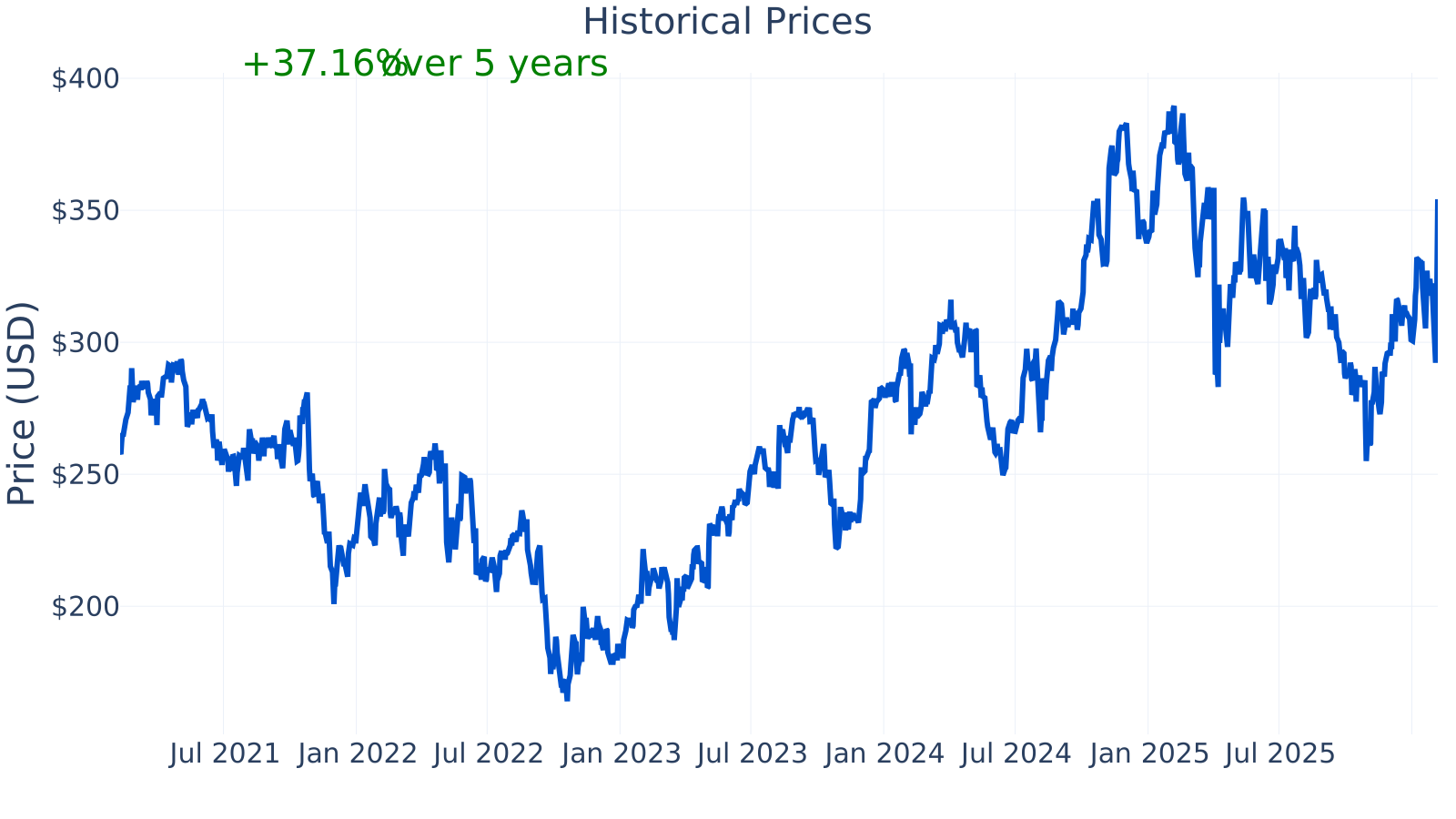
Corpay’s market capitalization is about $25.0B, placing it among larger, established mid-to-large public companies. The stock’s beta of ~0.81 suggests it has historically been less volatile than the broader market. The company’s P/E ratio is ~23.6, below the stated industry median (~25.7). Profitability stands out: profit margin is ~23.6% versus an industry median of ~6.7%. Recent year-over-year revenue growth is ~20.7% (industry median ~15.2%). One metric that is notably higher than the industry is leverage: debt-to-equity is ~211% versus an industry median near ~20%. Trailing twelve-month free cash flow is about $1.30B.
Growth (Medium)
Corpay operates in business-to-business payments and spend management—areas that have long-term tailwinds because companies continue shifting away from manual processes (paper invoices, checks, fragmented approval workflows) toward more automated, software-supported payment systems. As businesses add more digital workflows, demand can increase for tools that combine payments with controls, reporting, and compliance features.
Corpay’s strategy also appears oriented toward expanding “share of wallet” within customers: once a company routes a portion of payments through a platform, it can be easier to add adjacent products (for example, expanding from basic payment execution to additional controls, reporting, or cross-border capabilities). This kind of expansion approach can support growth without relying only on winning entirely new customers.
The pattern shown suggests revenue growth has fluctuated over time: it was strong in parts of 2021–2022, slowed through 2023–mid 2024, and then re-accelerated by late 2024 into 2025, reaching about 20.7% in the most recent point shown. Relative to the industry median listed in the table (~15.2%), the latest growth rate is higher, though the earlier slowdown highlights that growth is not perfectly steady.
Free cash flow over the trailing twelve months is consistently positive in the period shown, ranging from roughly $0.88B (2022) to about $1.90B (2024), and then around $1.34B (2025). Positive free cash flow can matter for long-term resilience because it is a source of funding for debt repayment, share repurchases, acquisitions, and reinvestment—without needing to raise capital.
Potential catalysts (in a neutral, descriptive sense) typically relate to continued adoption of automated payables, cross-border payment usage, customer consolidation of spend onto fewer platforms, and the company’s ability to integrate acquisitions effectively (a common growth approach in payments and software-enabled services).
Risks (Medium-High)
This article is for informational purposes only and does not constitute financial advice. Some content is AI-generated. See Disclaimer


