Stock Analysis · Corning Incorporated (GLW)
Overview
Corning Incorporated is a materials science company best known for developing specialized glass, ceramics, and optical physics products that get built into everyday technology. Its products show up in smartphone screens and other consumer electronics, fiber-optic networks used by telecom operators and data centers, and glass used in displays and automotive applications. Corning’s business is often described as “high-tech manufacturing”: it relies on proprietary materials, process know-how, and large-scale production capabilities.
In its public reporting, Corning organizes its activities into major business segments. These segments are the clearest way to understand where revenue comes from (exact percentages vary by year):
- Optical Communications (fiber, cable, and connectivity solutions for telecom networks and data centers)
- Display Technologies (glass used in televisions, monitors, and other display panels)
- Specialty Materials (including Corning’s well-known cover glass used in mobile devices and other durable glass applications)
- Environmental Technologies (ceramic substrates and filters used in emissions-control systems for vehicles)
- Life Sciences (labware and consumables used in research, bioprocessing, and pharmaceutical/biotech labs)
Across these segments, demand can be cyclical because it is tied to consumer electronics, display manufacturing utilization, telecom capital spending, and automotive production. At the same time, Corning’s long history of R&D and deep manufacturing expertise are central to how it competes.
From 2021 to 2025, total revenue increased from about $14.1B to $15.6B, while profitability swung significantly: net income fell sharply in 2023–2024 before recovering in 2025. Research and development spending stayed relatively steady around $1.0B–$1.1B per year, which signals continued investment in future products even during weaker earnings periods.
Key Figures
| Metric | Value | Industry ⓘ |
|---|---|---|
| Date | May 04, 2026 | |
| Context | ||
| Sector | Technology | |
| Industry | Electronic Components | |
| Market Cap ⓘ | $135.95B | |
| Beta ⓘ | 1.05 | |
| Fundamental | ||
| P/E Ratio ⓘ | 76.45 | 46.65 |
| Profit Margin ⓘ | 11.09% | 6.29% |
| Revenue Growth ⓘ | 20.00% | 17.50% |
| Debt to Equity ⓘ | 75.97% | 37.71% |
| PEG ⓘ | 1.76 | |
| Free Cash Flow ⓘ | $1.50B | |
Corning’s market capitalization is about $136.0B, and its beta of about 1.05 suggests the stock has historically moved roughly in line with the broader market. The latest trailing P/E ratio is about 76.5 versus an industry median near 46.6, indicating the shares are priced at a higher multiple than many peers in the same broad industry grouping.
Profitability and growth metrics look stronger than the industry median in the latest snapshot: profit margin is about 11.1% (industry median ~6.3%), and year-over-year revenue growth is about 20.0% (industry median ~17.5%). Leverage is higher than the industry median: debt-to-equity is about 76% versus an industry median near 38%. Trailing twelve-month free cash flow is about $1.5B, and the PEG ratio is about 1.76 (a metric that combines valuation with expected growth assumptions).
Growth (Medium)
Corning is exposed to several long-duration themes that can support demand over time: expanding data usage (which can drive fiber and connectivity needs), ongoing upgrades in consumer devices (which can support specialty glass), and tighter emissions standards (which can support environmental technologies). However, many of these markets are not smooth year-to-year; they can move in waves depending on customer inventory levels and capital spending cycles.
The year-over-year revenue growth pattern shows that Corning went through a downcycle in 2022–2024 (several quarters of negative growth), followed by a clear rebound into 2025 and early 2026, reaching roughly 20% year-over-year most recently. This kind of swing is consistent with Corning’s end markets, where customer ordering can slow and then re-accelerate as inventories normalize and investment restarts.
Free cash flow also reflects that cycle: it dropped to about $0.43B (TTM) in 2023, then recovered to about $1.5B most recently. For long-term business resilience, the direction matters because free cash flow is what can support reinvestment, debt reduction, and shareholder returns over time.
Strategically, Corning emphasizes innovation and scaling manufacturing for specialized materials. Continued R&D near the $1B+ annual level (as seen over multiple years) can be an important ingredient for staying relevant in markets where customers demand performance improvements (durability, optical performance, reliability, and manufacturability).
Risks (Medium-High)
Corning’s debt-to-equity has generally been above the industry median over the period shown and is about 76% most recently. Higher leverage can increase sensitivity to changes in interest rates, refinancing conditions, and earnings volatility—especially in cyclical downturns when profitability may weaken. Interest expense has also been a recurring cost (hundreds of millions annually in the multi-year view), which matters because it reduces the portion of operating profit that reaches net income.
Profit margins have been volatile. Corning’s margin fell to low single digits during parts of 2023–2024 before improving to about 11.1% most recently, again above the industry median (~6.3%). This variability highlights an important risk: even if revenue is stable over the long run, mix shifts and utilization rates (how fully factories are running) can significantly affect profitability.
Competitive positioning is best understood by segment. Corning’s competitive advantages typically come from patented materials science, deep customer relationships, and process expertise needed to manufacture high-spec products at scale. Leadership can be strong in certain niches (for example, specialized glass or optical components), but each segment has its own competitive set and pricing dynamics. In optical connectivity and components, competition can include large networking and component suppliers; in display glass and specialty glass, competitive pressure can come from other advanced materials and glass manufacturers; and in life sciences lab products, competition can come from diversified lab supply and bioprocessing tools companies.
Other key risks include customer concentration in certain businesses, rapid technology shifts (products can be designed out if alternatives become cheaper or better), and geopolitical or supply-chain disruptions that can affect manufacturing inputs, global demand, and the ability to serve customers reliably.
Valuation
Corning’s trailing P/E ratio has expanded considerably compared with earlier years in the chart, and it is currently around 69–76 depending on the specific date shown, which is above the industry median (roughly low-40s in the latest observation). A higher P/E multiple typically implies the market is assigning a higher value to each dollar of current earnings—often because investors expect earnings to grow, margins to improve, or the business to become less cyclical over time.
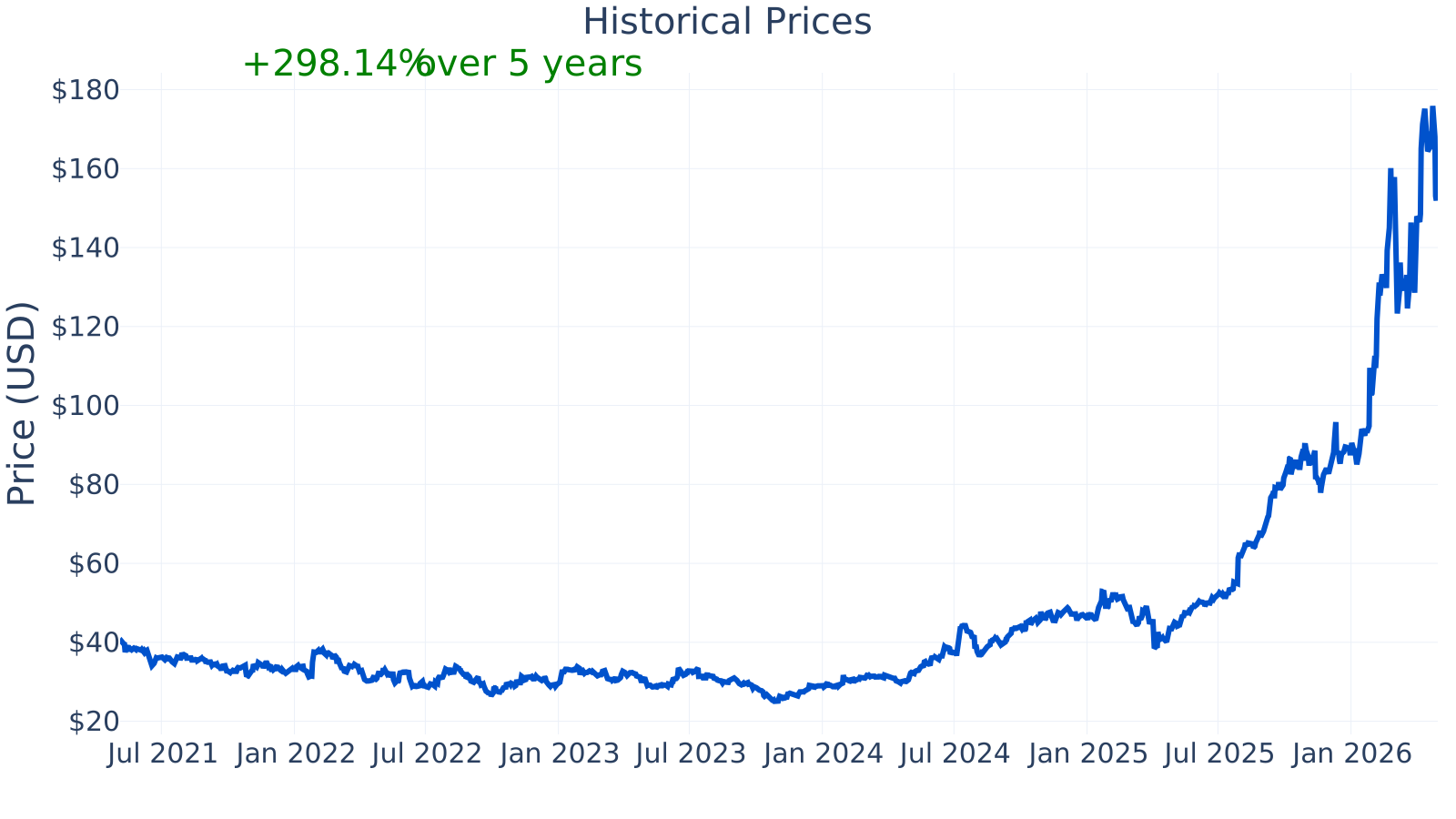
For context, the stock price trend has increased sharply into 2026, while earnings-based multiples have also risen, which suggests that price appreciation has outpaced (or at least moved ahead of) the recent earnings level. The PEG ratio near 1.76 indicates that, when combining valuation with growth expectations, the valuation still embeds meaningful assumptions about future performance. Whether that valuation is “justified” will largely depend on how durable the revenue rebound is, whether margins stay closer to recent improved levels, and how effectively Corning manages its balance sheet through cycles.
Conclusion
Corning is a long-established specialty materials and manufacturing company with products tied to major technology and industrial systems: communications networks, consumer devices, displays, emissions control, and laboratory research. The business shows clear cyclical behavior, with revenue and margins weakening in the 2022–2024 period and improving into 2025–2026, alongside a recovery in free cash flow.
The main long-term strengths are its R&D intensity, specialized manufacturing capabilities, and entrenched positions in specific applications where performance and reliability matter. The main areas to watch are the combination of earnings volatility (margins have swung widely), leverage (debt-to-equity above the industry median), and valuation sensitivity (a P/E ratio well above the industry median). Taken together, the facts point to a company with meaningful technology-driven opportunities but also a results profile that can change materially across industry cycles.
Sources:
- Corning Incorporated — Annual Report on Form 10-K (SEC EDGAR)
- Corning Incorporated — Quarterly Reports on Form 10-Q (SEC EDGAR)
- Corning Incorporated — Investor Relations materials (business segments and company descriptions)
- Wikipedia — “Corning Incorporated” (basic company background)
This article is for informational purposes only and does not constitute financial advice. Some content is AI-generated. See Disclaimer


