Stock Analysis · CoreWeave Inc (CRWV)
Overview
CoreWeave Inc. (CRWV) provides cloud computing infrastructure designed for high-performance workloads, with a major focus on artificial intelligence. In simple terms, it operates large data centers filled with advanced chips (often GPUs) and rents that computing power to customers that need to train AI models or run AI applications at scale. The company positions itself as a specialized “AI cloud” provider, which differs from general-purpose cloud services by optimizing hardware, networking, and software for AI-heavy tasks.
CoreWeave’s revenue is primarily generated by selling access to its computing infrastructure and related services. Based on the company’s filings, the business is commonly described around a single major revenue stream (compute infrastructure / cloud services), with detail typically broken down more by customer concentration and contract structure than by many separate product categories. When a clearer split is not provided in filings, it is generally most accurate to describe the sources at a high level as:
- Compute / cloud infrastructure services (primary revenue stream) — providing GPU-accelerated compute capacity and associated platform services.
- Related services tied to operating that infrastructure — such as storage, data transfer/networking, and managed elements that support the core compute offering (often bundled with compute in contracts).
The key operational idea is straightforward: demand for AI compute rises, CoreWeave builds (or leases) the infrastructure needed to supply it, and customers pay for usage and/or contracted capacity over time.
From 2022 to 2025, the company’s revenue scaled sharply (from about $15.8M in 2022 to about $5.13B in 2025). Over the same period, operating costs also expanded quickly. By 2025, operating income turned slightly positive (about $14M), but net income remained negative (about -$1.17B), with interest expense (about $1.23B in 2025) standing out as a major drag on overall profitability.
Key Figures
| Metric | Value | Industry ⓘ |
|---|---|---|
| Date | Apr 27, 2026 | |
| Context | ||
| Sector | Technology | |
| Industry | Software - Infrastructure | |
| Market Cap ⓘ | $58.18B | |
| Beta ⓘ | N/A | |
| Fundamental | ||
| P/E Ratio ⓘ | N/A | 29.35 |
| Profit Margin ⓘ | -22.74% | 6.83% |
| Revenue Growth ⓘ | 110.40% | 14.85% |
| Debt to Equity ⓘ | 454.48% | 24.49% |
| PEG ⓘ | N/A | |
| Free Cash Flow ⓘ | -$7.25B | |
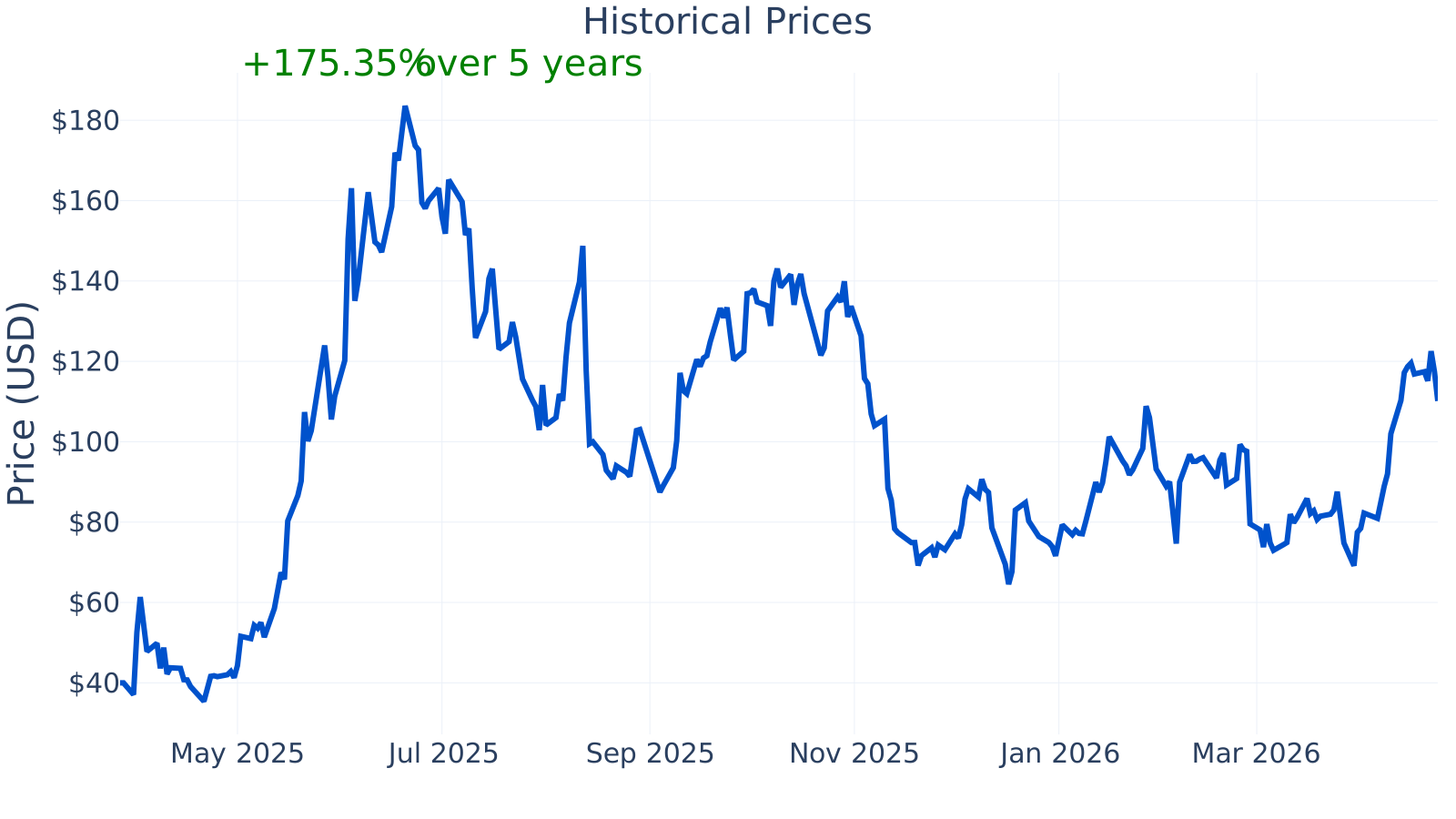
CoreWeave’s market capitalization is about $58.2B. The company shows very fast revenue growth (about 110% year-over-year), far above the industry median (about 15%). At the same time, profitability is currently weak: profit margin is about -22.7% versus an industry median near +6.8%. Free cash flow over the trailing twelve months is about -$7.25B, indicating the business is consuming substantial cash, which is typical of an infrastructure build-out phase but still financially important. Leverage is also very high, with debt-to-equity around 454% compared with an industry median around 24%.
Growth (High)
CoreWeave operates in a part of technology infrastructure that has been expanding quickly: computing capacity for AI training and inference. The basic driver is that more AI models and AI-enabled products require large amounts of specialized compute, and that demand can rise faster than general IT spending when AI adoption accelerates. This industry backdrop can support strong growth for providers that can secure hardware supply, deploy data centers efficiently, and sign sizable multi-year customer commitments.
The year-over-year revenue growth trend remains very high, but it has been decelerating over the periods shown (from roughly 420% to about 110%). That pattern is common when a company moves from an early, smaller base to a much larger revenue scale; however, it also raises the question of how sustainable future growth rates are once the “easy” scaling phase passes.
Free cash flow is deeply negative (around -$7.6B to -$8.1B across the periods shown). For an AI infrastructure provider, negative free cash flow can reflect heavy spending on equipment and data center capacity, but it also means the company may depend on continued access to financing (debt and/or equity) and on meeting utilization and pricing assumptions as that capacity ramps.
Potential catalysts for the business model typically come from (1) expanding availability of high-demand chips, enabling capacity growth, (2) additional large customer wins or contract expansions, and (3) improving unit economics as deployed infrastructure reaches higher utilization levels.
Risks (Very High)
CoreWeave’s most visible risks relate to leverage, cash usage, and the pace of AI infrastructure demand. Building and operating large-scale compute capacity is capital-intensive, and the company’s financial profile indicates substantial reliance on funding and meaningful ongoing costs to support rapid expansion.
Debt-to-equity is extremely elevated (about 454% at the latest point shown) versus an industry median near 24%. This level of leverage can increase sensitivity to interest rates, refinancing conditions, and any mismatch between expected customer demand and actual utilization of deployed capacity. It can also limit flexibility if the market environment shifts or if technology cycles change faster than anticipated.
Profit margins are negative across the periods shown, improving from roughly -38.7% to around -22.7%, while the industry median is positive and trending around mid-single digits. This suggests the company is still working through the cost structure of rapid scaling (including depreciation, operating costs, and financing costs). Even if operating income improves, net results may remain pressured if financing costs stay high.
Competition risk is also significant. CoreWeave operates alongside much larger cloud providers and specialized compute-focused firms. Large competitors can include major hyperscale cloud platforms that offer AI compute as part of broad cloud ecosystems, as well as other GPU cloud specialists. Relative positioning often comes down to availability of capacity, performance, total cost for customers, contract terms, and speed of deployment. While specialization can be a competitive advantage (optimizing specifically for AI workloads), larger rivals may have advantages in scale, balance sheet strength, global data center footprint, and the ability to bundle services (compute, storage, databases, and enterprise tools).
Additional long-term risks include customer concentration (if a small number of customers drive a large share of revenue), supply chain constraints for advanced chips, rapid shifts in AI hardware (new generations making older equipment less competitive), and regulatory or energy-related constraints affecting data center operations.
Valuation
A traditional price-to-earnings (P/E) comparison is not very informative here because the company is currently loss-making (the P/E values shown are effectively not meaningful), while the industry median P/E is around the high-20s to low-30s. In these situations, valuation discussions often rely more on factors like revenue scale and growth, gross margin and operating leverage trajectory, cash burn, and balance-sheet risk rather than earnings-based multiples.
With a market capitalization around $58.2B alongside rapid growth but also negative margins, large negative free cash flow, and very high leverage, the market’s valuation implicitly depends on expectations that the company can (1) keep scaling revenue, (2) improve profitability as infrastructure utilization rises, and (3) manage financing needs without unacceptable dilution or refinancing stress. Whether the current price is “expensive” cannot be concluded from earnings-based metrics alone; it hinges mainly on the durability of demand and the company’s ability to convert growth into sustainable cash generation while operating with substantial debt.
Conclusion
CoreWeave is positioned in a fast-growing area of technology infrastructure tied to AI computing demand, and it has demonstrated exceptional revenue expansion over the last several years. At the same time, the financial profile shown here highlights a company still in a heavy build-out phase: negative profit margins, very large cash outflows, and unusually high leverage compared with industry norms. The long-term story therefore centers on execution—keeping capacity highly utilized, sustaining strong customer demand, and translating scale into durable profitability and cash flow while managing debt costs and refinancing risk.
Sources:
- U.S. Securities and Exchange Commission (SEC) EDGAR — CoreWeave Inc. filings (Form 10-K, 10-Q, 8-K)
- CoreWeave Inc. Investor Relations — investor materials and press releases
- Wikipedia — “CoreWeave” (basic company background)
This article is for informational purposes only and does not constitute financial advice. Some content is AI-generated. See Disclaimer