Stock Analysis · Confluent Inc (CFLT)
Overview
Confluent Inc. is a software company focused on “data in motion”—helping organizations move information between applications and systems in real time. In simple terms, many businesses have data scattered across tools (websites, payment systems, inventory, customer support, analytics). Confluent’s products help connect these tools so events (like a purchase, a delivery update, or a fraud alert) can be shared quickly and reliably across the organization.
The company is closely associated with Apache Kafka, a widely used open-source technology for real-time data streaming. Confluent builds commercial products and managed cloud services around this approach, aiming to make it easier for enterprises to run streaming systems securely, at scale, and with less operational work.
Confluent primarily generates revenue from subscriptions to its software and cloud services. Based on how the company typically describes its business in filings, the main sources of revenue are generally:
- Confluent Cloud subscription revenue (usage-based and subscription spending on Confluent’s managed cloud offering)
- Confluent Platform subscription revenue (subscriptions for self-managed/enterprise software)
- Services and other revenue (professional services such as training and support, typically smaller than subscriptions)
The financial profile shown below also highlights a common pattern for growing software companies: strong revenue expansion and gross profit generation, paired with substantial ongoing spending on research and development and go-to-market functions.
Across 2021–2025, total revenue rose from about $388M to about $1.17B, while gross profit increased from about $251M to about $867M. Over the same period, operating losses narrowed (still negative), reflecting that spending on R&D and sales/marketing remains significant as the company scales.
Key Figures
| Metric | Value | Industry ⓘ |
|---|---|---|
| Date | May 04, 2026 | |
| Context | ||
| Sector | Technology | |
| Industry | Software - Infrastructure | |
| Market Cap ⓘ | $11.13B | |
| Beta ⓘ | 0.95 | |
| Fundamental | ||
| P/E Ratio ⓘ | N/A | 29.58 |
| Profit Margin ⓘ | -25.31% | 6.71% |
| Revenue Growth ⓘ | 20.50% | 18.30% |
| Debt to Equity ⓘ | 94.55% | 24.92% |
| PEG ⓘ | 2.16 | |
| Free Cash Flow ⓘ | $50.46M | |
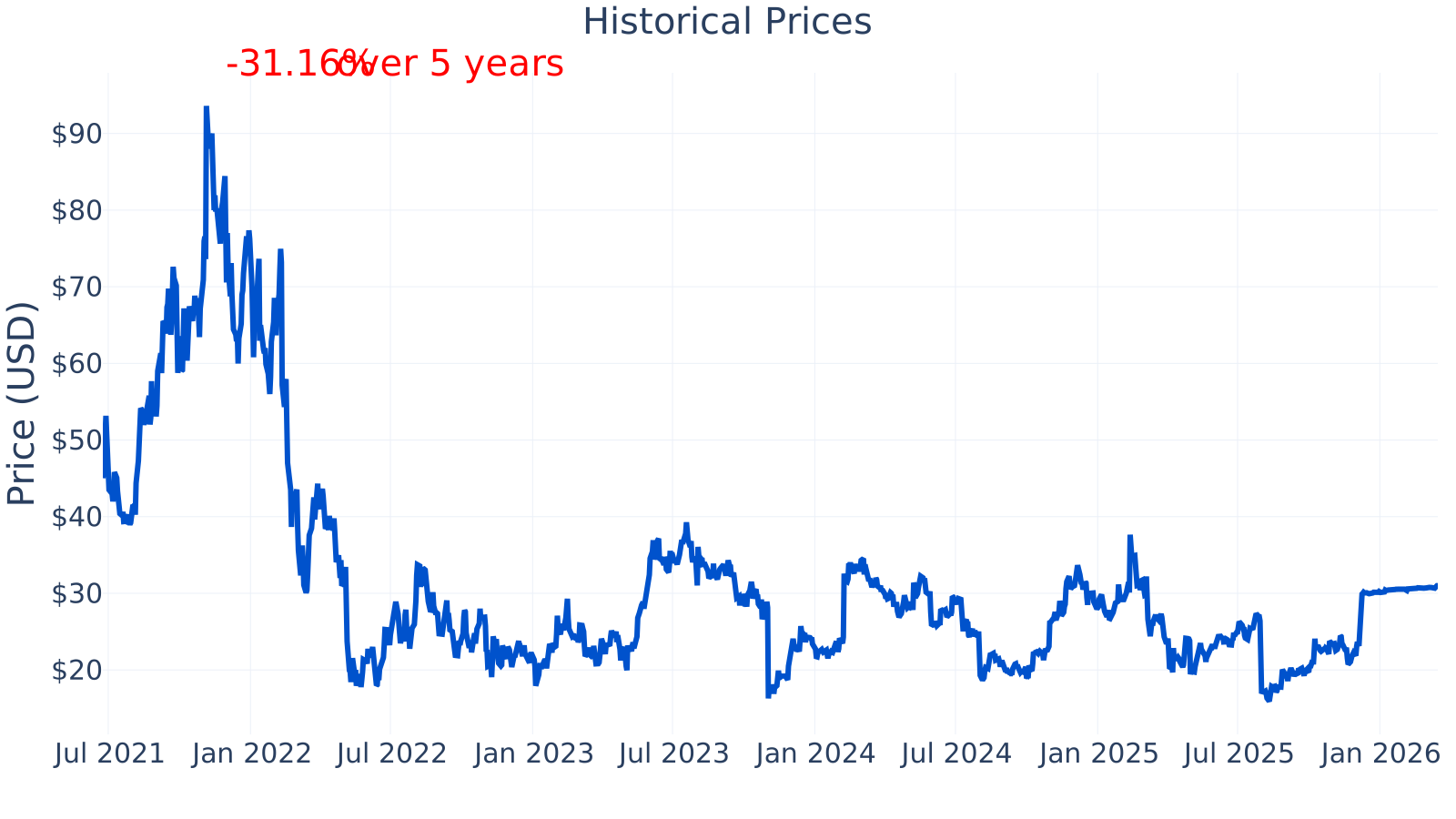
Confluent’s market capitalization is about $11.1B, and its beta is about 0.95, which suggests the stock has recently moved broadly in line with the overall market (though individual periods can vary). Profitability remains negative with a latest profit margin of about -25.3% versus an industry median near +6.7%. Growth is still solid: revenue growth year over year is about 20.5% (industry median about 18.3%). Leverage is higher than the typical peer set, with debt-to-equity around 94.5% versus an industry median near 24.9%. Free cash flow over the trailing twelve months is about $50.5M, indicating cash generation has recently turned positive even while accounting earnings remain negative.
Growth (medium)
Confluent operates in the broader infrastructure software market, where companies invest in systems that help applications share information, integrate with each other, and support real-time experiences. This theme is tied to long-running trends such as cloud adoption, digitization of business operations, and increased demand for real-time analytics and automation.
From a strategy perspective, Confluent’s mix of a managed cloud offering and enterprise subscriptions is designed to meet customers where they run workloads (public cloud and hybrid environments). A managed service can be a meaningful growth driver because it reduces the operational burden for customers and can expand with usage over time, though it also introduces variability tied to consumption patterns.
The year-over-year revenue growth rate has cooled from very high levels earlier in the period (above 70% in late 2021) to roughly 20% most recently. This pattern is common as a company scales: growing from a larger base typically makes it harder to keep extremely high percentages. Even so, growth around the low-20% range remains above the industry median shown in the comparison.
Free cash flow improved substantially over time, moving from negative levels (around -$109M in 2021 and about -$196M in 2023) to slightly positive by early 2025, and most recently about $50M on a trailing twelve-month basis. For long-term business durability, this direction matters because it suggests the company is progressing toward funding more of its operations through internally generated cash rather than relying primarily on external financing.
Potential catalysts, as described in typical company strategy discussions, generally relate to: increased enterprise adoption of real-time data architectures, more workloads moving to managed cloud services, and expanded product capabilities that make streaming easier to govern, secure, and integrate across an organization.
Risks (high)
A key risk is that Confluent is still not profitable on a net income basis. While operating losses have narrowed compared with earlier periods, the company continues to invest heavily in product development and customer acquisition. If revenue growth slows further or spending remains elevated, the timeline to sustained profitability could extend.
Profit margin has improved materially from very negative levels (around -88% in late 2021) to about -25% most recently, but it remains below the industry median (around +6.7%). This gap highlights that peers, on average, have reached stronger profitability, while Confluent is still in a transition phase.
Leverage is another consideration. Debt-to-equity has trended down from levels above 100% earlier in the period to about 94.5% most recently, but it remains well above the industry median (roughly 24.5%). Higher leverage can reduce flexibility during weaker demand periods, particularly for companies that are still building consistent profitability.
Competition is meaningful in infrastructure software. Confluent competes with:
- Managed streaming and event services from major cloud providers (which can be bundled with broader cloud contracts)
- Other data integration and messaging platforms that support event-driven architectures
- Open-source and self-managed alternatives (including teams running Kafka directly without a commercial platform)
Confluent’s competitive position is often described around its deep specialization in streaming, its product ecosystem built around Kafka, and the operational convenience of its managed cloud service. However, large platform vendors can compete aggressively using pricing, bundling, and existing enterprise relationships. Another structural risk is that open-source technologies can limit pricing power if customers decide to self-manage rather than pay for a managed or enterprise offering.
Valuation
A traditional price-to-earnings (P/E) ratio is not meaningful here because Confluent’s earnings are negative, and the P/E values are therefore shown as 0 on the chart. In these cases, market participants often rely more on revenue growth, cash flow trends, and operating margin progress rather than earnings-based multiples.
One available valuation-related metric is the PEG ratio, shown around 2.16. PEG attempts to relate valuation to growth, but it can be sensitive to assumptions about future growth and profitability, especially for a company still reporting net losses. As a result, valuation discussion tends to hinge on whether Confluent can sustain above-industry growth while continuing to improve cash generation and margins over time.
Conclusion
Confluent is a growing infrastructure software company centered on real-time data streaming, with revenue expanding to roughly $1.17B by 2025 and improving free cash flow that has recently turned positive. Growth has moderated compared with earlier years, but it remains slightly above the industry median shown, and profitability metrics have improved meaningfully even though they remain negative.
The main trade-offs visible in the fundamentals are clear: the business is scaling and improving cash flow, but it still operates at a net loss, faces strong competition (including large cloud platforms and open-source alternatives), and carries higher leverage than the typical peer group. How these factors evolve—especially the path to durable profitability and the ability to defend differentiation—will likely be central to assessing long-term outcomes.
Sources:
- U.S. SEC EDGAR — Confluent Inc. filings (Form 10-K, Form 10-Q)
- Confluent Investor Relations — Shareholder materials and press releases (as published by the company)
- Wikipedia — “Confluent, Inc.” (basic company background)
This article is for informational purposes only and does not constitute financial advice. Some content is AI-generated. See Disclaimer


