Stock Analysis · Confluent Inc (CFLT)
Overview
Confluent Inc. is a software company focused on “data streaming,” which is a way for organizations to move and process information continuously in real time instead of in large batches. In practical terms, this supports everyday digital experiences such as fraud detection, customer personalization, logistics tracking, and system monitoring—where companies want information to flow quickly and reliably between applications.
Confluent commercializes technology built around Apache Kafka, a widely used open-source project for streaming data. The company provides an enterprise-ready platform that aims to make Kafka easier to deploy, connect, govern, secure, and operate at scale across cloud and on‑premises environments. Confluent’s offering is commonly delivered as a cloud service, which can reduce the operational burden for customers compared with running complex infrastructure themselves.
Revenue is primarily generated from providing its platform and related services to customers. In company filings, Confluent generally discusses revenue in broad categories rather than a detailed multi-product percentage breakdown. At a high level, the main sources are typically described as:
- Subscription revenue (ongoing access to Confluent’s platform, including cloud and software subscriptions)
- Services revenue (professional services such as training and consulting)
Subscription revenue is generally the larger component, with services revenue usually a smaller share, based on how the company describes its model in SEC filings.
Over the years shown, revenue rises steadily, and gross profit grows with it. At the same time, operating expenses remain high—particularly research and development and selling/general/administrative costs—which helps explain why operating income and net income remain negative despite improving scale.
Key Figures
| Metric | Value | Industry ⓘ |
|---|---|---|
| Date | Feb 16, 2026 | |
| Context | ||
| Sector | Technology | |
| Industry | Software - Infrastructure | |
| Market Cap ⓘ | $10.93B | |
| Beta ⓘ | 0.95 | |
| Fundamental | ||
| P/E Ratio ⓘ | N/A | 25.13 |
| Profit Margin ⓘ | -25.31% | 6.91% |
| Revenue Growth ⓘ | 20.50% | 15.25% |
| Debt to Equity ⓘ | 94.55% | 19.82% |
| PEG ⓘ | 2.15 | |
| Free Cash Flow ⓘ | $50.46M | |
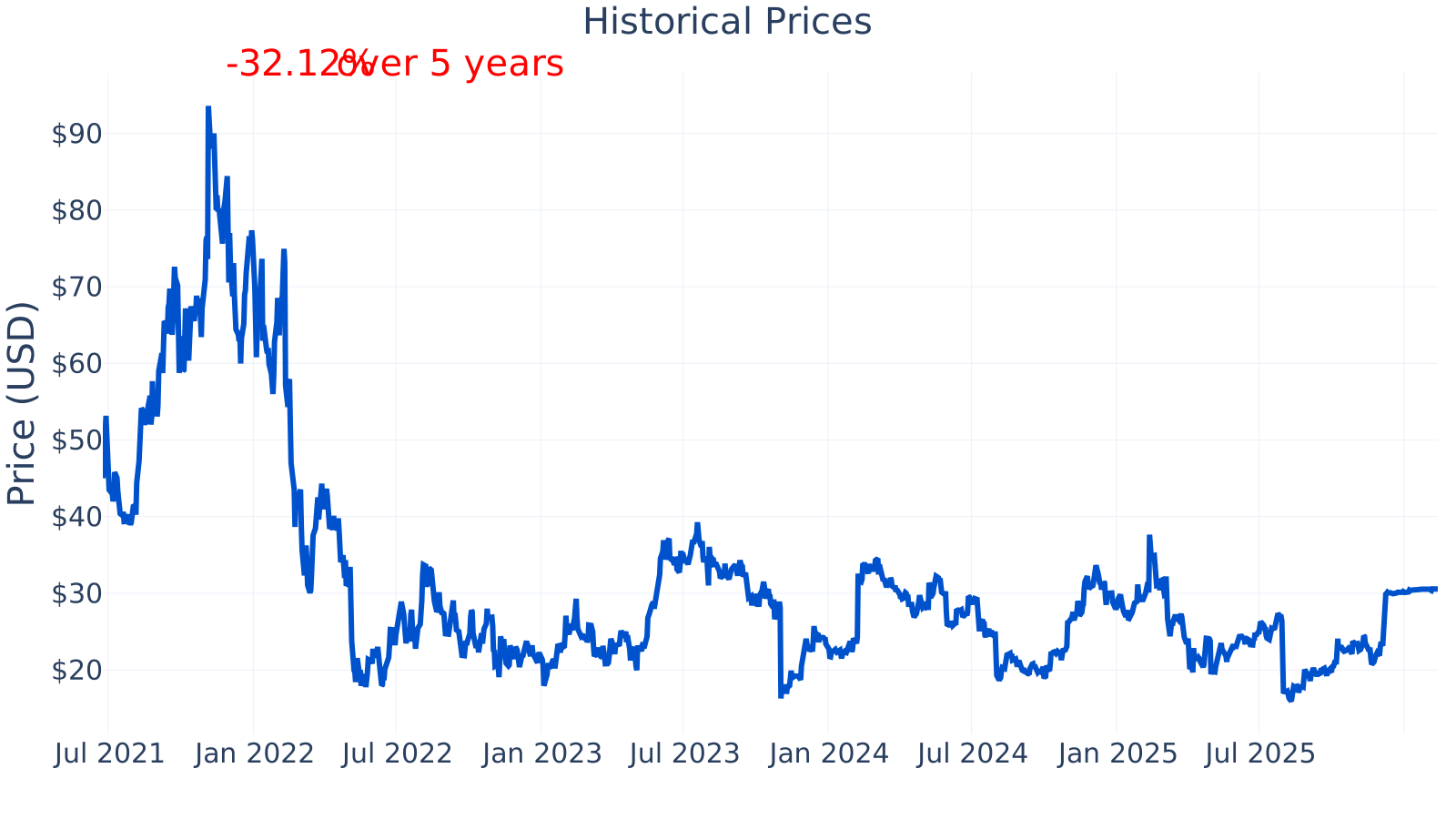
Confluent’s market capitalization is about $10.9B, placing it in the mid-cap range. The stock’s beta of ~0.95 suggests price moves have been roughly in line with the broader market on average (though individual periods can vary a lot).
Profitability remains a central point to track: the latest profit margin is about -25.3%, while the industry median shown is about +6.9%. On growth, Confluent’s latest year-over-year revenue growth is ~20.5%, above the industry median of about 15.3%. The latest debt-to-equity is ~94.5%, notably higher than the industry median near 19.8%. Free cash flow over the trailing twelve months is about $50.5M, indicating the business has recently been able to generate cash even while reporting accounting losses.
Growth (Medium)
Confluent operates in software infrastructure, where long-term demand is linked to the ongoing shift toward cloud computing, more connected applications, and the need for faster, event-driven systems. As organizations modernize IT systems and build data products that react instantly (for example, detecting fraud as transactions happen), streaming architectures tend to become more important.
Strategically, Confluent’s positioning is built around simplifying and operating streaming systems reliably at scale. This can matter because “always-on” data flows are operationally demanding: performance, reliability, security, and governance issues can become complex as usage grows across teams and regions. A managed cloud offering can be a meaningful growth lever if customers prefer to outsource day-to-day operations while still using a Kafka-based approach.
The chart shows revenue growth slowing from very high rates earlier (above 50% in parts of 2021–2022) toward the ~20% range more recently. That pattern can be consistent with a company getting larger and operating in a more constrained enterprise spending environment, but it also means future results depend more on expanding within existing customers, landing larger deployments, and maintaining competitive differentiation.
Free cash flow has improved meaningfully over time, moving from negative levels to positive most recently (about $50.5M trailing twelve months). For long-term fundamentals, sustained positive free cash flow can reduce dependence on external financing and can indicate improving efficiency, though it should be interpreted alongside continued net losses and the drivers behind cash generation.
Risks (High)
This article is for informational purposes only and does not constitute financial advice. Some content is AI-generated. See Disclaimer


