Stock Analysis · Concentrix Corporation (CNXC)
Overview
Concentrix Corporation (CNXC) is a business services company that helps other organizations run and improve customer-facing operations. In practical terms, it provides customer support and customer experience (CX) services (such as contact centers and digital support), along with technology-enabled offerings like analytics, automation, and process optimization. Its clients are typically large companies that want to outsource parts of customer service, sales support, back-office processing, or digital customer journeys.
Concentrix’s revenue is primarily generated through long-term service contracts where it charges clients based on a mix of pricing methods (for example, per hour, per transaction, per agent seat, or outcome-based structures depending on the program). The company reports revenue by operating segments rather than giving a simple public “product revenue mix” breakdown across service lines, so an exact percentage split by service type is not consistently available in a single, comparable format across periods.
The company’s recent scale can be seen in how revenue flows through the income statement. From fiscal 2021 to fiscal 2024, total revenue increased from about $5.6B to about $9.6B, while costs and operating expenses also rose. Fiscal 2025 shows a sharp swing to operating loss and net loss, indicating a major deterioration in profitability that matters for long-term shareholders to understand (the filings provide the detailed drivers, including items such as impairment, restructuring, integration, and financing-related impacts).
Across fiscal 2021–2024, revenue expanded materially (to about $9.6B in fiscal 2024), but by fiscal 2025 operating income turned negative (about -$0.9B) and net income turned negative (about -$1.28B). Interest expense also increased over time (from about $23M in fiscal 2021 to roughly $290M in fiscal 2025), which can amplify the impact of weaker operating performance.
Key Figures
| Metric | Value | Industry ⓘ |
|---|---|---|
| Date | Apr 06, 2026 | |
| Context | ||
| Sector | Technology | |
| Industry | Information Technology Services | |
| Market Cap ⓘ | $1.66B | |
| Beta ⓘ | 0.50 | |
| Fundamental | ||
| P/E Ratio ⓘ | N/A | 17.80 |
| Profit Margin ⓘ | -13.34% | 5.35% |
| Revenue Growth ⓘ | 5.40% | 5.95% |
| Debt to Equity ⓘ | 170.18% | 52.83% |
| PEG ⓘ | 0.26 | |
| Free Cash Flow ⓘ | $484.56M | |
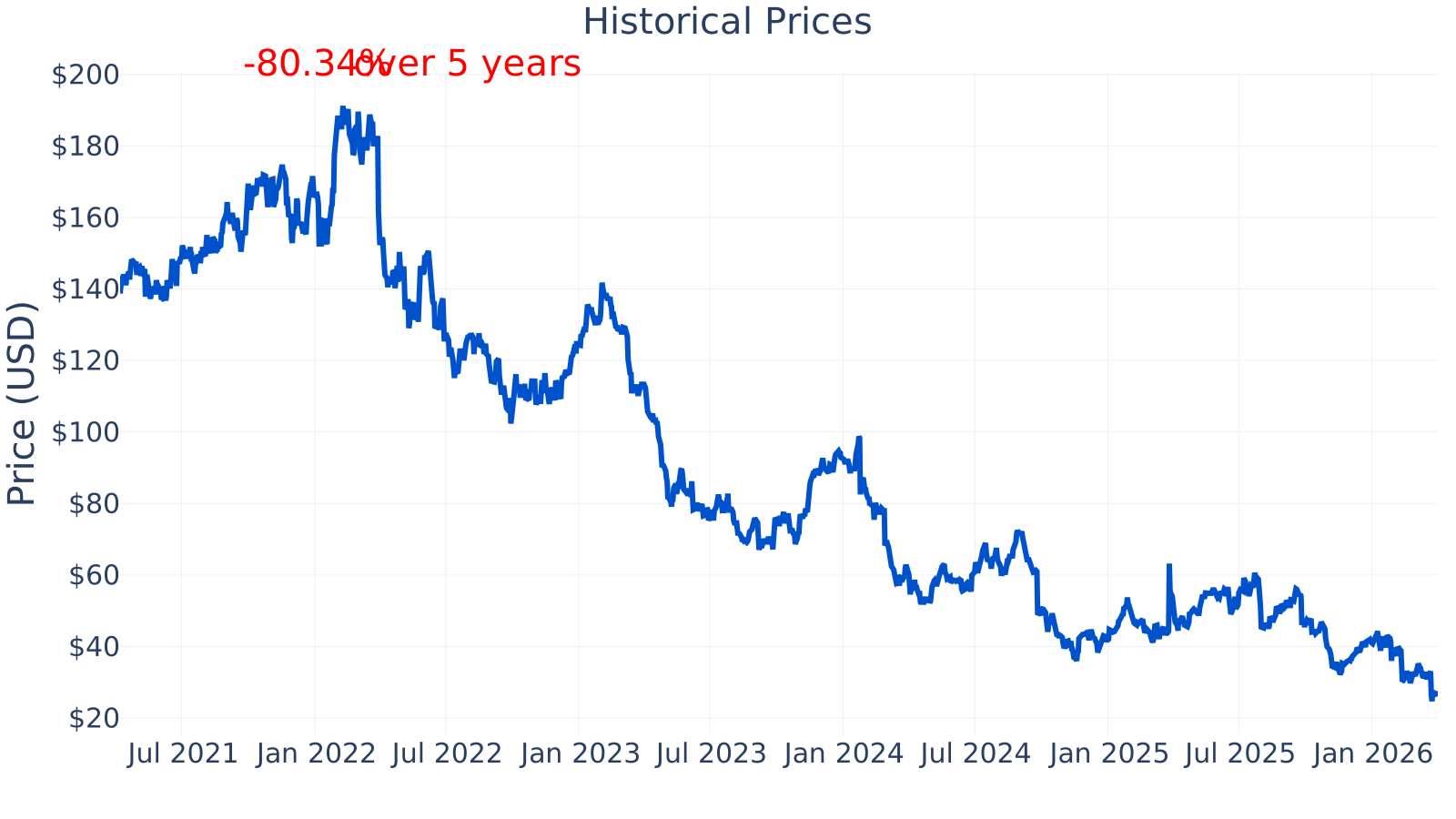
Concentrix’s market capitalization is about $1.66B, and the stock’s reported beta (~0.50) suggests it has historically moved less than the broader market on average (though company-specific events can still dominate outcomes). The company’s profit margin is -13.34%, which is well below the industry median of 5.35%, indicating current profitability is substantially weaker than many peers. Year-over-year revenue growth is about 5.40%, close to the industry median (~5.95%), while debt-to-equity is ~170% versus an industry median of ~53%, pointing to meaningfully higher leverage than the typical company in its comparison group. Despite these pressures, trailing twelve-month free cash flow is about $485M, showing the business is still generating cash after operating needs and capital spending.
Growth (Medium)
Concentrix operates in the broad market for outsourced customer experience and business process services, which has structural demand drivers: companies continuously try to reduce operating costs, improve service levels, add digital channels (chat, messaging, social), and use data and automation to handle higher volumes efficiently. These trends can support steady demand over long periods, especially for providers that can deliver at global scale and integrate technology with operations.
However, the growth profile in the recent numbers looks more mixed than a straightforward “high-growth” story. Revenue growth has slowed materially compared with earlier periods, and the latest year-over-year growth is in the mid-single digits. For long-term outcomes, the key question is less about whether the industry exists (it likely will) and more about whether Concentrix can convert scale into durable margins while managing labor, pricing, client concentration, and technology transitions.
The year-over-year revenue growth trend shows a deceleration from higher rates earlier in the period to more modest growth recently (about 5.4% at the latest point). There were also periods of unusually high growth that can occur around acquisitions or major contract expansions, followed by normalization.
Free cash flow has been positive across the periods shown, rising from about $277M (2021) to about $485M (latest). Positive free cash flow can help fund debt repayment, restructuring, technology investments, or selective acquisitions. That said, cash generation should be interpreted alongside profitability and financing costs, especially when margins have recently turned negative.
Risks (High)
The largest risk signal in the recent fundamentals is profitability. The company’s profit margin has moved from positive mid-single digits earlier in the timeline to negative in the latest period. This kind of swing often reflects a combination of operating pressures (pricing, wage inflation, utilization) and special charges (for example, restructuring or impairment) that can be large and lumpy. Even if some drivers are one-time, the magnitude matters because it can limit flexibility and change how the market values the business.
The margin trend shows a steady decline from roughly 5%–8% earlier in the period to near break-even and then to about -13% most recently, while the industry median stays positive. That widening gap suggests Concentrix-specific issues (or acquisition/integration effects) are weighing on results beyond what is typical for peers.
Leverage is another central risk. Higher debt can be manageable when earnings are stable, but it becomes more challenging when operating income drops and interest expense rises. The income statement flow also shows interest expense increasing over time, which can reduce net results even if operations stabilize.
Debt-to-equity increased from roughly 50%–60% earlier to about 170% recently, far above the industry median in the same periods. This implies greater sensitivity to refinancing conditions, interest rates, and covenant restrictions, and it raises the importance of consistent cash generation.
Competition is intense. Concentrix operates among large global business process outsourcing and CX providers and also competes with consulting/IT services firms and in-house client teams. Major competitors commonly include large CX outsourcing specialists and diversified IT/BPO providers such as Teleperformance, Foundever (Sitel Group), TTEC, TaskUs, and Genpact (competitive sets vary by client, geography, and service scope). In addition, automation and AI can be a two-sided competitive force: it can lower service delivery costs and create new offerings, but it can also reduce demand for traditional labor-based contact center work or shift pricing power toward clients and platform vendors.
Competitive advantages in this industry usually come from scale, global delivery footprint, deep client relationships, compliance and security capabilities, and execution in hiring/training across many locations. Concentrix is a significant player by revenue scale, but the recent profitability and leverage trends suggest execution and integration discipline are particularly important for maintaining an advantage over time.
Valuation
Traditional valuation ratios can become harder to interpret when earnings are depressed or negative. Concentrix’s P/E ratio series shows periods where the multiple is meaningfully below the industry median, but the most recent points are shown as zero because the P/E becomes non-meaningful when earnings turn negative (or when accounting earnings are heavily distorted by large charges). In those cases, investors often rely more on cash flow, debt metrics, and normalized earnings power than on the headline P/E.
Historically, Concentrix often traded at a lower P/E than the industry median (frequently in the low-to-mid teens versus an industry median commonly in the 20s). Recently, the P/E is not meaningful due to the earnings downturn, which makes comparisons less informative until profitability stabilizes. Given the combination of high leverage (relative to peers) and weakened margins, valuation discussions tend to hinge on whether earnings and margins can recover while free cash flow remains resilient enough to support the balance sheet.
Conclusion
Concentrix is a scaled provider of outsourced customer experience and related business services, operating in an industry with long-running demand drivers tied to cost optimization and digital customer engagement. The company has also demonstrated the ability to generate substantial free cash flow over time.
At the same time, the recent fundamental picture shows elevated uncertainty: profitability has deteriorated sharply into negative territory, leverage is high compared with industry norms, and interest expense has risen. These factors place greater weight on management’s ability to stabilize operations, protect cash generation, and reduce balance-sheet risk. For long-term shareholders, the core issue is whether the company can return to sustainable, peer-competitive profitability while maintaining enough financial flexibility to navigate client shifts and technology-driven change.
Sources:
- SEC EDGAR — Concentrix Corporation Form 10-K (Annual Report)
- SEC EDGAR — Concentrix Corporation Form 10-Q (Quarterly Report)
- Concentrix Investor Relations — Press Releases and SEC Filings archive
- Wikipedia — “Concentrix” (company background and history)
This article is for informational purposes only and does not constitute financial advice. Some content is AI-generated. See Disclaimer


