Stock Analysis · CommVault Systems Inc (CVLT)
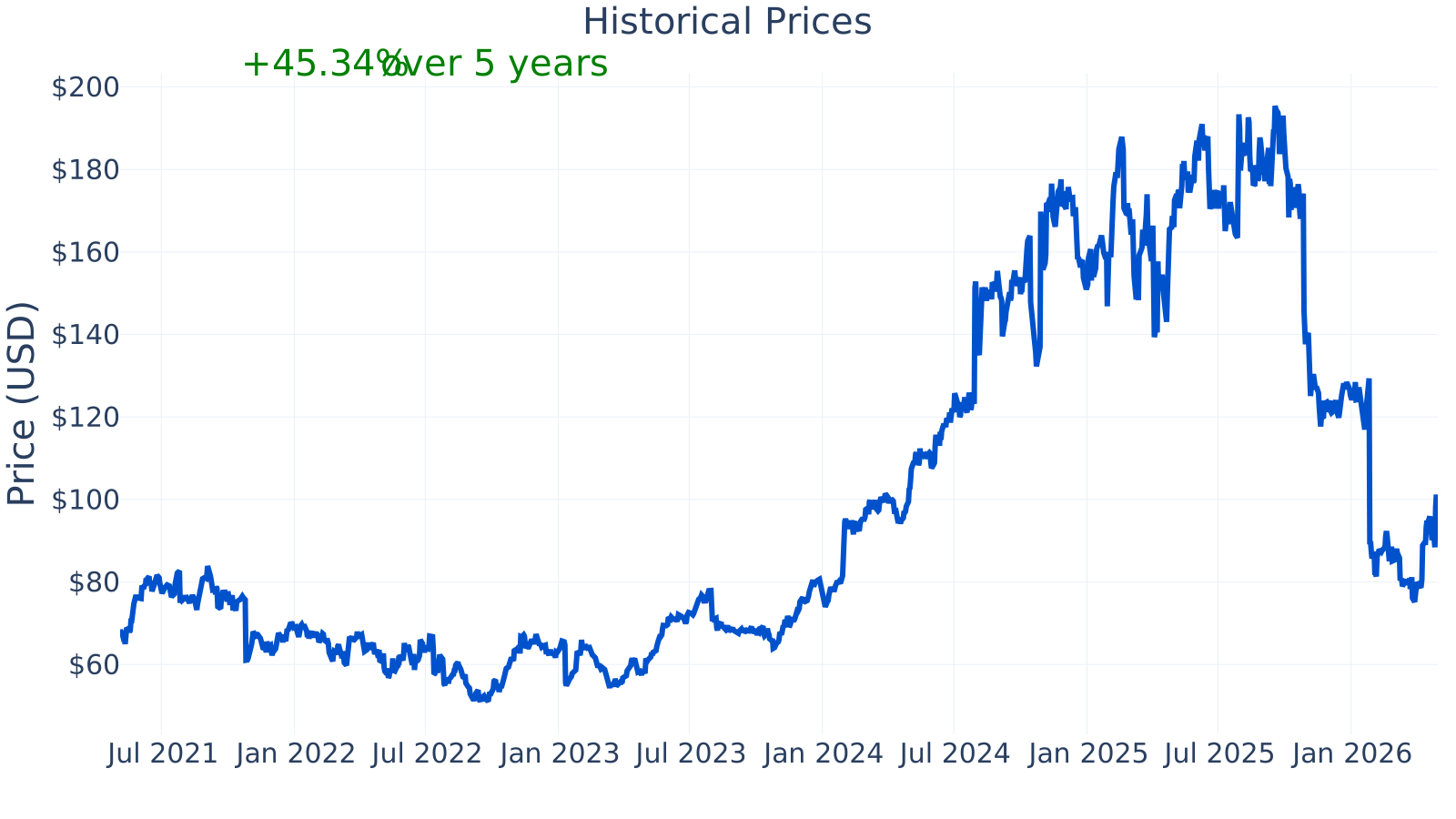
Overview
CommVault Systems, Inc. (CVLT) is a software company focused on protecting and managing business data. In simple terms, it helps organizations back up their information, recover it after accidents or cyberattacks (including ransomware), and move or manage data across different environments such as on-premises data centers and public cloud providers. Its products are generally used by mid-sized to large organizations that need reliable data protection, compliance, and operational continuity.
CommVault’s business model is built around selling software and related services that keep customer data available and safe. Over time, many software companies (including CommVault) have been shifting toward more recurring revenue (for example, subscriptions) rather than one-time licenses, because that can make revenue more predictable and better aligned with ongoing product updates and customer support.
Public filings typically break revenue into broad categories such as software subscriptions/licenses and services (including maintenance/support and professional services). Exact percentages vary by fiscal year and are best verified in the most recent annual report.
Over the last several fiscal years shown, total revenue increased from about $770M (FY2022) to about $1.18B (FY2026), while gross profit also increased (about $656M to about $950M). Operating income improved versus earlier periods, though operating expenses (including R&D and selling/general/administrative costs) also rose as the business scaled.
Key Figures
| Metric | Value | Industry ⓘ |
|---|---|---|
| Date | May 04, 2026 | |
| Context | ||
| Sector | Technology | |
| Industry | Software - Application | |
| Market Cap ⓘ | $4.38B | |
| Beta ⓘ | 0.62 | |
| Fundamental | ||
| P/E Ratio ⓘ | 63.02 | 26.40 |
| Profit Margin ⓘ | 5.97% | 7.95% |
| Revenue Growth ⓘ | 13.30% | 15.60% |
| Debt to Equity ⓘ | 12243.14% | 27.14% |
| PEG ⓘ | 3.17 | |
| Free Cash Flow ⓘ | $237.15M | |
CommVault’s market capitalization is about $4.38B, and the stock’s beta (~0.62) suggests it has tended to move less than the overall market. The latest P/E ratio (~63.0) is above the industry median (~26.4), which often implies higher expectations embedded in the price, lower current earnings, or both.
Profitability, as measured by profit margin (~6.0%), is below the industry median (~8.0%) in the latest period shown. Revenue growth year-over-year is about 13.3%, slightly below the industry median (~15.6%). Free cash flow over the trailing twelve months is approximately $237M, which indicates the business has been generating cash after operating costs and capital spending.
Growth (medium)
CommVault operates in the data protection and cyber resilience segment of enterprise software. The long-term drivers are generally structural: data volumes continue to expand, companies rely more on cloud infrastructure, and ransomware and other cyber risks keep data backup and recovery high on IT priority lists. These conditions tend to support ongoing demand for backup, disaster recovery, and broader “resilience” capabilities.
A strategy centered on recurring software revenue and cloud-compatible offerings can support steadier growth over time, especially when customers standardize on a platform for many years. In this type of software market, customer retention and expansion (selling more capabilities to existing customers) can be as important as new customer wins.
Revenue growth dipped into slightly negative territory around late 2022 and early 2023, then accelerated meaningfully through 2024 and 2025 before moderating to about 13% in the most recent period shown. For long-term readers, the main takeaway is that growth has not been linear, but the more recent trend shows a stronger run-rate than the earlier period.
Free cash flow increased from roughly $173M (2022) to about $237M (2026, trailing twelve months). For a software company, sustained and rising free cash flow can matter because it can fund product development, sales capacity, and balance-sheet flexibility without relying as much on external financing.
Risks (high)
CommVault operates in a competitive software category where customers can switch over time, and larger vendors may bundle data protection features into broader platforms. Pricing pressure, longer sales cycles, or customer consolidation can affect growth and margins. In addition, product execution matters: if the platform fails to keep up with new cloud architectures, security needs, or ease-of-use expectations, customers may move to alternatives.
Another key risk is profitability consistency. Profit margins in the time series shown swung from negative in parts of 2023 to very strong in 2024, then normalized lower again afterward. That variability can happen due to one-time items, changes in spending, or shifts in revenue mix, but it still increases uncertainty when trying to extrapolate long-term earnings power.
The latest debt-to-equity value shown is unusually high (~12,243%) versus the industry median (~27%), after being much lower in prior periods. This kind of sudden change often reflects balance-sheet mechanics (for example, equity moving lower) rather than only “more borrowing,” and it is important to verify the underlying cause in the most recent 10-K/10-Q (debt levels, share repurchases, accumulated deficits, or accounting changes). Regardless of the cause, an extreme ratio is a flag that warrants closer reading of the balance sheet and footnotes.
Profit margin improved sharply in 2024 (around 18–20% in several quarters shown) and then cooled to about 6% most recently, below the industry median. If margins stay closer to the recent lower level, it can make the valuation more sensitive to growth assumptions.
Competitive positioning is also a risk factor. CommVault is a recognized provider in enterprise backup and recovery, but it competes with multiple well-known vendors and approaches, including large platform companies and specialists. Commonly cited competitors in this space include Veritas, Veeam, Dell Technologies, IBM, Rubrik, and cloud-provider native tools. In markets like data protection, “leadership” is often fragmented by customer size, deployment preference (on-prem vs. cloud), and specific features (ransomware recovery, immutability, compliance), so competitive advantage tends to come from product breadth, reliability, integrations, and long-term customer trust rather than a single dominant share leader.
Valuation
The P/E ratio shown has been volatile over time, with several periods not displayed (set to 0 on the chart) due to unusually high or non-meaningful values. More recently, the company’s P/E has often been above the industry median (for example, around 45.4 for the latest point shown vs. an industry median around 31.8), while the latest metric table lists a current P/E around 63.0. When a company trades at a higher P/E than peers, the market is typically embedding expectations for better future performance (such as faster growth, higher future margins, or durability of cash flows).
At the same time, the latest profit margin is below the industry median and revenue growth is also slightly below the industry median in the table. That combination can create a “tension” in the valuation narrative: a higher multiple alongside operating metrics that are not currently leading the peer group. How justified the valuation is depends on factors not captured by a single period—such as recurring revenue quality, customer retention, the drivers behind margin normalization, and whether the business can sustain mid-teens growth while maintaining strong cash generation.
Conclusion
CommVault is a data protection software company positioned in a category with durable long-term demand drivers, including expanding data volumes, cloud adoption, and persistent cybersecurity threats. Recent years show higher revenue levels and rising free cash flow, alongside periods of improved operating income.
However, the record also shows meaningful variability in profit margins and an unusually high latest debt-to-equity figure that stands out versus both the company’s own history and the industry median, making balance-sheet details especially important to review in SEC filings. On valuation, the stock has recently carried a higher earnings multiple than the typical peer, which implies the market is assigning significant value to future performance.
Sources:
- SEC EDGAR — CommVault Systems, Inc. Form 10-K (Annual Report)
- SEC EDGAR — CommVault Systems, Inc. Form 10-Q (Quarterly Reports)
- Commvault Investor Relations — SEC Filings & Annual Reports
- Wikipedia — “Commvault” (company overview and history)
This article is for informational purposes only and does not constitute financial advice. Some content is AI-generated. See Disclaimer


