Stock Analysis · Columbia Sportswear Company (COLM)
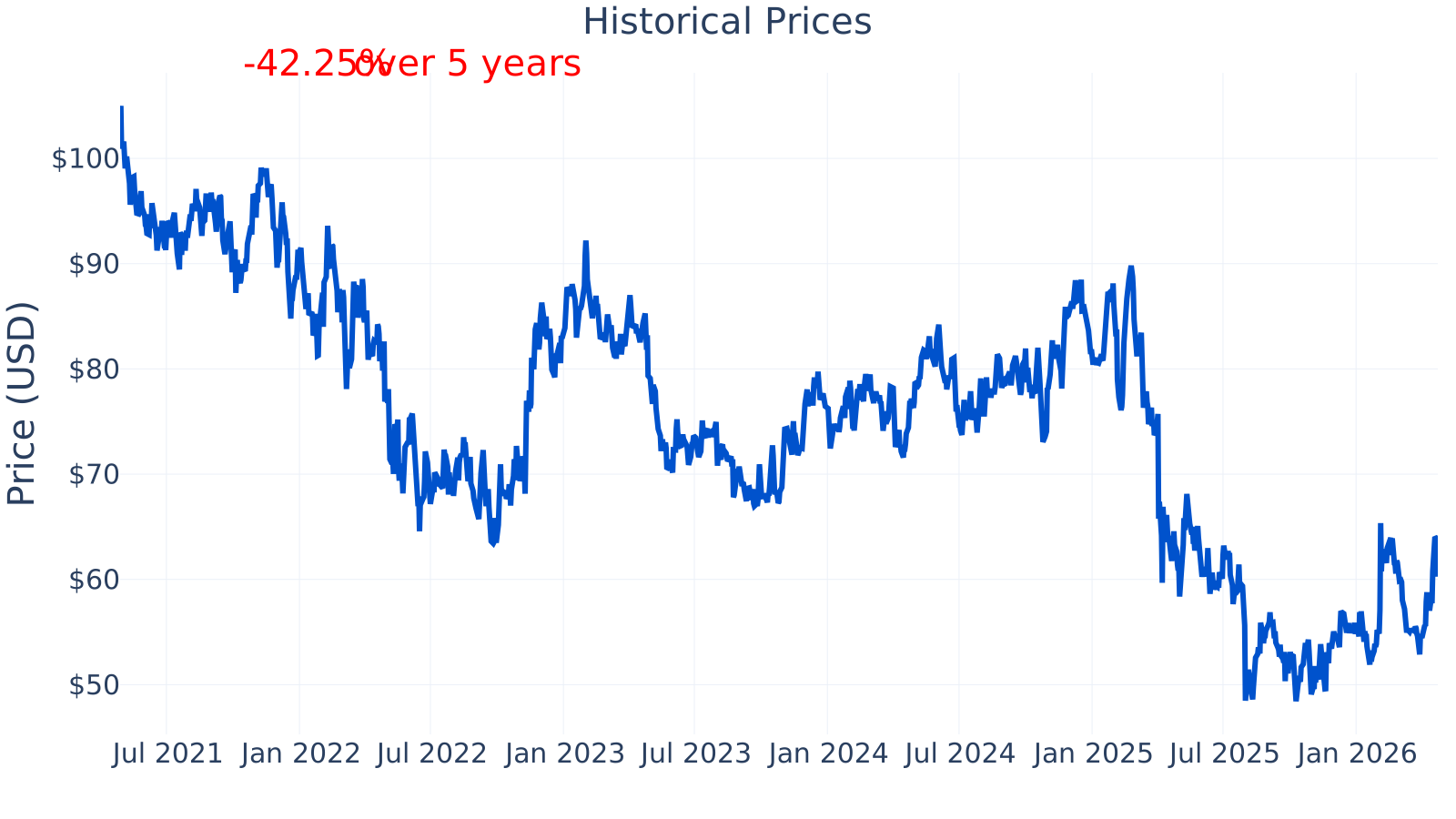
Overview
Columbia Sportswear Company is a global apparel and footwear business focused on outdoor and active lifestyles. It designs, sources, markets, and sells products such as jackets, fleeces, pants, hiking and trail footwear, and related accessories. The company sells through a mix of wholesale partners (such as sporting goods and department stores) and direct-to-consumer channels (brand websites and company-owned retail stores).
Columbia Sportswear operates a portfolio of brands that target different parts of the outdoor and active market. The best-known brand is Columbia, and the company also owns and markets other outdoor-focused brands such as SOREL, Mountain Hardwear, and prAna. Seasonality matters in this industry, with demand often influenced by weather patterns (for example, cold-weather outerwear seasons) and by broader consumer spending trends.
Main sources of revenue typically break down across brand families (and also by geography and distribution channel in company reporting). Based on the company’s business model, the core revenue drivers are:
- Columbia brand (largest contributor)
- SOREL
- Mountain Hardwear
- prAna
Percentages vary by year and are disclosed in company filings by brand, geography, and channel; those filings are the best place to confirm the latest mix.
Across the years shown, revenue has been broadly in the $3.1–$3.5 billion range, while profitability has trended downward from earlier highs: net income decreased from about $354 million (2021) to about $177 million (2025). A key swing factor visible here is operating expenses (including selling, general, and administrative spending), which rose meaningfully versus earlier years, putting pressure on operating income.
Key Figures
| Metric | Value | Industry ⓘ |
|---|---|---|
| Date | Apr 27, 2026 | |
| Context | ||
| Sector | Consumer Cyclical | |
| Industry | Apparel Manufacturing | |
| Market Cap ⓘ | $3.15B | |
| Beta ⓘ | 0.88 | |
| Fundamental | ||
| P/E Ratio ⓘ | 18.60 | 25.25 |
| Profit Margin ⓘ | 5.22% | 5.33% |
| Revenue Growth ⓘ | -2.40% | 8.90% |
| Debt to Equity ⓘ | 50.69% | 114.05% |
| PEG ⓘ | 2.19 | |
| Free Cash Flow ⓘ | $216.74M | |
Columbia Sportswear’s market capitalization is about $3.15B, placing it in the mid-cap range. The stock’s beta of ~0.88 suggests it has historically moved somewhat less than the overall market on average (though any single stock can still be volatile).
On valuation and profitability, the company’s P/E ratio is ~18.6, below the industry median shown (~25.3). Profit margin is about 5.22%, close to the industry median (~5.33%). Recent growth is weaker: year-over-year revenue growth is about -2.4%, while the industry median shown is positive (~8.9%).
On balance sheet leverage, debt-to-equity is about 50.7%, which is lower than the industry median shown (~114.1%). Free cash flow over the trailing twelve months is about $216.7M, indicating the business is currently generating cash after operating needs and capital spending.
Growth (Medium)
The outdoor apparel and footwear market is mature in many regions, but it can still grow over time through product innovation, international expansion, and a greater share of direct-to-consumer sales (which can strengthen brand control and often carries different margin dynamics than wholesale). For Columbia Sportswear specifically, long-term growth tends to depend on brand relevance, product performance and design, and disciplined execution in merchandising and inventory management.
A practical way to view recent momentum is revenue growth over time:
The trend shown includes periods of strong growth earlier in the period and more recent softness, including multiple quarters with negative year-over-year comparisons. This pattern is consistent with a company operating in a consumer category that can be sensitive to discretionary spending and promotional intensity, and where comparisons can become difficult after unusually strong demand periods.
Cash generation is another lens on durability, especially for a company that must manage inventory and seasonality:
Free cash flow has been positive across the points shown, but it has also been uneven (for example, very strong in 2024 compared with 2023 and then moderating afterward). In apparel businesses, free cash flow can swing with inventory builds and reductions, timing of payables, and shifts in promotions.
Potential catalysts, when they occur, are often operational rather than “one-time events”: improved inventory positioning (less discounting), better product assortments that resonate with consumers, expansion in selected international markets, and steady growth of direct-to-consumer channels.
Risks (Medium)
Columbia Sportswear operates in a highly competitive consumer category where brand heat can change quickly, retailers can reduce orders, and promotions can rise sharply if too much inventory builds up across the industry. Demand is also influenced by weather and by consumer spending patterns, making results more cyclical than essential-goods businesses.
Competition is intense across outdoor and athletic apparel and footwear. Key competitors include large global brands and specialized outdoor labels, such as The North Face (VF Corporation), Patagonia (private), and Arc’teryx (private), along with broader athletic brands (for example, Nike and adidas) that also compete for consumer attention and shelf space. Columbia Sportswear is a well-known brand in outdoor apparel, but it is not the dominant leader across the entire global performance/athletic category; it competes more as a scaled specialist in outdoor and related segments.
Balance sheet leverage is often important in consumer cyclicals because downturns can pressure margins and working capital. The company’s leverage has historically been below the industry median, though it has risen recently:
The company’s debt-to-equity ratio increased to about 50.7% at the latest point shown, up from the low-20% range earlier in the period. Even after that increase, it remains below the industry median shown, which can matter if industry conditions weaken.
Profitability is another key risk area, because apparel companies can see margins compress quickly due to promotions, freight costs, and product mix:
The company’s profit margin has declined from double-digit levels earlier in the period to around 5.2% more recently, roughly in line with the industry median shown. This indicates that the business has recently operated with less cushion than in prior years, making execution (pricing discipline, inventory management, and expense control) more important.
Valuation
The current P/E ratio is about 18.6, which is below the industry median shown (~25.3). Historically, the company’s P/E has fluctuated meaningfully (with higher readings earlier in the period and lower readings more recently). A lower P/E can reflect a more modest growth outlook or higher perceived business uncertainty, but it can also reflect market expectations that profitability and growth may normalize.
To judge whether today’s valuation is “expensive” or “cheap” in a descriptive sense, it helps to weigh it against the company’s recent fundamentals. Recent revenue growth has been negative (about -2.4% year-over-year) and profit margin has compressed to about 5.2%. Those factors can help explain why the valuation multiple is not elevated versus the industry median. At the same time, positive free cash flow and below-median leverage are supportive fundamentals that can matter when comparing businesses within the same industry.
Conclusion
Columbia Sportswear is a long-established outdoor apparel and footwear company with a recognizable lead brand (Columbia) and additional niche brands. The business model is understandable—design and marketing of products sold through wholesale and direct-to-consumer channels—but results can vary with consumer demand, weather, retailer ordering patterns, and promotional cycles.
Recent fundamentals show mixed signals: revenue growth has been soft and profit margins have moved down versus earlier years, while free cash flow remains positive and leverage is still below the industry median despite a recent uptick. The valuation multiple (P/E) is below the industry median shown, which is consistent with the recent slowdown and margin pressure. Over a long horizon, the key swing factors to monitor are whether revenue growth re-accelerates, whether profitability stabilizes or improves, and whether the company keeps inventory and operating costs aligned with demand.
Sources:
- U.S. SEC EDGAR — Columbia Sportswear Company filings (Form 10-K, Form 10-Q)
- Columbia Sportswear Company — Investor Relations (Annual Report / Form 10-K materials)
- Wikipedia — “Columbia Sportswear” (basic company background)
This article is for informational purposes only and does not constitute financial advice. Some content is AI-generated. See Disclaimer


