Stock Analysis · Cohu Inc (COHU)
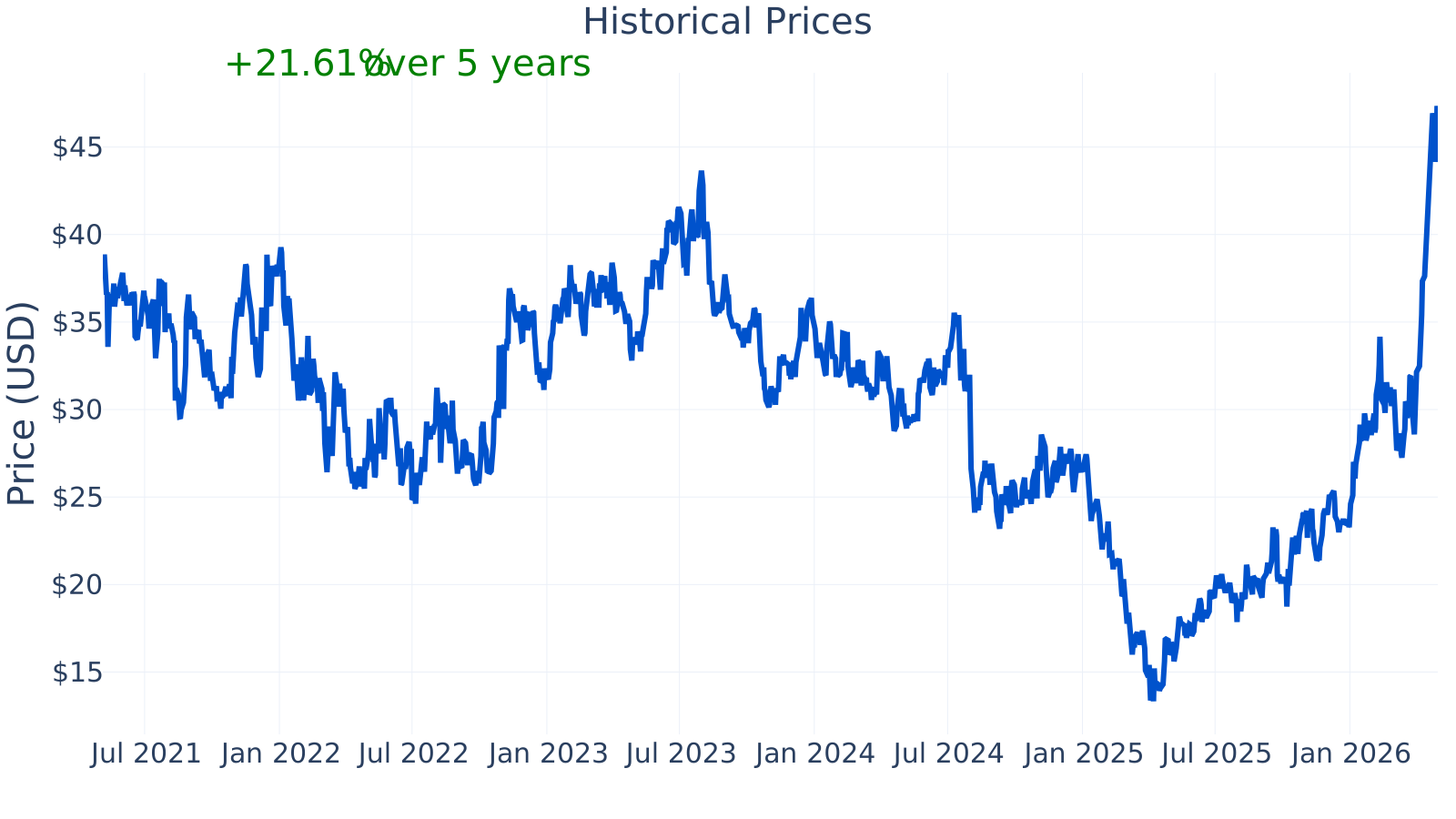
Overview
Cohu, Inc. is a semiconductor equipment company. In simple terms, it provides tools and services used to test and inspect computer chips (semiconductors) so manufacturers can check quality, reliability, and performance before chips are shipped into products such as smartphones, cars, industrial systems, and data centers. Because chip makers must test devices throughout the production process, demand for Cohu’s products tends to move with the broader semiconductor cycle (periods of expansion followed by slowdowns).
Cohu’s business is generally tied to capital spending and production needs across the semiconductor supply chain. Its offering typically includes test handling equipment (moving/positioning chips for testing), interface products (connecting chips to test systems), and inspection/metrology capabilities, plus related services and support. Over time, results can be influenced by customer concentration (a small number of large chip companies), the pace of new chip introductions, and how quickly customers ramp or pause factory investments.
Revenue breakdown by product line is typically disclosed in the company’s annual report/10-K (and may be organized by product groups and/or geography). Percentages are not included here because they are not provided in the information available in this prompt.
Across the last several years, total revenue declined from about $887M (2021) to about $453M (2025). Profitability also weakened: net income moved from a profit (about $167M in 2021) to losses (about -$70M to -$74M in 2024–2025). Over the same period, operating expenses stayed relatively elevated (roughly in the $216M–$260M range), meaning lower revenue translated quickly into operating losses.
Key Figures
| Metric | Value | Industry ⓘ |
|---|---|---|
| Date | May 04, 2026 | |
| Context | ||
| Sector | Technology | |
| Industry | Semiconductor Equipment & Materials | |
| Market Cap ⓘ | $2.15B | |
| Beta ⓘ | 1.24 | |
| Fundamental | ||
| P/E Ratio ⓘ | N/A | 48.78 |
| Profit Margin ⓘ | -11.54% | 8.18% |
| Revenue Growth ⓘ | 29.30% | 11.50% |
| Debt to Equity ⓘ | 40.81% | 26.74% |
| PEG ⓘ | 1.15 | |
| Free Cash Flow ⓘ | $10.73M | |
Cohu’s market capitalization is about $2.15B. The stock’s beta is about 1.24, which is commonly interpreted as meaning the share price has tended to move more than the broader market (up or down). The latest profit margin is about -11.5% versus an industry median around +8.2%, reflecting recent losses. On the other hand, the latest year-over-year revenue growth is about +29.3% versus an industry median around +11.5%, indicating a rebound from a weak period. Debt-to-equity is about 40.8% (industry median ~26.7%), suggesting more leverage than the typical peer in its industry group. Trailing twelve-month free cash flow is about $10.7M, which is positive but much lower than earlier periods shown.
Growth (Medium)
The company operates in the semiconductor equipment ecosystem, which is supported by long-term demand drivers such as increased chip content in vehicles and industrial equipment, continued computing needs, and ongoing complexity in chip manufacturing that requires robust testing. Even with these long-term drivers, the industry is cyclical: equipment orders and factory utilization can swing meaningfully depending on end-market demand and inventory corrections.
The year-over-year revenue growth trend shown highlights that Cohu went through an extended downcycle (several quarters of negative growth through 2023–2024) followed by a return to positive growth in 2025 and early 2026. The latest reading is about +29.3% year over year, above the industry median shown. For long-term business momentum, a key question is whether growth can persist beyond a single cyclical rebound, especially given the revenue drop visible between 2021 and 2024.
Free cash flow has also been uneven. It was solidly positive in 2022 and 2023 (about $82M and $110M as of the periods shown), weakened in 2024 (about $57M), turned negative by early 2025 (about -$11.7M), and is now slightly positive over the trailing twelve months (about $10.7M). For equipment suppliers, sustained free cash flow matters because it helps fund research and development and reduces reliance on debt during downturns.
Risks (High)
The biggest risk is semiconductor-cycle exposure. When customers reduce capital spending or slow production, equipment orders can fall quickly, pressuring revenue and margins. The multi-year revenue decline visible from 2021 to 2024 illustrates how sharply results can change during a downturn.
Profitability is another major risk right now. The company’s profit margin is currently negative, which means the business is not earning an accounting profit at this stage of the cycle. When a company is operating at a loss, the investment discussion typically becomes more sensitive to execution (cost control, timing of demand recovery, and maintaining competitive products) and to liquidity (cash generation and access to financing if the downturn lasts longer than expected).
The margin chart shows a clear deterioration from mid-to-high teens in 2021 to negative territory beginning in 2024, reaching roughly the -10% to -22% range through 2025, and sitting around -11.5% most recently. This contrasts with the industry median remaining positive over the same timeframe, which suggests Cohu’s profitability has been weaker than many peers during this period.
Balance sheet and financing risk is also relevant, especially when profits are negative. More debt can amplify outcomes in both directions: it may help fund operations and investment, but it can also increase fixed obligations during weaker periods.
Debt-to-equity was low for several years (generally under 10% through much of 2023–2024 in the chart), but it jumped sharply to around 45.8% at the end of 2025 and sits around 40.8% most recently. That is above the industry median shown (~26.7%), which may indicate a more leveraged position than typical peers at this point in time.
Competition is a structural risk. Semiconductor test and inspection markets include well-established global suppliers and specialized niche providers. Cohu competes on technology performance, reliability, cost of ownership, and the ability to support customers across geographies. Competitive advantages in this space often come from deep engineering know-how, long customer relationships, and a proven installed base—yet customers can still shift spending if a competitor’s solution is better suited to a new chip design or packaging approach.
Key competitors generally include other semiconductor test-handling and test/inspection equipment providers (the company’s annual report typically identifies competitive dynamics and market positioning in more detail). Without adding non-permitted external sources here, it is best described as a competitive field where leadership can vary by niche, and where customers’ technology roadmaps strongly influence supplier wins and losses.
Valuation
A price-to-earnings (P/E) ratio is most useful when a company has stable, positive earnings. In the P/E history shown, the company’s P/E was meaningfully above zero in earlier years, but it is shown as 0 for several recent points. That typically happens in charts like this when earnings are negative or extremely low (making the P/E not meaningful). In other words, the standard P/E lens is currently less informative for Cohu than it would be for a consistently profitable company.
Given the current context—negative profit margin, recovering revenue growth, and a higher debt-to-equity ratio than the industry median—valuation discussions often shift toward questions such as (1) whether profitability normalizes as the cycle improves, (2) how durable the revenue rebound is, and (3) whether cash generation strengthens enough to support ongoing investment without additional leverage. Without a meaningful current P/E, comparisons to the industry median P/E (about 48.8) are not a decisive indicator on their own.
Conclusion
Cohu is a semiconductor equipment supplier focused on test, handling, and related capabilities—an area supported by long-term chip demand growth but also known for pronounced cycles. Recent years show a clear downcycle: revenue fell materially from 2021 to 2024, and profitability turned negative. More recently, revenue growth has turned positive again (about +29% year over year), and trailing free cash flow is slightly positive, which may signal an improving operating environment.
At the same time, the company’s current negative margins and the recent increase in leverage (debt-to-equity around 41%, above the industry median) indicate elevated operating and financial sensitivity if conditions weaken again. With earnings currently depressed, common valuation tools like the P/E ratio are less effective, making the longer-term assessment more dependent on the company’s ability to restore sustainable profitability through the next phase of the semiconductor cycle.
Sources:
- SEC EDGAR — Cohu, Inc. Form 10-K (Annual Report)
- SEC EDGAR — Cohu, Inc. Form 10-Q (Quarterly Reports)
- Cohu, Inc. Investor Relations — SEC filings and earnings materials (company-hosted)
- Wikipedia — “Cohu” (basic company background)
This article is for informational purposes only and does not constitute financial advice. Some content is AI-generated. See Disclaimer


