Stock Analysis · Cognizant Technology Solutions Corp (CTSH)
Overview
Cognizant Technology Solutions Corp is a global IT services company. In simple terms, it helps large organizations run and modernize their technology. That work typically includes building and maintaining software, moving systems to the cloud, improving cybersecurity, managing data, and supporting day-to-day IT operations. The company also supports business process work tied closely to technology (for example, operating parts of digital customer service or handling certain back-office workflows).
Cognizant’s revenue mainly comes from providing services (people, processes, and platforms) under longer-term client relationships. In its annual reporting, the company groups revenue into major service lines. The largest buckets are typically:
- Digital business and technology services (such as application development, data/AI-related work, cloud, and digital engineering)
- IT operations and infrastructure services (such as workplace support, infrastructure, and managed services)
- Business process services tied to technology-enabled operations (in areas where Cognizant provides ongoing operational support)
Across these categories, a key feature of the business model is repeat work from enterprise clients, where projects can evolve into multi-year managed services or ongoing modernization programs. Revenue is also diversified across industries (for example, healthcare/life sciences, financial services, and other enterprise sectors), which can help reduce reliance on any single end market.
Over the last several years, total revenue has been relatively stable to modestly higher (about $18.5B in 2021 to about $21.1B in 2025). Operating income increased notably in 2025 (about $3.6B) compared with prior years (roughly $2.8–$3.0B), while net income was about $2.23B in 2025. One visible headwind is a higher income tax expense in 2025 (about $1.48B), which matters because taxes can meaningfully affect what ultimately reaches net income.
Key Figures
| Metric | Value | Industry ⓘ |
|---|---|---|
| Date | Feb 07, 2026 | |
| Context | ||
| Sector | Technology | |
| Industry | Information Technology Services | |
| Market Cap ⓘ | $37.20B | |
| Beta ⓘ | 0.96 | |
| Fundamental | ||
| P/E Ratio ⓘ | 16.90 | 21.13 |
| Profit Margin ⓘ | 10.56% | 4.91% |
| Revenue Growth ⓘ | 4.90% | 6.15% |
| Debt to Equity ⓘ | 10.49% | 54.49% |
| PEG ⓘ | 1.35 | |
| Free Cash Flow ⓘ | $2.60B | |
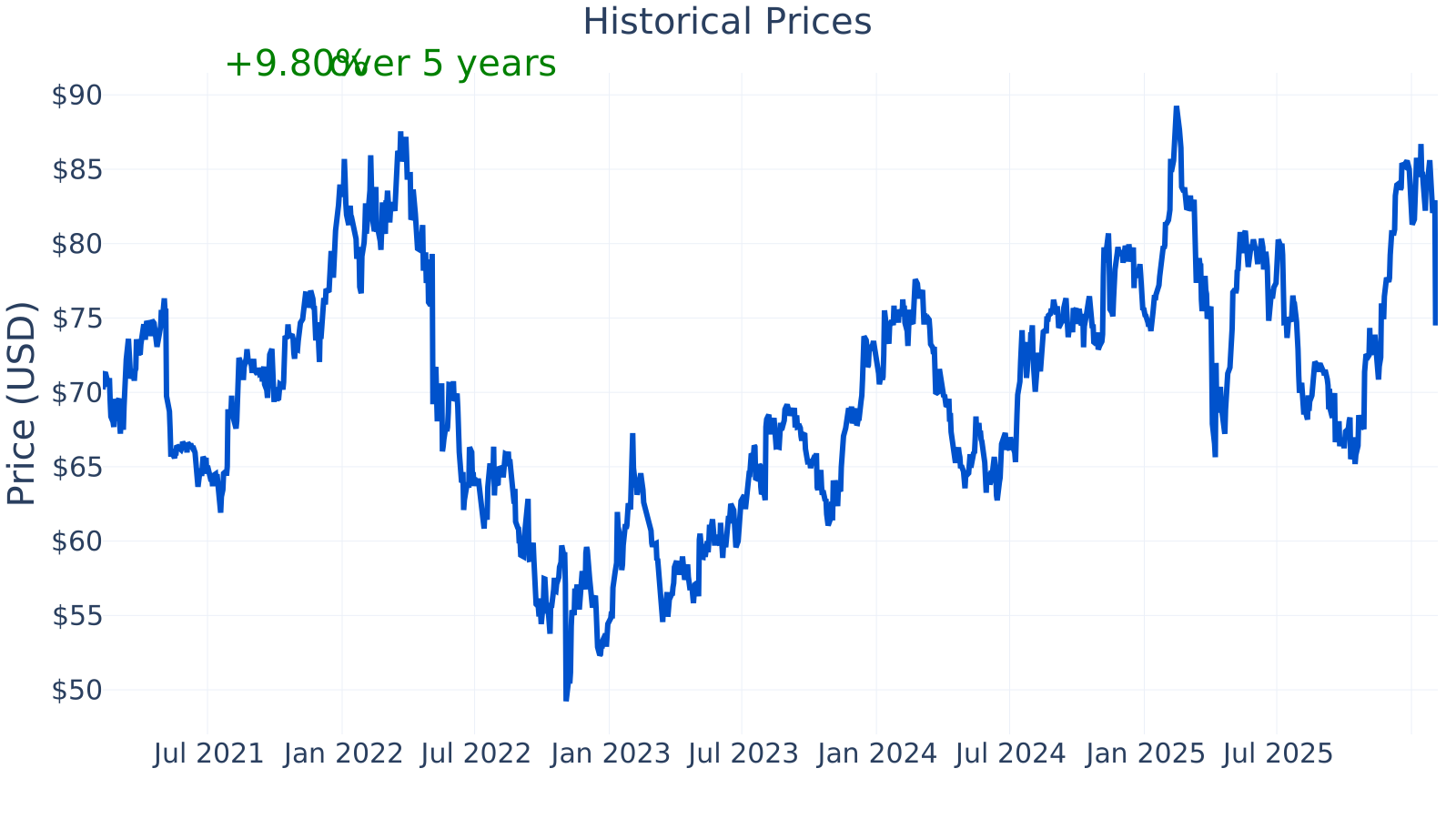
Cognizant’s market capitalization is about $37.2B, placing it among the larger publicly traded IT services companies. The stock’s beta of ~0.96 suggests its share price has historically moved roughly in line with the broader market (not unusually volatile versus the market). The company’s P/E ratio is ~16.9, below the industry median (~21.1) in the same IT services peer set. Profitability stands out: profit margin is ~10.6% versus an industry median of ~4.9%. Recent year-over-year revenue growth is ~4.9%, slightly below the industry median (~6.2%). Balance-sheet leverage appears conservative with debt-to-equity ~10.5% compared with an industry median ~54.5%. Trailing twelve-month free cash flow is about $2.6B, indicating meaningful cash generation after operating costs and capital spending.
Growth (Medium)
Cognizant operates in the information technology services industry, which is supported by long-running trends: enterprises continue migrating to cloud environments, modernizing older systems, improving cybersecurity, and using data to automate workflows and improve decision-making. These programs tend to be multi-year, and many large clients prefer established vendors that can deliver at scale across geographies.
Revenue growth has been uneven. It was strong in parts of 2021, slowed through 2022, turned slightly negative at times during 2023–2024, and then improved again in late 2024 and through 2025. The most recent reading shows about 4.9% year-over-year growth, indicating a return to modest expansion but not consistently high growth.
Cash generation is a core feature for long-term business durability. Free cash flow was around $2.6B in 2021, dipped to about $2.3B in 2022, recovered to about $2.7B in 2023, fell sharply to about $1.4B in 2024, and then rebounded to about $2.1B in 2025 (with the latest trailing figure shown as $2.595B). A pattern like this can reflect changes in demand, pricing, delivery costs, and working-capital swings (for example, the timing of client payments or staffing levels). The rebound suggests improved cash conversion versus the 2024 low, though the variability is important context.
In terms of strategy, IT services companies generally focus on expanding wallet share with existing clients, building capabilities in fast-changing areas (cloud platforms, cybersecurity, data/AI, and industry-specific solutions), and improving delivery efficiency. The strongest catalysts in this industry are usually not single events; they tend to be broader enterprise spending cycles (modernization waves, security-driven spending, and large-scale outsourcing decisions) that can accelerate bookings and renewals when demand strengthens.
Risks (Medium)
One key risk is that the business depends on corporate IT budgets. When economic uncertainty rises, clients can delay discretionary transformation projects or renegotiate scope and pricing. Because many contracts are tied to staffing and delivery volumes, changes in demand can flow through to revenue growth and utilization of employees.
Competition is another major factor. Cognizant faces large global IT services peers and consulting-led firms that offer overlapping services, including Accenture, IBM, Tata Consultancy Services (TCS), Infosys, Wipro, HCLTech, and others. These competitors often have comparable scale, long client relationships, and the ability to invest heavily in talent and new capabilities. Cognizant is a well-known player, but the market is fragmented and competitive; leadership tends to vary by industry vertical, geography, and specific service line rather than a single winner across all categories.
Execution risk also matters: delivering complex modernization work on time and within budget, retaining skilled employees, and managing wage inflation and attrition can affect margins and client satisfaction. In addition, the company has global operations, which can bring currency-related impacts and regulatory or compliance complexity across jurisdictions.
From a balance-sheet standpoint, leverage looks relatively modest. Debt-to-equity is about 10.5% most recently and has generally remained well below the industry median over time. Lower leverage can reduce financial risk during weaker demand periods, though it does not eliminate operational and competitive risks.
Profitability has been consistently above the industry median in the period shown. Margins peaked around the 11%–12% range in several quarters and most recently sit at about 10.6%, while the industry median is around 4.9%. This relative margin strength can be a competitive advantage if it reflects durable delivery efficiency, pricing discipline, and a favorable mix of work. However, margins can still compress if pricing weakens, wage costs rise faster than bill rates, or clients shift toward lower-margin engagements.
Valuation
Valuation is commonly discussed using the price-to-earnings (P/E) ratio, which compares the stock price to the company’s earnings. Cognizant’s latest P/E is about 16.9, which is below the industry median of ~21.1 in the same IT services peer set. A lower P/E can indicate the market is pricing in slower growth, higher uncertainty, or more mature business expectations relative to peers. It can also reflect differences in business mix, client concentration, and long-term growth outlook.
Over the period shown, Cognizant’s P/E ratio generally trended down from the low-to-mid 20s in 2021 toward the low-to-mid teens at various points in 2022–2025, and it has often been below the industry median. Interpreting whether that gap is “justified” depends on whether the company can sustain its higher-than-median profit margin while maintaining steady growth. The recent mix of modest revenue growth (about 4.9%) and strong profitability (about 10.6% margin) is consistent with a mature services company profile: cash-generative, but not necessarily fast-growing.
Conclusion
Cognizant is a large IT services provider focused on enterprise modernization, operations, and digital work. The business has shown meaningful profitability relative to industry peers and has operated with comparatively low leverage, which can support resilience across cycles. At the same time, revenue growth has been inconsistent in recent years, with a return to modest year-over-year expansion more recently.
In long-term context, the company sits in an industry with ongoing demand drivers (cloud migration, cybersecurity, and modernization), but it competes against several similarly capable global firms. The current valuation profile, as reflected in P/E versus peers, appears to embed more moderate expectations than the peer median, which places added importance on execution, sustained margins, and the durability of renewed growth.
Sources:
- SEC EDGAR — Cognizant Technology Solutions Corp filings (Form 10-K, Form 10-Q)
- Cognizant Investor Relations — Annual Report / Form 10-K materials and shareholder information
- Wikipedia — “Cognizant” (basic company background)
This article is for informational purposes only and does not constitute financial advice. Some content is AI-generated. See Disclaimer


