Stock Analysis · Cognex Corporation (CGNX)
Overview
Cognex Corporation designs and sells machine vision products—hardware and software that help factories “see” and make decisions automatically. In plain terms, Cognex systems can inspect products, read codes, guide robots, and check quality at high speed. These tools are typically used in manufacturing and logistics settings where consistent accuracy and throughput matter.
The company’s revenue largely comes from selling machine vision products and related software and services. In its financial reporting, Cognex commonly describes its offering around these categories:
- Vision systems (camera-based systems used for inspection and guidance)
- Barcode readers (industrial code reading for tracking and automation)
- Vision software (tools to build and deploy machine vision applications)
- Services and other (support, training, and related items)
From a business model perspective, Cognex is tied to how much customers invest in automation. When manufacturers expand capacity or upgrade production lines, demand for machine vision tends to improve; when customers slow capital spending, orders can soften.
Over the last several years, revenue and profit have moved up and down with customer demand, while operating expenses have remained relatively steady in dollar terms. Research and development spending stayed in a similar range (roughly $135–$140M per year across 2021–2025), suggesting continued investment in product development even during weaker demand periods.
Key Figures
| Metric | Value | Industry ⓘ |
|---|---|---|
| Date | May 04, 2026 | |
| Context | ||
| Sector | Technology | |
| Industry | Scientific & Technical Instruments | |
| Market Cap ⓘ | $9.34B | |
| Beta ⓘ | 1.47 | |
| Fundamental | ||
| P/E Ratio ⓘ | 82.26 | 36.70 |
| Profit Margin ⓘ | 11.51% | 12.58% |
| Revenue Growth ⓘ | 9.90% | 8.10% |
| Debt to Equity ⓘ | 5.13% | 23.49% |
| PEG ⓘ | 2.71 | |
| Free Cash Flow ⓘ | $236.77M | |
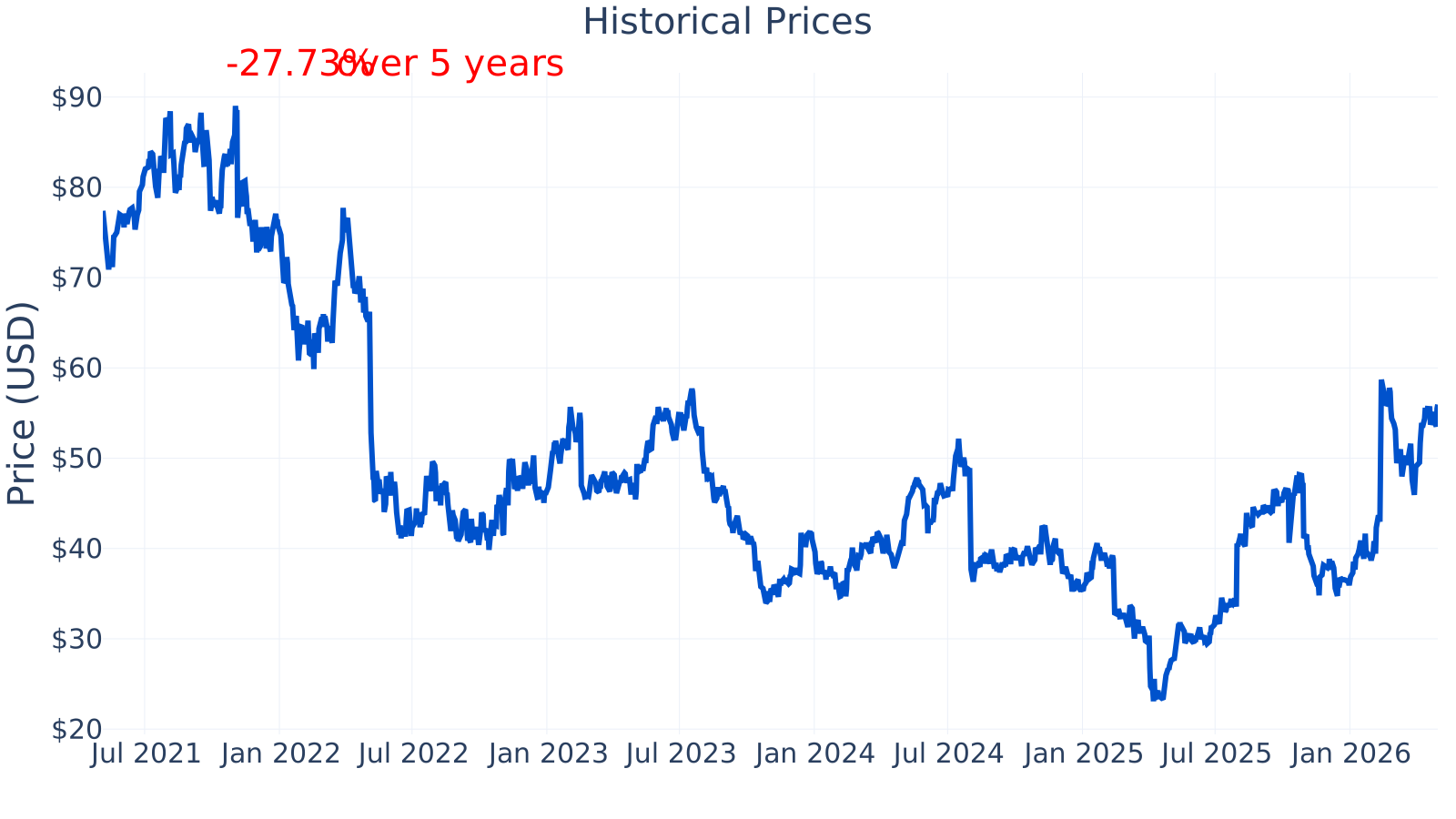
Cognex’s market capitalization is about $9.3B. The stock’s beta (~1.47) suggests it has historically moved more than the overall market (higher volatility than a broad index).
Profitability and balance-sheet leverage look conservative relative to many industrial-technology businesses: debt-to-equity is ~5% (versus an industry median around 23%). Current profit margin is ~11.5%, slightly below the industry median (~12.6%), and well below Cognex’s own higher margins earlier in the period shown in the margin chart.
On growth, the latest year-over-year revenue growth is ~9.9% (industry median ~8.1%). Free cash flow over the trailing twelve months is about $237M, an important measure because it reflects cash generated after operating needs and capital spending.
Growth (Medium)
Cognex operates in industrial automation, a long-running trend driven by manufacturers seeking higher productivity, more consistent quality, labor efficiency, and better traceability. Machine vision is often a foundational piece of automation because it turns visual checks (previously done by people) into repeatable, measurable processes.
The company’s strategy is closely linked to expanding real-world use cases for machine vision—such as quality inspection, robotics guidance, and high-speed code reading—across end markets that can include electronics, automotive-related manufacturing, consumer goods, and logistics. Over time, broader adoption of advanced software techniques (including more capable vision algorithms) can increase the value of these systems, but customer spending can remain cyclical because projects are frequently part of capital budgets.
Revenue growth has been uneven: it was very strong in parts of 2021, turned negative across much of 2022 and 2023, and then returned to growth through several quarters in 2024 and 2025 (including high-single-digit to mid-to-high teens in some quarters). This pattern is consistent with an industry that can pause and reaccelerate depending on factory investment cycles.
Free cash flow has also fluctuated. It declined from roughly $247M (TTM ending 2022-03-31) to about $77M (TTM ending 2024-03-31), then recovered to about $162M (TTM ending 2025-03-31). The latest value listed in the metrics table is about $237M, indicating a rebound in cash generation compared with the trough period.
Risks (Medium)
A key risk for Cognex is customer spending cyclicality. Many buyers treat machine vision purchases as part of broader factory upgrades, which can be delayed during weaker economic conditions or when customers reduce capital expenditures. This can lead to periods of declining revenue even if long-term automation adoption continues.
Another risk is competition and pricing pressure. Machine vision includes global competitors ranging from specialized vision providers to broader industrial automation companies that bundle cameras, sensors, software, and controllers. Cognex is widely recognized for machine vision focus and product breadth, but customers may evaluate alternatives based on performance, integration ease, total cost, and availability.
Execution risk also matters: to sustain long-term relevance, Cognex must keep products current and maintain strong relationships with equipment makers, integrators, and end customers. If the market shifts toward different architectures or if rivals innovate faster, share gains can become harder.
The balance sheet leverage shown is low and fairly stable. Debt-to-equity rises from very low levels earlier in the period to roughly 5% most recently—still far below the industry median (often in the 35%–45% range earlier in the timeline, and about 25% at the latest point). Lower leverage can reduce financial stress during downturns, but it does not remove demand-related volatility.
Profit margin has compressed materially compared with 2021. It declines from around 31% (mid-2021) to roughly 11%–13% more recently, which is closer to (and sometimes below) the industry median. This trend can reflect a mix of factors such as revenue variability, operating cost structure, product mix, and pricing dynamics.
Competitive landscape (examples of categories of competitors) typically includes:
- Other machine vision specialists (competing directly on vision hardware/software performance and usability)
- Large automation platforms (companies that sell broader factory automation portfolios and may bundle vision into larger solutions)
- Lower-cost providers (products that may be “good enough” for some applications, increasing price competition)
Valuation
Cognex currently shows a P/E ratio of ~82.3, which is notably above the industry median of ~36.7 in the latest metrics. Historically in the period shown, Cognex’s P/E has often been above the industry median as well, and it increased sharply in 2024 before moderating somewhat in 2025. A higher P/E commonly indicates that the market is placing a higher value on each dollar of current earnings, which can be associated with expectations for stronger future growth, improving margins, or higher long-term business quality.
The PEG ratio (~2.71) is another lens that relates valuation to growth expectations; values above 1 can indicate that the price is high relative to near-term growth rates (though PEG depends heavily on how growth is estimated). Given that profit margins have been lower than earlier years and revenue growth has been uneven, the valuation places meaningful weight on improvement from current earnings power rather than simply reflecting stable, mature performance.
Conclusion
Cognex is a specialized industrial technology company focused on machine vision—an enabling capability for automation and quality control. The business participates in a long-term trend toward more automated, data-driven manufacturing, but its results can vary with capital spending cycles.
Financially, the company shows low leverage and has generated positive free cash flow across the time periods shown, with cash generation recovering from a weaker phase. At the same time, profit margins have compressed significantly versus earlier years, which highlights the importance of monitoring operating performance and end-market demand.
From a valuation standpoint, the shares trade at a higher earnings multiple than the industry median, implying higher expectations. In this context, how the company restores or expands profitability and sustains growth through the cycle is central to whether that higher valuation remains aligned with fundamentals over time.
Sources:
- U.S. Securities and Exchange Commission (SEC) EDGAR — Cognex Corporation filings (Form 10-K, Form 10-Q)
- Cognex Corporation — Investor Relations materials (Annual Report / filings repository)
- Wikipedia — “Cognex Corporation” (basic company background)
This article is for informational purposes only and does not constitute financial advice. Some content is AI-generated. See Disclaimer


