Stock Analysis · Cognex Corporation (CGNX)
Overview
Cognex Corporation (CGNX) builds products that help factories “see” what they are making. In simple terms, its systems use cameras and software to identify, measure, and inspect items on fast-moving production lines. This is commonly called machine vision, and it is used to spot defects, guide robots, read codes, confirm correct assembly, and improve consistency in manufacturing and logistics.
Cognex sells these products to customers that automate production, including electronics and semiconductor-related manufacturing, automotive suppliers, consumer goods, packaging, and logistics operations. The company’s revenue tends to move with industrial investment cycles: when manufacturers expand capacity or upgrade factories, demand for vision systems can rise; when customers slow spending, orders can soften.
From a business-model perspective, Cognex primarily generates revenue from selling hardware (vision sensors, cameras, barcode readers, and related systems) plus software that helps interpret images and integrate results into factory workflows. Public filings typically describe results by product families and by geography; exact, stable percentage splits can change year to year depending on customer mix and the timing of large automation projects.
Over the 2021–2025 period shown, revenue declined from about $1.04B (2021) to about $0.84B (2023) and then recovered to about $0.99B (2025). Over the same span, operating income and net income dropped materially versus 2021 levels, reflecting both lower revenue in the downturn and a cost structure that did not fall as quickly as sales.
Key Figures
| Metric | Value | Industry ⓘ |
|---|---|---|
| Date | Feb 16, 2026 | |
| Context | ||
| Sector | Technology | |
| Industry | Scientific & Technical Instruments | |
| Market Cap ⓘ | $9.74B | |
| Beta ⓘ | 1.53 | |
| Fundamental | ||
| P/E Ratio ⓘ | 86.46 | 37.73 |
| Profit Margin ⓘ | 11.51% | 12.51% |
| Revenue Growth ⓘ | 9.90% | 7.45% |
| Debt to Equity ⓘ | 5.13% | 49.68% |
| PEG ⓘ | 1.85 | |
| Free Cash Flow ⓘ | $236.77M | |
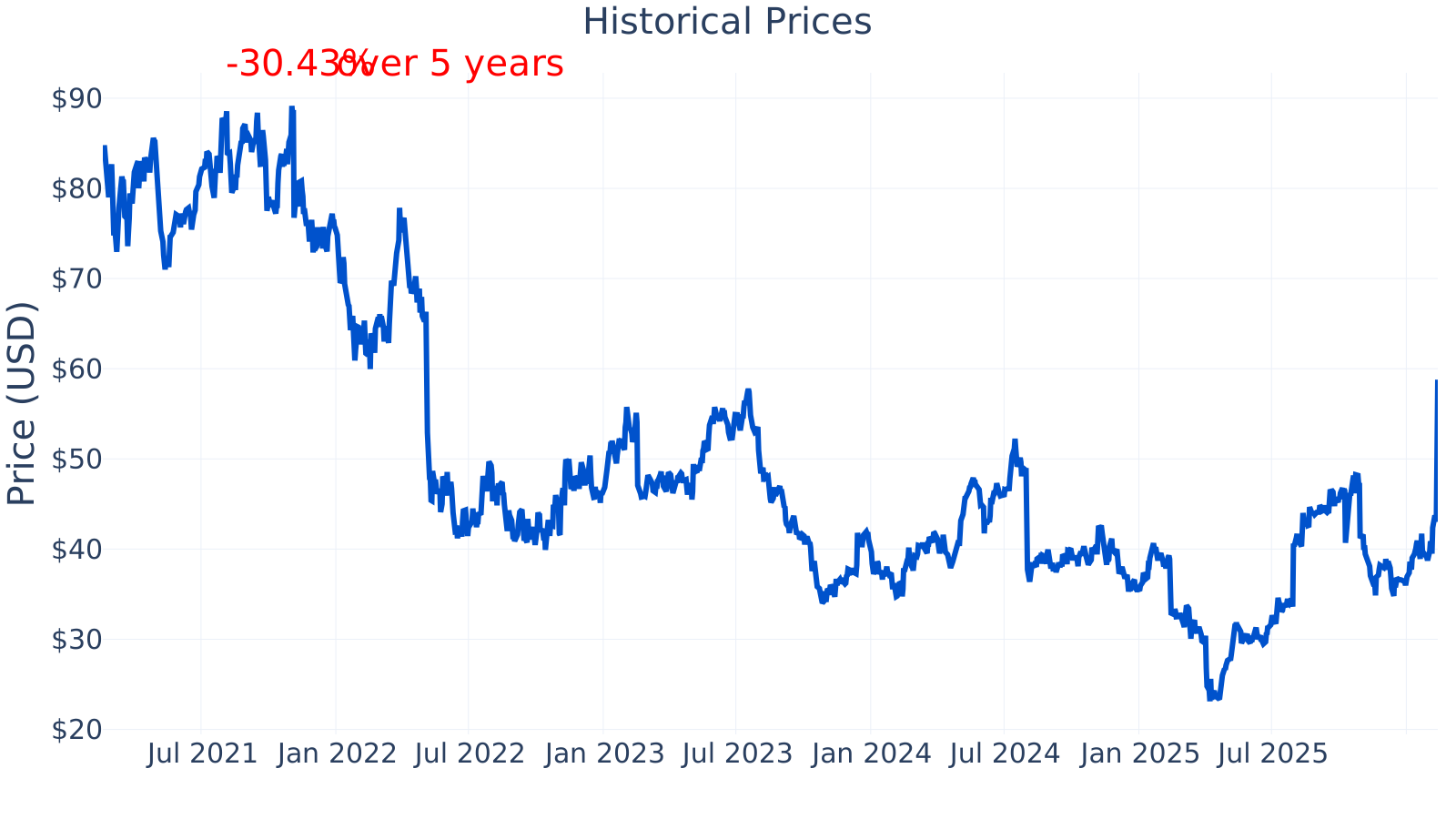
Cognex’s market capitalization is about $9.7B, and its beta of ~1.53 indicates the stock price has historically moved more than the broader market (higher ups and downs).
Valuation and profitability stand out versus the company’s industry group (Scientific & Technical Instruments). The P/E ratio is ~86.5 versus an industry median ~37.7, while the profit margin is ~11.5% versus an industry median ~12.5%. On growth, the latest year-over-year revenue growth is ~9.9%, above the industry median ~7.5%. Balance-sheet leverage appears low with debt-to-equity ~5.1% versus an industry median ~49.7%. The company also shows positive free cash flow (TTM) of about $236.8M, and a PEG ratio of ~1.85 (a common, simplified way to relate valuation to growth expectations).
Growth (Medium)
Machine vision and industrial automation are tied to long-term trends such as higher quality requirements, labor shortages, traceability needs (tracking parts through production), and increasing use of robotics. These forces generally support ongoing adoption of automated inspection and identification systems over time.
At the same time, Cognex operates in an industry that can be cyclical. Customers may delay equipment purchases during slower industrial periods, then resume spending later. That pattern is visible in Cognex’s recent history: revenue growth swung sharply from very strong expansion in parts of 2021 to declines through much of 2022 and 2023, then returned to positive territory in 2024–2025.
The chart highlights that the company moved from large positive growth rates in 2021 to negative growth across multiple quarters in 2022–2023, followed by a recovery with mostly positive year-over-year growth in late 2024 and 2025 (including a high-teens quarter and ending near ~9.9%). This type of “ups and downs” is consistent with a project-driven industrial purchasing environment.
Another way to think about growth quality is whether the business generates cash that can be reinvested. Cognex has remained cash-flow positive, though free cash flow has fluctuated.
Free cash flow over the trailing twelve months moved from roughly $263M (2021) to $247M (2022), then down to $201M (2023), reached a lower point around $77M (2024), and improved to about $162M (2025). This suggests the business can produce cash through the cycle, but cash generation has not been stable year to year.
In terms of strategy, Cognex’s focus on factory automation use cases (inspection, measurement, identification, and guidance) aligns with continued automation investment. Potential catalysts typically come from a rebound in industrial capital spending, renewed demand from electronics/semiconductor-related manufacturing, and broader adoption of automation in logistics and warehouses. The timing and magnitude of these catalysts can vary significantly.
Risks (Medium)
This article is for informational purposes only and does not constitute financial advice. Some content is AI-generated. See Disclaimer


