Stock Analysis · Cogent Communications Group Inc (CCOI)
Overview
Cogent Communications Group, Inc. is a facilities-based telecommunications company. In simple terms, it operates a large, high-capacity network (built on fiber and related infrastructure) and sells internet connectivity and data transport services to businesses and other organizations. Its offering is focused on delivering bandwidth (the “capacity” to move data), often to customers that want reliable connections across cities and countries without having to build their own network.
From a business model point of view, Cogent typically earns revenue from recurring service contracts: customers pay monthly fees for connectivity and transport. These services are commonly used by enterprises, content providers, and organizations that need to connect offices, data centers, and cloud on-ramps, or to move large volumes of traffic efficiently.
Public filings generally describe Cogent’s revenue in broad service categories (rather than a long list of product lines). A simple way to think about it is:
- Internet access services (selling dedicated internet connectivity to customers)
- Data transport services (moving data between locations, such as between data centers or major network hubs)
In recent years, the company’s financial statements show total revenue rising meaningfully versus earlier periods (for example, total revenue is shown around $590M in 2021 and above $1.0B in 2024), which suggests the scale of services sold has expanded. At the same time, profitability has been more volatile, which matters for long-term stability (discussed later).
One notable trend visible over time is that revenue increased from 2021 to 2024, while operating income and net income swung sharply (including a very strong 2023 and losses in 2024–2025). This kind of variability typically means long-term results may be heavily influenced by financing costs, accounting items, integration costs, or other non-steady factors in addition to day-to-day service economics.
Key Figures
| Metric | Value | Industry ⓘ |
|---|---|---|
| Date | Mar 02, 2026 | |
| Context | ||
| Sector | Communication Services | |
| Industry | Telecom Services | |
| Market Cap ⓘ | $939.17M | |
| Beta ⓘ | 0.78 | |
| Fundamental | ||
| P/E Ratio ⓘ | N/A | 16.24 |
| Profit Margin ⓘ | -20.32% | 6.34% |
| Revenue Growth ⓘ | -4.60% | 2.05% |
| Debt to Equity ⓘ | -4591.17% | 119.24% |
| PEG ⓘ | 85.89 | |
| Free Cash Flow ⓘ | -$198.15M | |
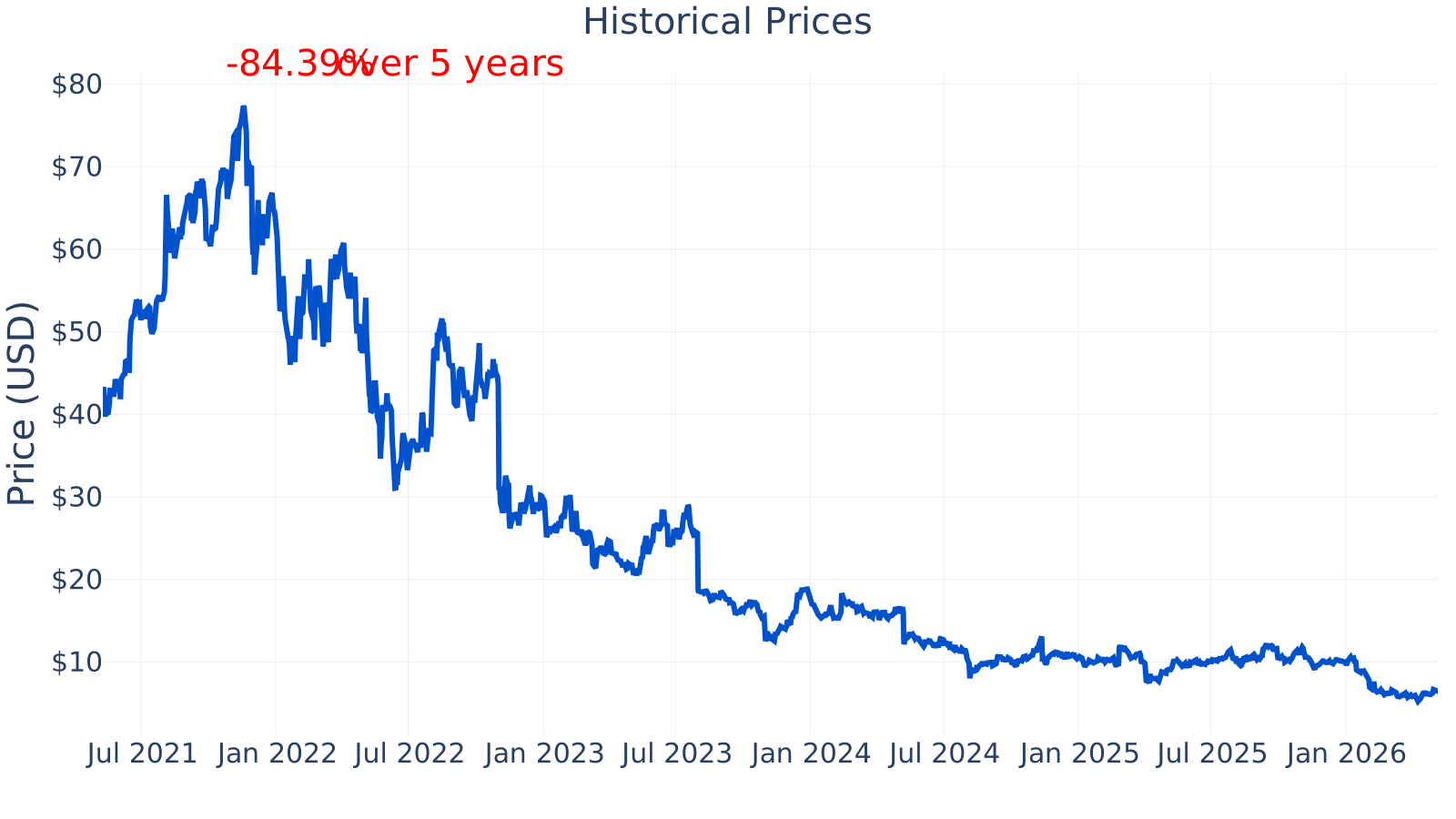
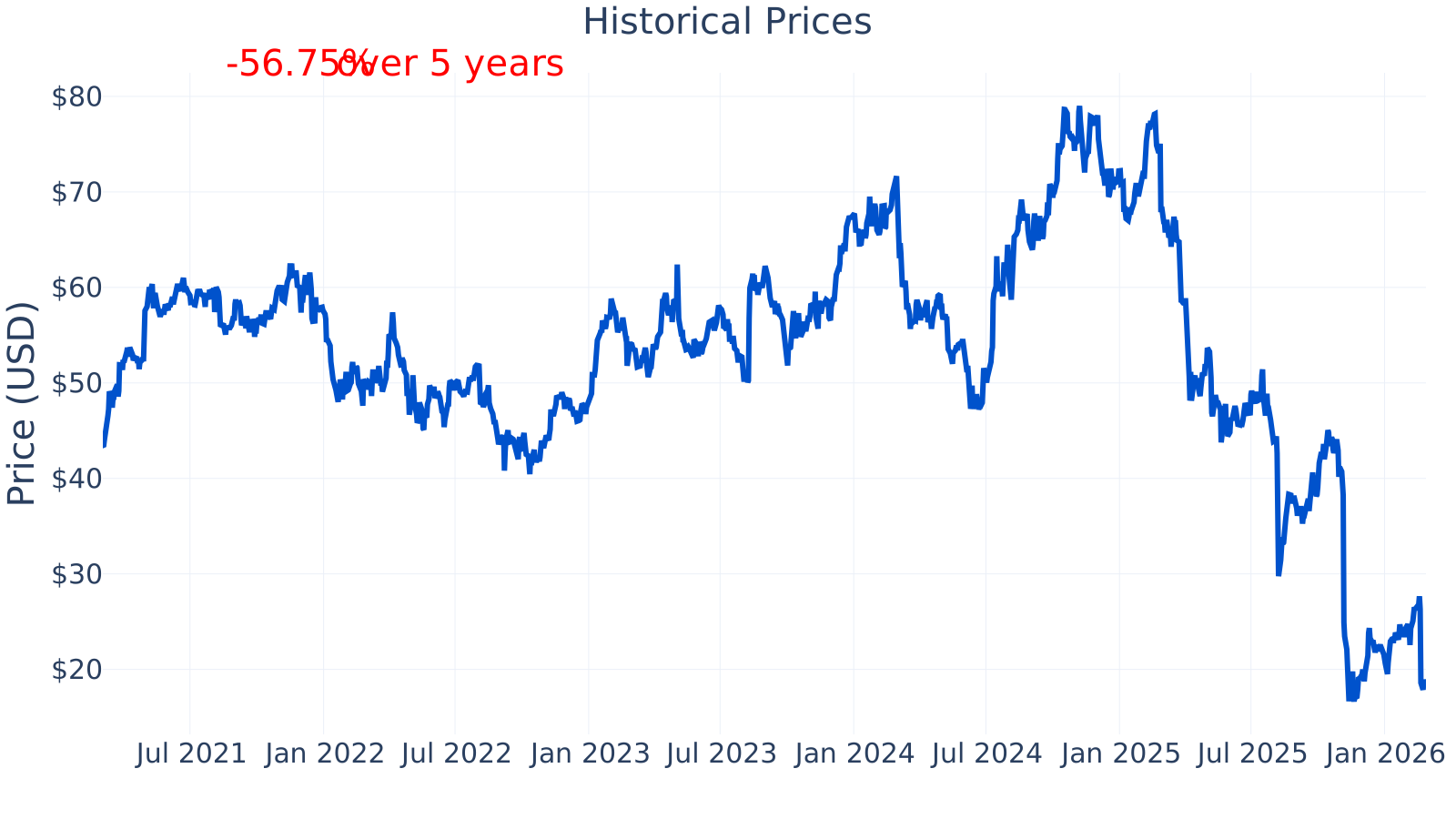
Cogent’s market capitalization is about $0.94B, placing it in the small-to-mid range among public telecom-related companies. The stock’s beta of ~0.78 suggests its price has historically moved less than the overall market on average (though individual periods can still be very volatile).
Current profitability metrics look pressured: the latest profit margin is about -20%, versus an industry median around +6%. Recent growth is also weaker: latest year-over-year revenue growth is about -4.7%, compared with an industry median around +2.1%.
Free cash flow (cash left after operating needs and capital spending) is shown as negative over the trailing twelve months at roughly -$198M. That matters because, over long periods, companies generally need internally generated cash (or reliable access to external funding) to maintain and expand networks.
The debt-to-equity figure appears unusual (negative) at the latest point, which commonly happens when accounting equity is negative. In practice, that typically signals a more leveraged balance sheet and less flexibility during downturns, so it’s something readers often double-check directly in the balance sheet and notes of the company’s SEC filings.
Growth (Medium)
The broader need for data transmission is a long-running trend: more video, cloud computing, remote work, and connected devices all increase the amount of traffic moving across networks. This is a supportive backdrop for companies that can deliver bandwidth efficiently and reliably.
That said, the company’s recent growth rate has cooled. The revenue growth series shows a period of very high year-over-year growth in 2023 and early 2024, followed by negative growth in late 2024 and through 2025. This pattern can happen when a company absorbs a major change (such as a large contract, a step-up in scale, or a business transition) and then faces tougher comparisons, customer churn, pricing pressure, or integration and execution challenges.
A key part of a long-term growth story in this industry is whether a network operator can (1) keep utilization high, (2) maintain pricing discipline, and (3) manage costs while investing enough to stay competitive. Cogent’s recent profitability and cash flow softness suggest the strategy may be in a “prove it” phase: the industry demand can be favorable, but the company still needs consistent execution for that demand to translate into durable earnings and cash generation.
The free cash flow trend shown moves from positive levels in 2021–2023 to significantly negative in 2024–2025. For long-term analysis, this often becomes a central question: whether the negative free cash flow is temporary (for example, elevated investment, one-time items, or a transition period) or a sign that the current economics are under pressure.
Risks (High)
A major risk for telecom and bandwidth providers is competitive intensity. Connectivity can become price-competitive when multiple carriers can serve the same buildings and routes, and customers may switch providers if price or service terms are better elsewhere. If pricing pressure rises faster than costs can be managed, margins can compress.
Another key risk is financial flexibility. Network businesses require ongoing capital spending (to expand reach, add capacity, and refresh equipment). When free cash flow is negative, the company may rely more on cash reserves, new debt, or other financing. This can become harder when interest rates are high or if lenders demand stricter terms.
The debt-to-equity history shown is volatile and sometimes extremely high or negative. This usually points to balance-sheet complexity (including periods where accounting equity may be small or negative). In plain language, it can mean the company is more sensitive to funding conditions than peers with steadier leverage metrics.
Profitability is also a risk area. While Cogent showed positive margins in earlier periods, the latest readings are negative and below the industry median.
The margin series includes unusually high values in 2023–early 2024 and then turns negative by late 2024 into 2025. Large swings like this often indicate that bottom-line results may be influenced by items that are not purely “business as usual” (for example, one-time gains/losses, tax effects, restructuring/integration costs, or financing impacts). In long-term analysis, many readers focus on whether operating performance stabilizes over several quarters.
On competitive positioning, Cogent participates in a field with many capable global and regional providers. Competitors can include large integrated telecom carriers, wholesale bandwidth providers, and other fiber/network operators. Compared with the largest telecom companies, Cogent is smaller by market value and scale, which can be a disadvantage in bargaining power and capital access. Its potential advantage is focus: a more concentrated business model centered on high-capacity internet and transport, but whether that translates into durable outperformance depends heavily on execution, customer retention, and cost control.
Valuation
Traditional valuation measures like the price-to-earnings (P/E) ratio can be difficult to interpret when earnings are volatile or negative. Cogent’s P/E history shown is highly variable, including periods where the P/E drops to very low values and periods where it is extremely high (and in some dates not meaningful). By comparison, the industry median P/E is shown around the mid-teens in multiple periods, and the latest industry median listed is about 16.2.
When a company’s profits and free cash flow are unstable, valuation discussions often shift from “Is the P/E low or high?” to questions like: whether cash generation is expected to normalize, how much ongoing investment is required, and how leverage and interest expense affect future net income. In Cogent’s case, the combination of negative trailing free cash flow and negative recent profit margin makes valuation more dependent on forward execution and balance-sheet resilience than on a single snapshot multiple.
Conclusion
Cogent Communications operates in an industry with long-term demand drivers: global data traffic and the need for reliable connectivity. The company has also shown it can reach a much higher revenue scale than it had several years ago, which is an important structural point for a network operator.
At the same time, the most recent indicators highlighted here show pressure: year-over-year revenue contraction, negative profit margin, negative free cash flow, and balance-sheet metrics that look less straightforward than the typical peer median. For long-term, fundamentals-based analysis, the central issue is whether the company can convert its network scale into steadier profitability and cash generation while keeping financing risk contained.
Sources:
- U.S. SEC EDGAR — Cogent Communications Group, Inc. filings (Form 10-K, Form 10-Q)
- Cogent Communications — Investor Relations materials and press releases
- Wikipedia — “Cogent Communications” (company background)
This article is for informational purposes only and does not constitute financial advice. Some content is AI-generated. See Disclaimer