Stock Analysis · Cogent Communications Group Inc (CCOI)
Overview
Cogent Communications Group, Inc. (CCOI) is a facilities-based internet service provider. In simple terms, it owns and operates parts of the “plumbing” that carries internet traffic: a large fiber-optic network and related equipment. Using that network, it sells high-speed internet access and data transport services to businesses and other organizations, with a focus on delivering large amounts of bandwidth at relatively standardized service levels.
Cogent’s business model is built around recurring monthly service fees. The company primarily sells connectivity to:
- Business customers (organizations that need dedicated internet access)
- Other network operators (carriers, service providers, and content-related networks that need to exchange and transport traffic)
Public filings describe revenue mainly by service type (internet access and transport) and by customer categories, but exact percentage splits can change over time and are best read directly in the most recent annual report segment disclosures.
From a high level, Cogent’s economics depend on (1) adding new on-net buildings and customers, (2) increasing bandwidth sold per customer over time, and (3) managing network and operating costs as traffic scales.
Over the 2021–2024 period shown, total revenue rises meaningfully (from about $590M in 2021 to about $1.04B in 2024), while interest expense also increases (about $58M in 2021 to about $123M in 2024). The mix of profits also changes sharply in 2023–2024, with 2024 showing negative operating income and net income, indicating that costs and non-operating items became a much bigger factor than in earlier years.
Key Figures
| Metric | Value | Industry ⓘ |
|---|---|---|
| Date | Feb 08, 2026 | |
| Context | ||
| Sector | Communication Services | |
| Industry | Telecom Services | |
| Market Cap ⓘ | $1.19B | |
| Beta ⓘ | 0.78 | |
| Fundamental | ||
| P/E Ratio ⓘ | N/A | 15.18 |
| Profit Margin ⓘ | -21.46% | 6.18% |
| Revenue Growth ⓘ | -6.20% | 2.10% |
| Debt to Equity ⓘ | -6760.77% | 113.97% |
| PEG ⓘ | 85.89 | |
| Free Cash Flow ⓘ | -$186.70M | |
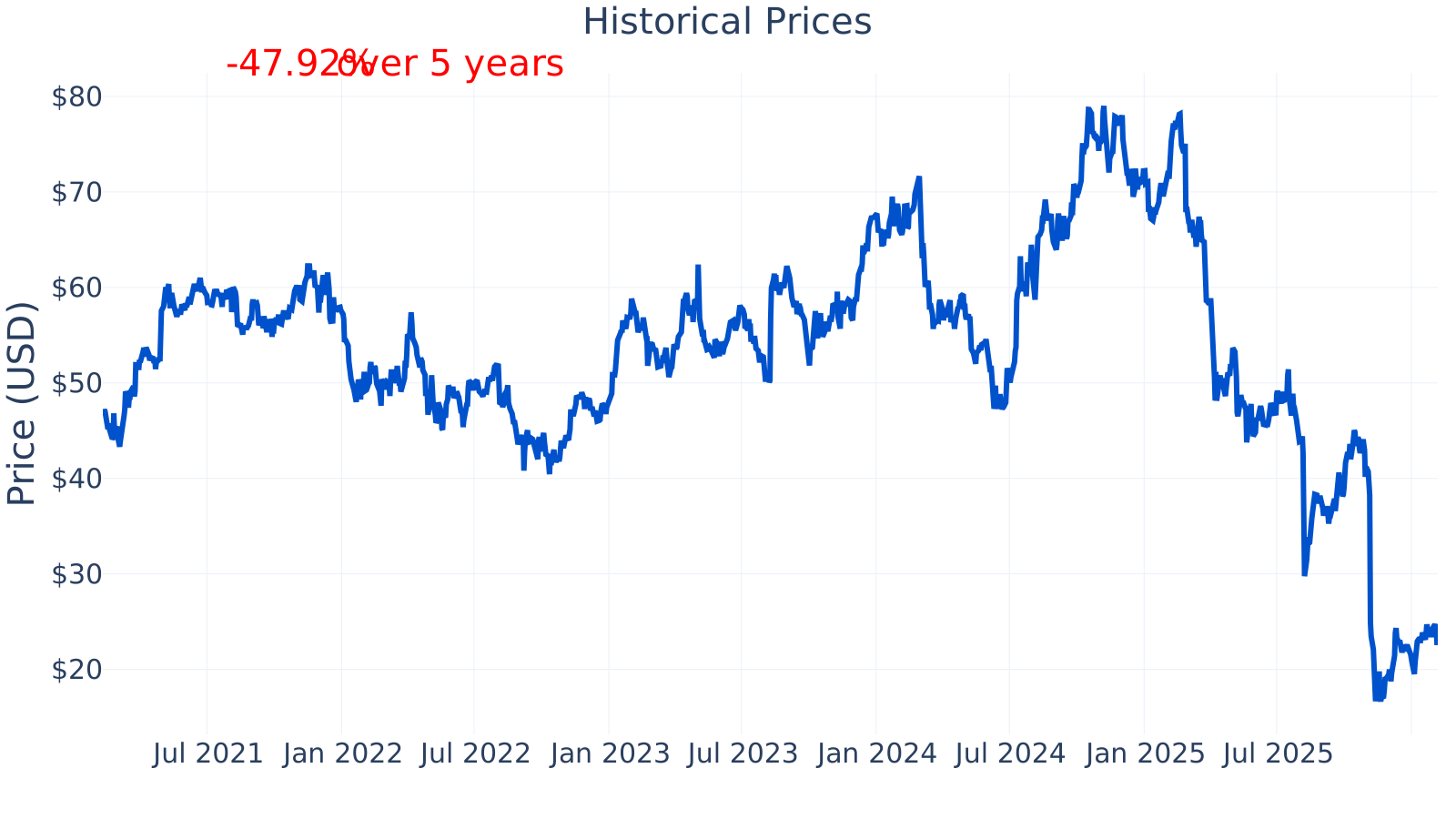
At the latest point shown, Cogent’s market capitalization is about $1.19B and its beta is about 0.78 (a measure of how volatile the stock has been relative to the broader market). Profitability and cash generation are the standout items: the company shows a net profit margin of about -21.5% versus an industry median near 6.2%, and trailing twelve-month free cash flow of about -$186.7M. Revenue growth year-over-year is about -6.2% versus an industry median near 2.1%. The reported debt-to-equity value is not straightforward to interpret here because equity can be very small or negative at times (which can make this ratio swing dramatically or appear negative), so it is more useful to cross-check leverage in the company’s balance sheet and debt footnotes in SEC filings.
Growth (Medium)
The broader demand backdrop for data connectivity is supported by long-term trends: more cloud usage, video, remote work, cybersecurity needs, and rising data traffic. That said, this does not automatically translate into strong growth for every network operator. In connectivity, outcomes depend heavily on pricing pressure, customer churn, the cost to build or acquire network footprint, and how efficiently a company can fill that footprint with paying customers.
Cogent’s strategy has historically emphasized scaling a fiber network and selling high-bandwidth services with a relatively standardized product approach. This can work well when customer additions and bandwidth increases outpace the cost base. A potential catalyst in this type of business is reaching “density” in more buildings/metros—once a network is in place, incremental customers can have attractive unit economics if installation and support costs are controlled.
The year-over-year revenue growth pattern is uneven. After modest low-single-digit growth in 2021–early 2023, the chart shows a very large jump in mid/late 2023 into early 2024, followed by a clear slowdown and then contraction (negative growth) through late 2024 and 2025. For long-term analysis, this kind of swing often signals that reported growth may have been influenced by major business changes (such as acquisitions, asset additions, or accounting/timing effects) rather than purely steady organic expansion; the company’s 10-K/10-Q discussion is typically where management explains those drivers.
Free cash flow trends notably lower over time in the period shown—positive in 2021–2023, then turning negative in 2024 and remaining negative into 2025 (roughly -$146.6M in 2024 and -$203.7M in 2025 at the points displayed). For a network operator, negative free cash flow can reflect heavy investment, integration costs, higher interest expense, or weaker operating performance. Understanding whether this is “temporary investment” versus “structural earnings pressure” is central to judging long-run compounding potential.
Risks (High)
This article is for informational purposes only and does not constitute financial advice. Some content is AI-generated. See Disclaimer