Stock Analysis · Clearwater Analytics Holdings Inc (CWAN)
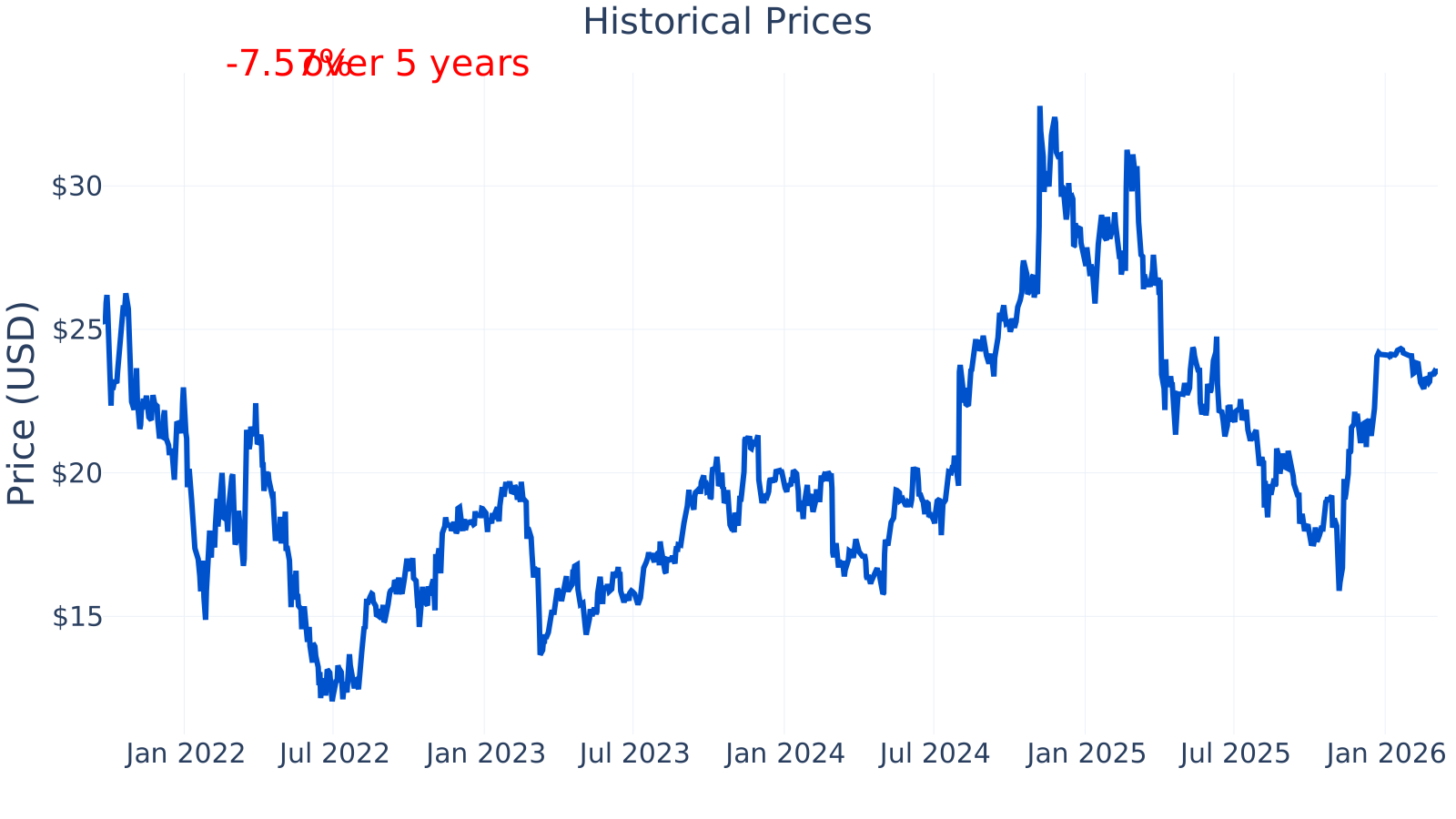
Overview
Clearwater Analytics Holdings Inc (CWAN) provides cloud-based software that helps large organizations manage and report on investment portfolios. Its platform is designed to bring together data from many custodians, asset managers, and internal systems, then produce accounting, performance, compliance, risk, and regulatory reporting in a more automated way. Customers commonly include insurance companies, asset managers, corporations, and public-sector investment offices that need frequent, accurate reporting across many asset types.
The business model is primarily software-as-a-service (SaaS): customers pay ongoing fees to use the platform, with additional services that support implementation and ongoing client needs. In plain terms, Clearwater aims to be the “system of record” for investment operations—software that becomes embedded in day-to-day workflows once implemented.
In company filings, revenue is typically discussed in broad categories rather than a long list of products. The most common buckets are:
- Subscription (recurring) revenue from access to the Clearwater platform (generally the largest component)
- Services and professional services revenue related to onboarding, implementation, and customer support
Percentages by revenue category can vary by period and depend on how the company reports them in its latest annual filing.
Over recent years, total revenue increased strongly (from about $252.0M in 2021 to about $731.4M in 2025). At the same time, spending on research and development and on sales/administration also increased materially, which helps explain why bottom-line profitability has been uneven despite growth.
Key Figures
| Metric | Value | Industry ⓘ |
|---|---|---|
| Date | Mar 09, 2026 | |
| Context | ||
| Sector | Technology | |
| Industry | Software - Application | |
| Market Cap ⓘ | $7.01B | |
| Beta ⓘ | 0.66 | |
| Fundamental | ||
| P/E Ratio ⓘ | 14.96 | 27.00 |
| Profit Margin ⓘ | -5.31% | 7.87% |
| Revenue Growth ⓘ | 72.00% | 16.65% |
| Debt to Equity ⓘ | 43.67% | 25.51% |
| PEG ⓘ | 9.92 | |
| Free Cash Flow ⓘ | $164.29M | |
Clearwater’s market capitalization is about $7.0B and its beta is about 0.66, which indicates the stock has historically moved less than the overall market. The table also shows a currently reported P/E ratio of ~15.0 versus an industry median around 27.0, while the company’s profit margin is currently negative (~-5.3%) versus a positive industry median (~7.9%). Revenue growth is shown as unusually high (~72% year-over-year), and free cash flow over the trailing twelve months is about $164.3M. Debt-to-equity is roughly 43.7%, above the industry median shown (~25.5%), which suggests higher relative use of debt than many peers.
Growth (medium)
Clearwater operates in financial software and data/reporting workflows for institutional investing—an area supported by long-term forces such as increasing reporting requirements, growth in portfolio complexity (more asset classes, more managers, more data sources), and the shift from on-premise tools and spreadsheets toward cloud platforms. These trends generally favor vendors that can standardize data, automate reconciliation, and shorten reporting cycles.
A key part of the company’s growth logic is “land and expand”: once a client runs core investment reporting on the platform, it can be difficult and risky to switch systems, and clients may add more portfolios, asset classes, or modules over time. This kind of workflow integration can support recurring revenue and longer customer relationships, although it typically requires continuous product investment.
The chart shows revenue growth running near the high teens to mid-20% for many quarters, then accelerating sharply in 2025 (around 70%+ year-over-year in the most recent periods shown). When growth changes this quickly, it is important to distinguish between growth from acquisitions versus organic expansion, and whether the increase is expected to persist or normalize. (Company filings typically provide that breakdown and management’s explanation.)
Free cash flow has risen from about $22.7M (TTM ended 2022-03-31) to about $81.6M (TTM ended 2024-03-31), and more recently is shown around $83.5M (TTM ended 2025-03-31), with the latest table indicating $164.3M TTM. In general, improving cash generation can matter for a software company because it helps fund product development and growth initiatives without relying as heavily on external financing. Differences between the chart and the latest table can happen when they cover different trailing periods or when more recent quarters are included in the latest TTM value.
Risks (medium)
Clearwater’s main risks are typical of a fast-growing enterprise software company that serves large, demanding institutions. Implementations can be complex, sales cycles can be lengthy, and customer expectations for accuracy and uptime are high. Any operational issues—such as data integration challenges, service delivery problems, or delays in onboarding—can affect customer satisfaction and the timing of revenue recognition.
Competition is another central risk. The investment operations and portfolio accounting ecosystem includes established providers and specialized platforms. Competitors can include large enterprise software vendors and well-known investment accounting and performance systems, as well as custodians and service providers offering technology-enabled solutions. Clearwater’s positioning is often described (in filings and product materials) as cloud-native and focused on automated data aggregation and reporting; the competitive advantage question for long-term outcomes typically comes down to switching costs, breadth of integrations, product depth across asset classes, and the ability to keep pace with evolving client requirements.
Profitability has also been inconsistent. Even when revenue is rising, software companies can show volatile net income due to factors such as stock-based compensation, amortization from acquisitions, and one-time tax-related items.
Debt-to-equity moved notably over time, dropping to very low levels in late 2024 before rising sharply in 2025 to the mid-40% range (about 43.7% most recently shown). A jump like this can reflect new borrowing and/or changes in equity, and it can increase financial risk if cash flows weaken or if interest costs rise.
The profit margin line is volatile, including extremely high positive readings in parts of 2024–2025 and then returning to negative most recently (about -5.3%). Spikes like this are often driven by non-recurring items rather than day-to-day operating performance. For understanding underlying profitability, many readers look at operating income trends, free cash flow, and management discussion in filings to separate core performance from one-time effects.
Valuation
For a software business, valuation is often discussed using a mix of earnings-based and growth-based measures, but those can be harder to interpret when net income is uneven. Based on the latest metrics shown, CWAN’s P/E ratio is about 15.0, below the industry median shown (about 27.0). That said, the usefulness of a P/E depends on whether earnings reflect ongoing operations or are affected by one-time items.
The historical P/E series shows meaningful values only in parts of 2025 (with other periods not displayed). In periods where earnings are near zero, negative, or distorted by unusual items, the P/E ratio may not provide a stable yardstick. In that context, readers commonly rely more on revenue growth, operating income trajectory, cash flow, and balance sheet leverage to frame how demanding (or not) the current valuation might be.
The latest table also shows a PEG ratio around 9.9, which is typically interpreted as high; however, PEG ratios can be unreliable when earnings growth assumptions are uncertain or when current earnings are not a steady baseline.
Conclusion
Clearwater Analytics is a cloud software provider focused on institutional investment reporting and portfolio operations, an area supported by long-term demand for automation, data standardization, and frequent reporting. The company has demonstrated strong revenue expansion over multiple years and has also shown improving free cash flow over time.
At the same time, the financial profile shown here includes uneven profitability and a notable increase in leverage in 2025, both of which add uncertainty. For long-term evaluation, the most decision-relevant items to monitor in filings are typically: the mix of recurring subscription revenue versus services, retention/expansion dynamics, the sustainability of recent high year-over-year growth, operating margin progression excluding unusual items, and whether the balance sheet leverage stabilizes or continues rising.
Sources:
- SEC EDGAR — Clearwater Analytics Holdings Inc filings (Form 10-K, Form 10-Q)
- Clearwater Analytics Investor Relations — Annual reports, shareholder materials, and press releases (company-hosted)
- Wikipedia — “Clearwater Analytics” (basic company background)
This article is for informational purposes only and does not constitute financial advice. Some content is AI-generated. See Disclaimer


