Stock Analysis · Clear Channel Outdoor Holdings Inc (CCO)
Overview
Clear Channel Outdoor Holdings, Inc. (CCO) is an out-of-home (OOH) advertising company. In simple terms, it sells advertising space on physical media that people see outside their homes—such as billboards along roads and advertising displays in urban areas. Advertisers (brands, local businesses, and agencies) pay to run campaigns for a period of time, and Clear Channel delivers those ads across its network of locations.
Revenue is primarily generated by selling advertising placements across its inventory. In its SEC filings, the business is commonly discussed through geographic operating segments (Americas and Europe), and revenue is tied to demand for OOH advertising, pricing, and how fully the company can “fill” available space (occupancy) across its displays.
Clear Channel’s filings also highlight ongoing efforts to modernize parts of its inventory (for example, expanding digital displays where permitted) and to focus on higher-performing markets. These initiatives matter because digital inventory can allow faster campaign changes and potentially better yield per location, while market exits and portfolio pruning can simplify operations and concentrate resources.
The longer-term income statement pattern shown here is that operating income has been positive in recent years, but interest expense remains very large relative to operating income, contributing to ongoing net losses. Total revenue has rebounded from earlier lows, but profitability at the bottom line has continued to be pressured by financing costs.
Key Figures
| Metric | Value | Industry ⓘ |
|---|---|---|
| Date | Mar 06, 2026 | |
| Context | ||
| Sector | Communication Services | |
| Industry | Advertising Agencies | |
| Market Cap ⓘ | $1.19B | |
| Beta ⓘ | 2.33 | |
| Fundamental | ||
| P/E Ratio ⓘ | N/A | 30.56 |
| Profit Margin ⓘ | 1.24% | 1.24% |
| Revenue Growth ⓘ | 8.20% | 7.90% |
| Debt to Equity ⓘ | -190.63% | 35.58% |
| PEG ⓘ | 16.57 | |
| Free Cash Flow ⓘ | $31.98M | |
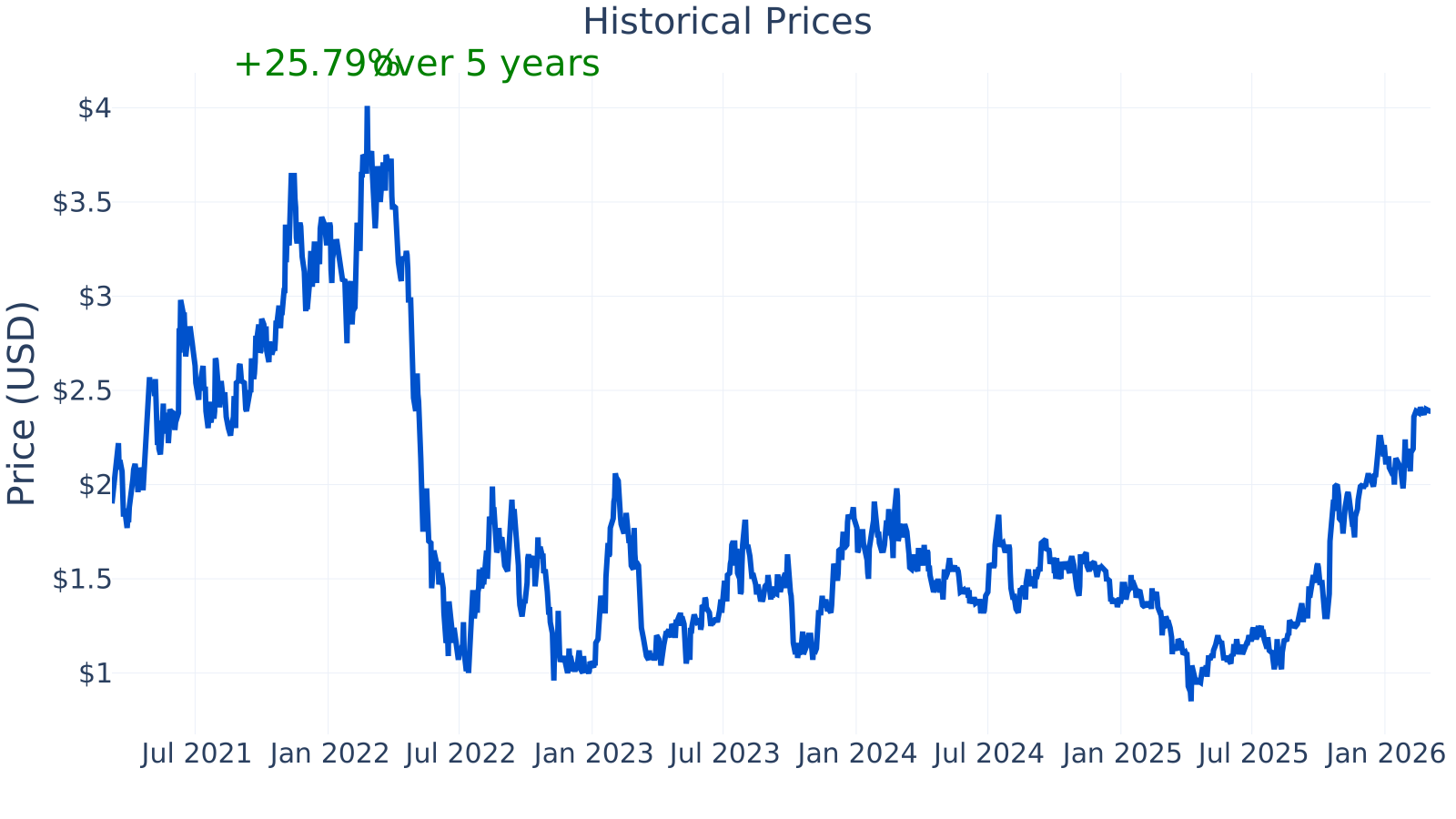
At the latest snapshot, Clear Channel’s market capitalization is about $1.19 billion, and the stock’s beta of about 2.33 indicates it has historically moved much more sharply than the broader market. The profit margin is about 1.24%, which is similar to the industry median in the table, but profitability has not been consistent over time (as shown later). Revenue growth year-over-year is about 8.2%, close to the industry median (~7.9%). Free cash flow over the trailing twelve months is about $32.0 million. The debt-to-equity figure shown is negative, which often happens when total liabilities exceed total shareholders’ equity; in that situation, the ratio is less intuitive than it is for companies with positive equity and generally signals balance-sheet strain rather than “low leverage.”
Growth (Medium)
Out-of-home advertising is a mature category, but it can still grow with overall advertising spend, population and traffic patterns, and continued adoption of digital displays. Industry dynamics are often linked to economic activity: when businesses feel confident, they tend to spend more on advertising; when conditions tighten, ad budgets can be reduced or delayed.
Clear Channel’s strategy described in filings—focusing on higher-return assets and modernizing its display base—fits the core way OOH operators try to improve results: increase the amount of inventory that can be sold at better rates, simplify the portfolio, and run a more efficient cost structure. Digital upgrades, where allowed, can also support shorter campaign cycles and make it easier to sell to a wider set of advertisers.
The year-over-year revenue growth pattern has been volatile. After strong growth in parts of 2021 and early 2022, there were multiple periods of contraction, followed by a return to positive growth more recently (roughly high single digits in the latest periods). For a long-term view, this suggests the business is sensitive to the advertising cycle and may not deliver smooth, steady growth year to year.
Trailing twelve-month free cash flow has improved meaningfully from deeply negative levels earlier in the period shown and has moved close to break-even and slightly positive more recently (about $32 million). That direction can be important because free cash flow is the pool of cash a company can potentially use for debt reduction, reinvestment, or other corporate needs—though one positive period does not, by itself, establish a long-term trend.
Risks (High)
A central risk for Clear Channel is financial leverage and financing cost. The company’s interest expense has been large compared with operating income in the years shown, which can limit flexibility and keep net income negative even when operations are profitable. When interest rates are higher or refinancing options are more expensive, highly leveraged companies can face additional pressure.
The debt-to-equity metric is negative across the whole period displayed, which typically reflects negative shareholders’ equity. In practical terms, that usually means accumulated losses and/or other balance-sheet items have reduced equity below zero, making leverage metrics harder to interpret and increasing the importance of liquidity, debt maturities, and covenant headroom discussed in filings.
Another major risk is cyclical demand. Out-of-home advertising is closely tied to advertising budgets, which tend to rise and fall with economic conditions. This can create swings in revenue and cash generation that may be difficult to predict over shorter periods.
Regulation and permitting are also important. Billboards and digital displays are subject to local rules on placement, size, brightness, and content. Changes in municipal policies or permitting outcomes can affect the ability to expand or upgrade inventory, particularly for digital conversions that often face stricter oversight.
Profit margins have swung widely over the period shown: deeply negative earlier, improving toward break-even, briefly turning slightly positive in one period, and then moving negative again. The industry median margins shown are generally positive across many periods, which highlights that Clear Channel’s profitability has been more stressed than a typical peer set.
Competitive positioning is another factor. Clear Channel operates in a concentrated OOH landscape that includes large, well-known operators with significant scale and premium inventory in major markets. Key competitors commonly cited for U.S. billboards and related OOH include Lamar Advertising and OUTFRONT Media, along with numerous regional and local operators. Scale, location quality, and relationships with advertisers/agencies can be competitive advantages in this industry, but competition for permits, leases, and premium sites is persistent. Clear Channel has brand recognition and a broad footprint, yet the financial profile (notably debt and interest burden) can be a disadvantage versus peers with stronger balance sheets.
Valuation
For valuation, traditional price-to-earnings (P/E) measures can be less informative when earnings are small, volatile, or negative. That context matters for Clear Channel because net income has been negative in multiple recent years, and margins have moved around significantly.
The P/E series shown is mostly not meaningful (displayed as 0 in many periods), which is consistent with a business where earnings are not consistently positive. In the period where a P/E is shown (around 30.6), it is below the industry median displayed nearby (around 48.8 for that date). However, given the inconsistent profitability and the large role of interest expense, P/E alone may not capture the balance-sheet and cash-flow risk that long-term owners typically monitor.
In this situation, investors often spend more time on questions like: whether free cash flow can remain positive through a full cycle, how quickly debt can be reduced, and whether operating improvements can outpace financing costs. Market capitalization (about $1.19 billion in the latest table) also provides only a partial picture because enterprise value can differ materially when net debt is significant.
Conclusion
Clear Channel is a major out-of-home advertising operator whose results depend heavily on advertising demand, the quality and utilization of its display network, and continued modernization of inventory. Recent revenue trends show improvement from weaker periods, and free cash flow has moved closer to positive territory compared with earlier years.
At the same time, the financial structure stands out as a key constraint: interest expense has been very large relative to operating income, net income has remained negative in the years shown, and the negative equity signaled by the debt-to-equity metric adds balance-sheet risk. Competitive pressures and permitting/regulatory limits are ongoing realities in the billboard and urban display business.
Overall, the long-term profile is shaped by a mix of operating leverage to an improving ad cycle and meaningful financial leverage that can amplify downside when conditions weaken or financing costs remain elevated.
Sources:
- SEC EDGAR — Clear Channel Outdoor Holdings, Inc. Form 10-K (Annual Report)
- SEC EDGAR — Clear Channel Outdoor Holdings, Inc. Form 10-Q (Quarterly Report)
- Clear Channel Outdoor Holdings, Inc. — Investor Relations materials and SEC filing exhibits (company-hosted)
- Wikipedia — “Clear Channel Outdoor” (company background and basic history)
This article is for informational purposes only and does not constitute financial advice. Some content is AI-generated. See Disclaimer


