Stock Analysis · Cipher Mining Inc (CIFR)
Overview
Cipher Mining Inc (CIFR) is a Bitcoin mining company. In simple terms, it operates large-scale computing equipment (miners) hosted in industrial data centers to help process transactions on the Bitcoin network. In return, the network pays miners in newly issued bitcoin plus transaction fees. Cipher’s business is therefore closely tied to the Bitcoin ecosystem and to operating costs such as electricity, data center infrastructure, and mining hardware.
The company’s revenue is primarily generated when it successfully mines bitcoin. It can keep the bitcoin it mines (exposing results to bitcoin price changes) or sell some of it to cover operating costs and investments. In addition to mining revenue, Bitcoin miners may have smaller, secondary revenue streams such as hosting/colocation or other services, but Cipher’s core economic engine is mining.
Main sources of revenue (typical for Cipher’s business model, as described in company filings):
- Bitcoin mining revenue (substantially all revenue): value of bitcoin earned from block rewards and transaction fees, recognized under accounting rules when earned.
- Other/ancillary revenue (if any, usually small): may include items like hosting-related income or other minor operational revenues depending on the period and reporting.
At a high level, the recent income profile shows that revenue increased materially from 2022 to 2025, while profitability has been volatile and, in the most recent year shown, sharply negative (driven by costs and other expenses that can move quickly in this industry).
Over the period shown, total revenue rose from about $3.0M (2022) to $223.9M (2025). However, 2025 also shows a negative gross profit (cost of revenue exceeding revenue) and a very large net loss, highlighting how sensitive results can be to factors like mining economics, power and hosting costs, and financing costs.
Key Figures
| Metric | Value | Industry ⓘ |
|---|---|---|
| Date | Mar 09, 2026 | |
| Context | ||
| Sector | Technology | |
| Industry | Information Technology Services | |
| Market Cap ⓘ | $5.52B | |
| Beta ⓘ | 3.01 | |
| Fundamental | ||
| P/E Ratio ⓘ | N/A | 19.90 |
| Profit Margin ⓘ | N/A | 4.91% |
| Revenue Growth ⓘ | 41.40% | 6.25% |
| Debt to Equity ⓘ | 343.50% | 60.43% |
| PEG ⓘ | N/A | |
| Free Cash Flow ⓘ | -$695.86M | |
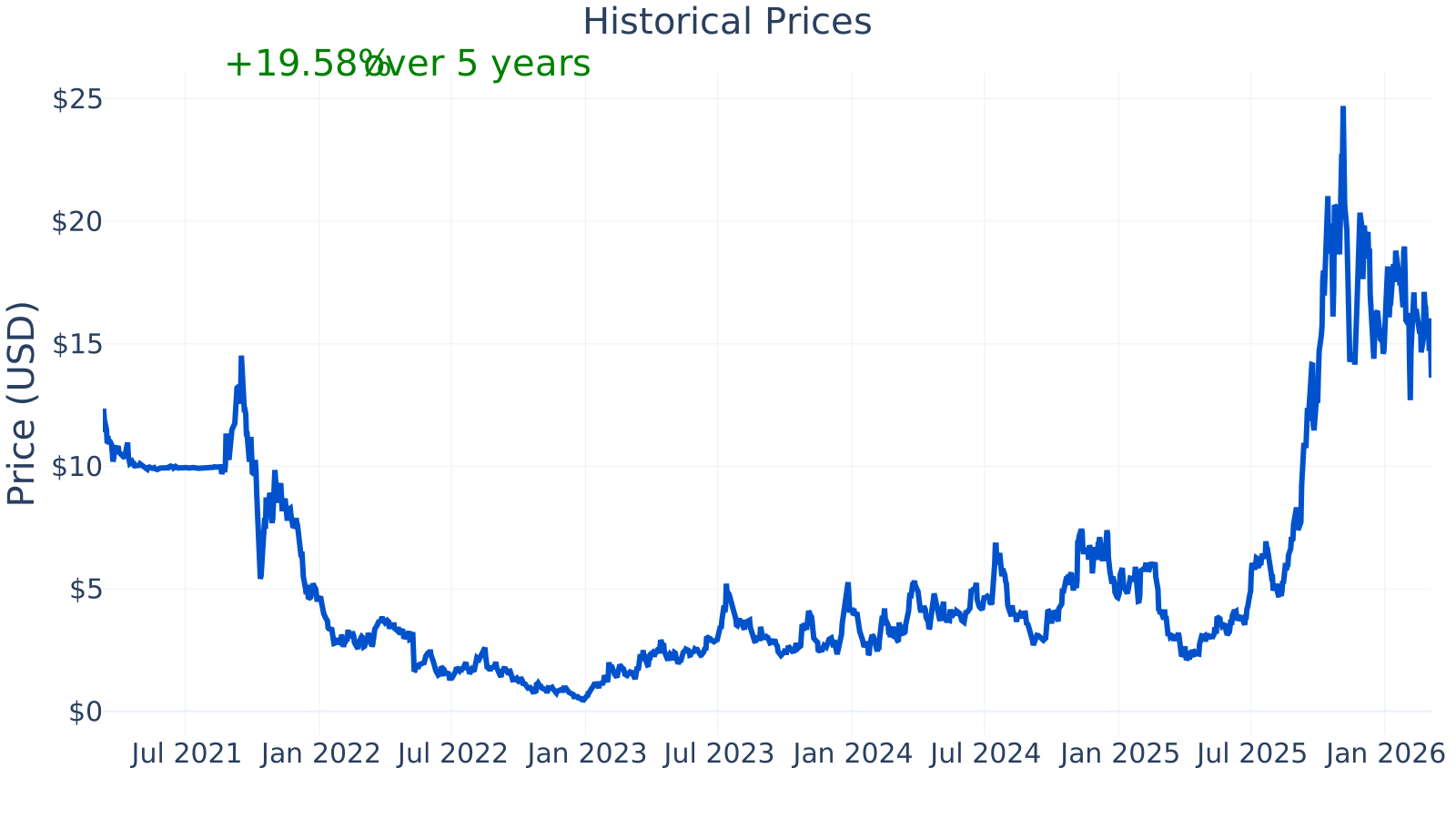
Cipher’s market capitalization is about $5.52B. The stock’s beta of ~3.01 indicates that the share price has historically moved much more than the overall market (high volatility). On growth, the latest year-over-year revenue growth shown is about 41%, above the industry median of about 6% for the stated peer group. Profitability is currently weak: the latest profit margin shown is ~0% in the summary table (and the time series includes multiple negative quarters). Financial leverage is a key item to watch: the latest debt-to-equity is ~343%, well above the industry median of about 60%. Free cash flow over the trailing twelve months is -$695.9M, meaning cash outflows exceeded inflows over that period (often a sign of heavy investment and/or challenging operating economics).
Growth (Medium)
Bitcoin mining sits within the broader digital asset infrastructure space. The industry can expand when bitcoin prices rise, when network transaction activity supports miner economics, and when companies can scale efficiently with low-cost power and modern hardware. At the same time, the network’s “difficulty” (how hard it is to mine) tends to rise as more miners join or upgrade equipment, which can offset growth and push weaker operators out.
For Cipher specifically, the growth logic typically depends on scaling mining capacity while controlling unit costs (especially electricity and hosting) and keeping the equipment fleet competitive. This is a capital-intensive strategy: companies often invest heavily ahead of revenue, and results can improve quickly if mining economics become favorable, but can also deteriorate quickly when they are not.
The year-over-year revenue growth series is highly volatile. It includes extremely large swings (for example, very large positive growth in late 2023 and late 2025) as well as periods of contraction. The most recent point shown is about 41% year-over-year growth, which suggests improving top-line momentum, but the path has not been steady.
Free cash flow has been negative throughout the period shown and has become more negative over time (from roughly -$1.3M in mid-2021 to about -$499.4M by early 2025, with the latest metric table showing -$695.9M TTM). For long-term business building, negative free cash flow can be normal during expansion; however, persistent and widening cash outflows also increase reliance on financing and make the company more exposed if market conditions tighten.
Potential catalysts in this business model (in general terms, consistent with how miners operate) include changes in bitcoin price, changes in network mining difficulty, improvements in power costs or uptime, fleet upgrades, and the ability to finance expansion at manageable terms. These factors can have a faster and larger impact than in many traditional industries.
Risks (Very High)
Cipher’s risk profile is heavily shaped by the economics of Bitcoin mining. Revenue is linked to bitcoin price and network conditions that the company cannot control. At the same time, major costs—electricity, hosting/infrastructure, and hardware—can be substantial. The result is that profitability can swing widely from quarter to quarter, and dilution or additional borrowing can occur if cash needs are large.
The debt-to-equity trend changes dramatically over time. It was very low through 2024 (generally under 10%), then increased sharply in 2025, reaching roughly 343% at the latest point shown, versus an industry median near 60%. A higher leverage level can amplify outcomes: it may help scale faster, but it can also increase financial pressure during unfavorable periods (for example, if mining margins compress or bitcoin prices fall).
Profit margin has also been unstable. The series shows periods of positive margins (for example, around 10%–13% in early/mid 2024) but many quarters with negative margins, and the latest point shown is deeply negative (around -367%). For comparison, the industry median in the chart hovers near 4%–7%. This gap underscores how challenging it can be for miners to consistently convert revenue into bottom-line profit, especially during heavy investment cycles or unfavorable mining economics.
Competitive positioning in Bitcoin mining usually depends on a few practical advantages rather than brand: access to low-cost and reliable power, efficient operations, modern hardware, and disciplined financing. Cipher participates in an industry with several large U.S.-listed peers and private operators. Commonly cited public competitors in the U.S.-listed mining space include companies such as Marathon Digital Holdings, Riot Platforms, CleanSpark, and Hut 8. Relative positioning can shift quickly based on who can add capacity most efficiently and who maintains the lowest cost structure, so leadership is not fixed.
Additional risks that tend to matter for this type of company include:
- Bitcoin protocol events and network changes (for example, periodic reward reductions) that can pressure mining economics if not offset by price or efficiency gains.
- Regulatory and policy uncertainty affecting digital assets and energy usage.
- Operational concentration (dependence on specific sites, power counterparties, or hosting arrangements), which can create downtime or cost shocks.
- Technology obsolescence, as mining hardware can become less competitive over time.
- Share-price volatility, which can affect financing flexibility and investor outcomes even when operations are stable.
Valuation
Valuing a Bitcoin miner is often difficult using traditional measures because earnings can be volatile or negative, and large non-cash items and rapid changes in operating conditions can distort typical multiples. When profits are inconsistent, ratios like P/E can be unavailable, not meaningful, or prone to sudden spikes.
The P/E ratio series is mostly not shown for Cipher (often occurring when earnings are negative or the ratio becomes non-meaningful), with a brief period in 2024 where the P/E appears around ~99–102, while the industry median stayed around ~26–29 in that timeframe. A higher P/E can reflect optimistic expectations during profitable periods, but for miners it can also swing sharply as earnings change. Because profitability has not been stable, it is generally more informative to consider the company’s cash needs (free cash flow), leverage (debt-to-equity), and the durability of operating margins rather than relying on a single valuation multiple.
Conclusion
Cipher Mining is a concentrated way to gain exposure to Bitcoin mining economics through an operating company rather than directly through bitcoin. The company has shown the ability to scale revenue substantially over the last few years, but financial results have been highly variable and the most recent period shown includes very large losses and deeply negative free cash flow.
For a long-term, fundamentals-focused view, the central facts are that (1) outcomes depend heavily on external variables like bitcoin price and network difficulty, (2) operating leverage can create large swings in profitability, and (3) the recent rise in debt-to-equity suggests a meaningfully higher financial risk profile than in prior periods and than the industry median. In this context, assessing Cipher as a long-term stock primarily becomes an assessment of whether its cost structure, operational execution, and financing approach can remain resilient across both favorable and unfavorable Bitcoin cycles.
Sources:
- SEC EDGAR — Cipher Mining Inc filings (Form 10-K, Form 10-Q, Form 8-K)
- Cipher Mining Inc Investor Relations — Press releases and shareholder materials
- Wikipedia — “Cipher Mining” (company overview and basic history)
This article is for informational purposes only and does not constitute financial advice. Some content is AI-generated. See Disclaimer