Stock Analysis · Ciena Corp (CIEN)
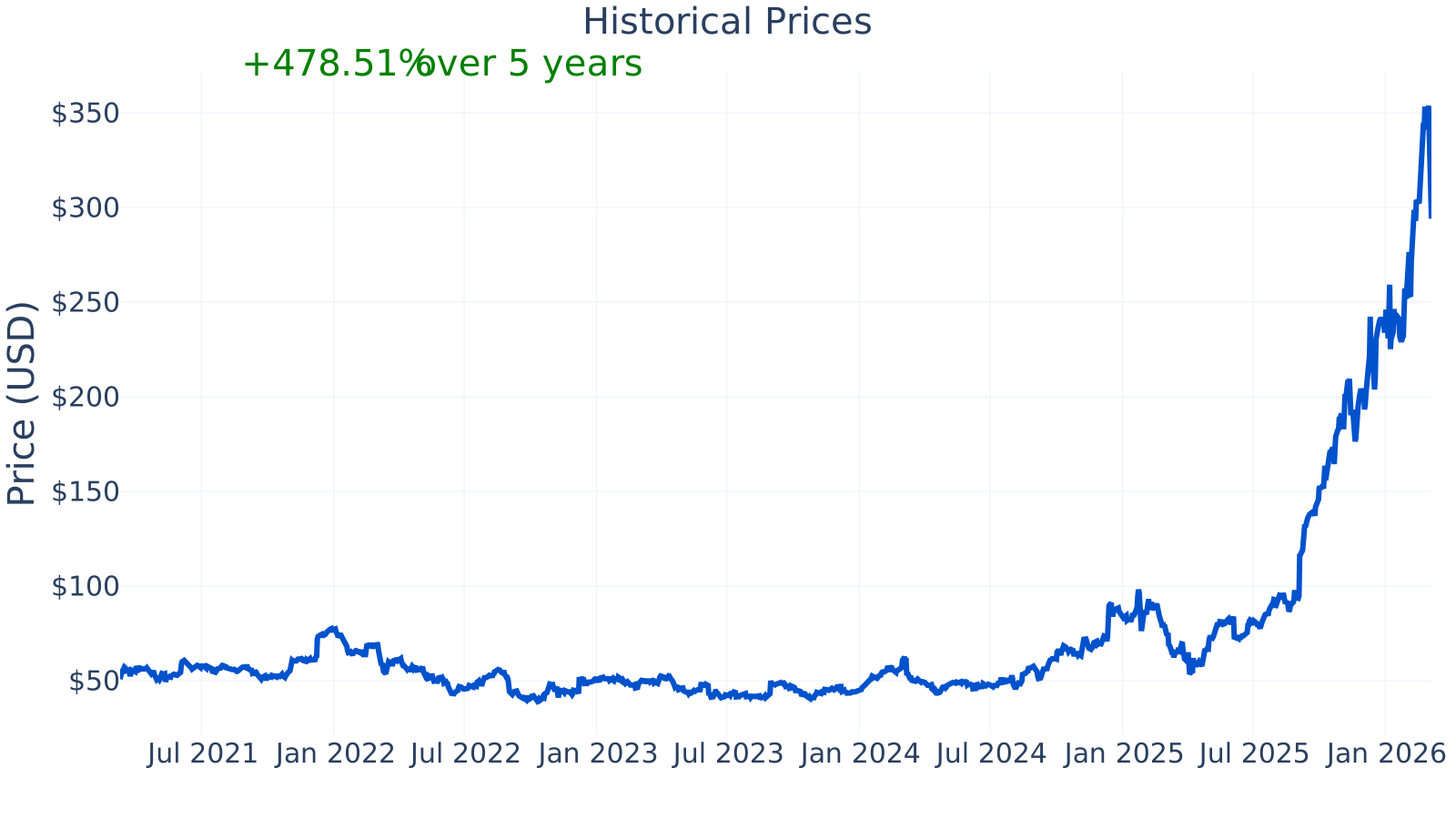
Overview
Ciena Corporation is a networking technology company that helps large organizations move huge amounts of data quickly and reliably. In simple terms, it provides the equipment, software, and services that power the “backbone” of digital communications—especially fiber-optic networks used by telecom carriers, cable operators, cloud providers, and other enterprises. These networks are what make everyday activities like video streaming, cloud computing, mobile data, and business connectivity work at scale.
Ciena’s business is generally built around selling networking products (hardware and software that run optical and IP networks) and supporting them with services (installation, maintenance, and professional services). Over time, the company has emphasized software capabilities and ongoing customer support alongside hardware, because networks are complex and customers typically operate them for many years.
In its SEC filings, Ciena describes revenue in a small number of broad buckets rather than consumer-style product lines. The biggest sources typically include:
- Networking platforms and related software (the core systems used to transmit and manage data across fiber networks)
- Platform and software features / subscriptions (capabilities layered on top of network equipment, depending on customer configuration)
- Services (maintenance/support and professional services such as deployment and optimization)
Because the exact mix can shift by year and depends on customer project timing, the most reliable place to confirm current percentages is the latest annual report (Form 10-K) segment and revenue-disaggregation notes.
The multi-year income-flow view shows that revenue has increased overall from fiscal 2021 to fiscal 2025, but profitability has been uneven. Research and development spending rises materially across the period, which is typical for a communications equipment company that must keep up with fast-evolving network standards. Net income also fluctuates significantly year to year, highlighting that earnings can be sensitive to product mix, pricing, costs, and customer spending cycles.
Key Figures
| Metric | Value | Industry ⓘ |
|---|---|---|
| Date | Mar 09, 2026 | |
| Context | ||
| Sector | Technology | |
| Industry | Communication Equipment | |
| Market Cap ⓘ | $41.61B | |
| Beta ⓘ | 1.09 | |
| Fundamental | ||
| P/E Ratio ⓘ | 346.08 | 46.86 |
| Profit Margin ⓘ | 4.47% | 3.87% |
| Revenue Growth ⓘ | 33.10% | 14.10% |
| Debt to Equity ⓘ | 8.64% | 70.76% |
| PEG ⓘ | 1.39 | |
| Free Cash Flow ⓘ | $742.21M | |
Ciena’s market capitalization is about $41.6B, and its beta of 1.09 suggests the stock has historically moved slightly more than the broader market. The latest P/E ratio (~346) is far above the industry median (~47), which usually happens when earnings are temporarily depressed, the stock price has risen faster than earnings, or both. Profit margin is about 4.47%, roughly in line with the industry median (~3.87%). Recent year-over-year revenue growth (~33.1%) is above the industry median (~14.1%) in the same period. Debt-to-equity is about 8.64%, well below the industry median (~70.8%), indicating comparatively low leverage at this point in time. Trailing twelve-month free cash flow is about $742M, showing cash generation has recently been positive.
Growth (Medium)
Ciena operates in communications infrastructure, a long-lived area supported by persistent demand growth in data traffic. Fiber buildouts, upgrades to higher-capacity optical links, and the expansion of cloud and AI-related data center connectivity are structural themes that can require ongoing investment from carriers and large network operators. That said, spending in this space is often “lumpy”: customers may pause, then accelerate, depending on budgets, macro conditions, and how urgently capacity is needed.
Ciena’s strategy centers on building higher-capacity optical networking systems and the software that helps customers automate, manage, and optimize complex networks. In a market where customers expect multi-year roadmaps, vendor credibility and the ability to deliver upgrades matter. The company’s continued high investment in R&D (visible in the income-flow view) aligns with competing in a technology-driven segment where performance improvements and new features can influence large purchasing decisions.
The revenue growth pattern is volatile across the timeline, including periods of contraction followed by re-acceleration. The most recent point shows a strong rebound (about 33% year-over-year), which stands out versus the industry median shown in the table. For long-term context, the key question is whether stronger growth persists across multiple periods or reflects timing of large customer deployments.
Free cash flow swings from positive to negative and back to positive, with the most recent trailing figure around $742M. For an equipment supplier, this can reflect working capital timing (inventory and receivables), as well as profitability and capital spending needs. A sustained pattern of positive free cash flow over several periods is typically more informative than a single strong year.
Risks (High)
Ciena’s results can be heavily influenced by spending cycles at a relatively concentrated set of large customers (such as telecom carriers and major network operators). When these customers slow capital expenditures, projects can be delayed or resized, affecting revenue visibility and margins. This customer-driven cyclicality is a core risk for many companies selling “big-ticket” network infrastructure.
Competition is intense. Ciena participates in optical transport and networking markets where it faces large, well-funded rivals and specialized vendors. Key competitors commonly include Nokia (optical and IP networking), Cisco (routing/switching and broader networking), Coherent (formerly II-VI) and other optical component/solutions providers in parts of the ecosystem, and additional optical networking vendors depending on the segment and geography. Competitive positioning tends to vary by product category (optical line systems, coherent optics, network control software, routing, etc.) and by customer requirements, so “leadership” is not a single all-or-nothing label across the entire portfolio.
The debt-to-equity trend is generally moderate for most of the timeline and then drops sharply at the most recent point to about 8.6%, below the industry median shown. If this level is sustained, it can reduce financial risk (less reliance on borrowing). However, large shifts can also occur due to balance-sheet changes over time, so it is useful to verify the drivers in the latest 10-Q/10-K (debt balances, equity changes, and any refinancing).
Profit margin declines substantially from earlier double-digit levels in the timeline to low single digits, then recovers to about 4.47% most recently (roughly in line with the industry median at that point). This history underscores a key risk: even when revenue grows, profitability can be pressured by product mix, pricing, supply chain costs, and operating expense levels—especially in periods of heavy investment.
Valuation
One commonly used valuation metric is the price-to-earnings (P/E) ratio, which compares the stock price to earnings. For Ciena, the latest P/E in the table is about 346, far above the industry median (~47). A very high P/E often signals that reported earnings are currently low relative to the stock price, which can happen when margins have been pressured, when there are unusual items affecting earnings, or when the market is assigning a high value to expected future improvement.
The historical P/E series shows that Ciena’s valuation multiple has moved from the teens/20s earlier in the timeline to substantially higher levels more recently, while the industry median has remained far lower. Interpreting this requires context: if earnings normalize upward (for example, through better margins, higher scale, or improved product mix), the P/E can fall even without a stock price decline. Conversely, if earnings remain compressed or volatile, a high P/E can persist and makes the valuation more sensitive to disappointments.
Because Ciena operates in a cyclical, project-driven market, valuation is often better understood alongside multiple indicators: revenue durability, margin trajectory, and cash generation. The recent combination of strong year-over-year revenue growth and positive free cash flow is supportive from an operating perspective, while the very high earnings multiple indicates that profitability levels are a central variable to monitor.
Conclusion
Ciena is a communications infrastructure company focused on optical networking platforms, related software, and services that enable high-capacity data transport. The long-term demand backdrop for bandwidth and fiber connectivity is supported by structural growth in data traffic, but customer spending can be cyclical and results can vary meaningfully from year to year.
The recent picture combines strong revenue growth, positive free cash flow, and low leverage (relative to industry medians), alongside a track record of uneven profitability and a very elevated P/E ratio versus peers. In practical terms, the main long-term variables to track are whether margins and earnings become more consistent, how durable demand is across customer cycles, and whether continued R&D investment translates into competitive products that win repeat deployments.
Sources:
- U.S. SEC EDGAR — Ciena Corporation filings (Form 10-K, 10-Q, 8-K)
- Ciena Investor Relations — Annual Report materials and SEC filing copies
- Wikipedia — “Ciena” (basic company background)
This article is for informational purposes only and does not constitute financial advice. Some content is AI-generated. See Disclaimer


