Stock Analysis · Churchill Downs Incorporated (CHDN)
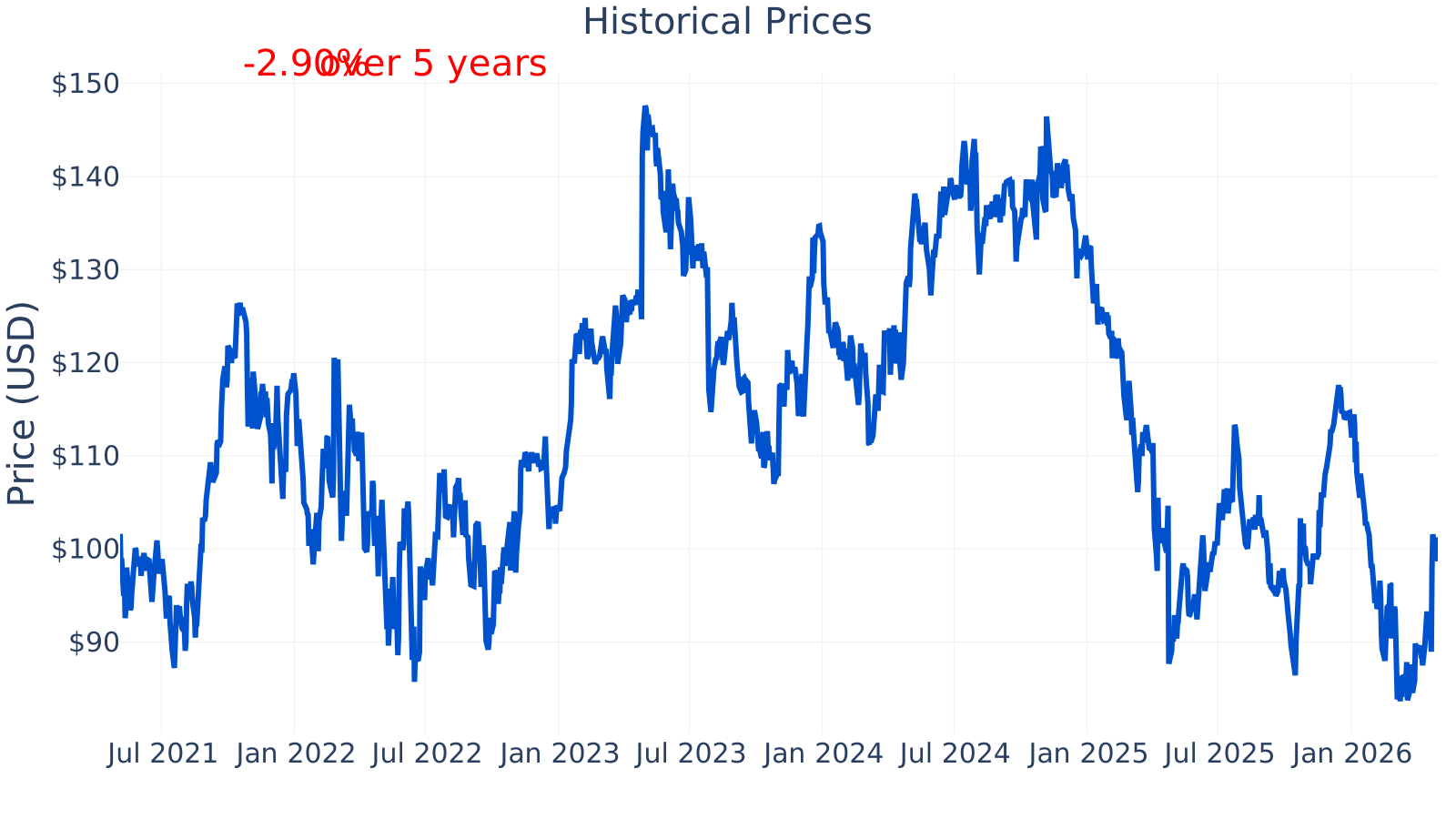
Overview
Churchill Downs Incorporated (CHDN) is a U.S.-based gambling and entertainment company best known for operating Churchill Downs racetrack and hosting the Kentucky Derby. Beyond horse racing, the company runs regional casino-style gaming properties (often called “racinos” when attached to racing), and it also operates online wagering businesses. In practice, CHDN blends well-known live events with recurring local gaming revenue and a digital platform that can scale across states where it is permitted.
In its SEC filings, CHDN typically reports results across three main business areas. In simple terms, revenue mainly comes from:
- Live and historical horse racing gaming venues (regional properties that offer gaming entertainment and related food & beverage)
- Online wagering (digital horse-racing betting via its online platforms, where allowed)
- Racing and events (Churchill Downs racetrack operations, including the Kentucky Derby and associated activities)
Because revenue mix can shift year to year (and depends on acquisitions, property expansions, and state rules), the most reliable breakdown and percentages are found in the latest annual report segment footnote rather than in general market summaries.
Across recent years, total revenue has risen meaningfully (about $1.6B in 2021 to about $2.9B in 2025), while operating income has remained strong (roughly $0.4B to $0.8B). One item that stands out is interest expense, which increased materially from 2021 to 2025; that matters because higher interest costs can reduce the portion of operating profit that ultimately becomes net income.
Key Figures
| Metric | Value | Industry ⓘ |
|---|---|---|
| Date | May 04, 2026 | |
| Context | ||
| Sector | Consumer Cyclical | |
| Industry | Gambling | |
| Market Cap ⓘ | $6.88B | |
| Beta ⓘ | 0.65 | |
| Fundamental | ||
| P/E Ratio ⓘ | 18.17 | 32.91 |
| Profit Margin ⓘ | 13.21% | 5.85% |
| Revenue Growth ⓘ | 3.10% | 4.30% |
| Debt to Equity ⓘ | 449.64% | 190.53% |
| PEG ⓘ | 1.57 | |
| Free Cash Flow ⓘ | $674.60M | |
CHDN’s market capitalization is about $6.9B, and its beta of ~0.65 suggests the stock has historically moved less than the broader market on average (though that can change). The company’s P/E ratio is ~18.2, below the industry median ~32.9 in this peer set, while its profit margin is ~13.2% versus an industry median ~5.9%, indicating stronger profitability than many gambling peers. Recent year-over-year revenue growth is ~3.1% (industry median ~4.3%), which points to slower current growth than the median competitor set. A key balance-sheet item is leverage: debt-to-equity is ~450% versus an industry median ~191%, indicating heavier use of debt relative to equity than typical peers. Trailing twelve-month free cash flow is about $675M, a meaningful source of flexibility for reinvestment, debt service, and other corporate needs.
Growth (Medium)
CHDN operates within the broader legal gambling industry, which is shaped less by technology disruption and more by regulatory expansion (state-by-state), consumer entertainment spending, and the company’s ability to build or acquire attractive properties. A practical long-term tailwind for CHDN is that it participates in multiple formats—destination events (Kentucky Derby), local/regional gaming, and online wagering—so growth does not depend on a single channel.
Revenue growth has been positive in most periods shown, but it has also moderated recently. In the latest period displayed (2026-03-31), year-over-year growth is about 3.2%, below the peer median shown in the table. This pattern can be consistent with a mature business mix where growth depends on capacity expansions, new properties, acquisitions, and jurisdiction openings rather than rapid organic acceleration every quarter.
Free cash flow has been volatile over the periods shown (including a negative stretch in 2024), followed by a strong rebound to roughly $675M in the most recent trailing twelve months. For a company in gaming and venues, swings can happen due to expansion projects, property upgrades, or other timing effects where cash spending occurs ahead of revenue. Over the long run, consistently positive free cash flow is important because it can support reinvestment and reduce reliance on external financing.
Potential catalysts for future growth (in a neutral, factual sense) tend to include: new or expanding gaming jurisdictions, successful property expansions that raise capacity and foot traffic, and improvements in online wagering scale where permitted. The Kentucky Derby and associated “Derby Week” also function as a globally recognized brand asset that can support pricing power and sponsorship interest, though it is concentrated around a specific time of year.
Risks (High)
CHDN’s risk profile reflects a combination of regulatory exposure, consumer spending sensitivity, and meaningful financial leverage. Gambling businesses can be resilient, but they are not immune to economic downturns; local gaming spend and travel/entertainment budgets can weaken during tougher economic periods. In addition, state regulations and tax rates can change, and approvals are required for many expansions and operating permissions.
Leverage is a central risk to track. The latest debt-to-equity shown is about 450%, above the peer median displayed. While debt can amplify returns in good periods, it can also reduce flexibility when interest rates are high or when operating performance softens. The historical series shows CHDN has remained above the industry median over time, even as the ratio has improved from prior peaks.
Profitability is a comparative strength: the latest profit margin is about 13.1%, and the company has generally stayed well above the peer median shown across the period. Still, margins can be pressured by higher labor and operating costs at properties, changes in promotional intensity in online wagering, and interest expense (which does not appear in operating margin but affects net results).
On competitive positioning, CHDN is a well-known name in U.S. racing and has a distinctive marquee event in the Kentucky Derby, which is difficult to replicate and can be viewed as a brand-based advantage. In regional gaming and online wagering, competition is more direct. Major competitors in U.S. gambling broadly include large casino operators and gaming-focused digital operators; however, CHDN’s mix (regional gaming plus racing heritage plus online horse wagering) is somewhat differentiated versus companies focused only on destination casinos or only on digital sports betting. Competitive intensity is typically highest where multiple operators can target the same customers with similar offerings, especially in digital channels and in mature regional markets.
Valuation
At the latest point shown, CHDN’s P/E ratio is about 18.4, below the peer median (about 21.6 on the same date in the chart) and also below the industry median shown in the table. Historically, the displayed P/E range includes periods in the 20s to 40s earlier in the timeline, with more recent readings in the high teens to low 20s. Interpreting this in context, a lower P/E can reflect a combination of factors such as slower near-term growth, higher leverage, or investor caution about regulatory and cyclical risks—while a higher P/E often corresponds to stronger expected growth or perceived stability.
Whether the current valuation is “expensive” or “cheap” cannot be concluded from a single ratio alone. For CHDN, the main fundamentals that interact with valuation are: (1) moderating revenue growth in the most recent period, (2) stronger-than-peer margins, (3) meaningful leverage and interest costs, and (4) the company’s ability to sustain cash generation while continuing to invest in properties and digital platforms. Comparing valuation to peers is also complicated because gambling companies can have very different mixes (destination resorts vs. regional casinos vs. online-heavy models) and different regulatory footprints.
Conclusion
Churchill Downs Incorporated combines a unique, long-standing racing brand (anchored by the Kentucky Derby) with a broader portfolio of gaming venues and online wagering. Financially, the company shows a pattern of growing revenue over multiple years and profitability metrics that have often exceeded the peer median shown, alongside recently strong trailing free cash flow.
The main trade-offs visible from the fundamentals discussed are that recent revenue growth has cooled to low single digits while leverage remains elevated versus peers, which increases sensitivity to interest costs and operating setbacks. In a long-term context, the company’s results may hinge on disciplined capital allocation, the pace of new or expanded gaming opportunities, and the ability to maintain strong operating performance across properties while managing debt levels.
Sources:
- SEC EDGAR — Churchill Downs Incorporated filings (Form 10-K, Form 10-Q)
- Churchill Downs Incorporated Investor Relations — Annual Report / Form 10-K (Business and Segment Information sections)
- Wikipedia — “Churchill Downs Incorporated” (basic company background)
This article is for informational purposes only and does not constitute financial advice. Some content is AI-generated. See Disclaimer


