Stock Analysis · Chewy Inc (CHWY)
Overview
Chewy, Inc. (CHWY) is an online retailer focused on pet products and pet-related services in the United States. The company sells everyday essentials like pet food and treats, as well as discretionary items like supplies and accessories. Chewy also offers services tied to ongoing pet care, including pet pharmacy offerings, which can help increase repeat purchasing and customer retention over time. The business model is built around e-commerce convenience (home delivery), a broad product selection, and recurring demand driven by routine pet care needs.
Chewy’s revenue is primarily generated from product sales to customers through its online platform. In its filings, the company generally describes its sales as coming mainly from pet food and treats, alongside other product categories such as hard goods (supplies). Chewy also generates revenue from pet health-related offerings (such as pharmacy), which are typically positioned as a way to deepen customer relationships and increase repeat activity. Public filings often emphasize autoship/subscription-style repeat orders as an important component of how Chewy operates, even when the revenue line itself is reported as total net sales rather than many separate segments.
Main sources of revenue (high-level categories described in company filings):
- Pet food and treats (core, recurring purchase category)
- Hard goods (supplies, accessories, and other discretionary items)
- Pet health-related offerings (including pharmacy)
Over the last several fiscal years shown, total revenue increased from about $9.0B (FY2022) to about $11.9B (FY2025). Gross profit also rose (about $2.4B to about $3.5B), while operating income moved from a loss (FY2022) to positive levels in subsequent years, indicating improved cost discipline relative to sales. Selling, general, and administrative expenses remain the largest operating cost line, which is typical for an e-commerce business with fulfillment, marketing, and customer service costs.
Key Figures
| Metric | Value | Industry ⓘ |
|---|---|---|
| Date | Feb 07, 2026 | |
| Context | ||
| Sector | Consumer Cyclical | |
| Industry | Internet Retail | |
| Market Cap ⓘ | $11.63B | |
| Beta ⓘ | 1.60 | |
| Fundamental | ||
| P/E Ratio ⓘ | 57.18 | 34.01 |
| Profit Margin ⓘ | 1.64% | 6.32% |
| Revenue Growth ⓘ | 8.30% | 11.35% |
| Debt to Equity ⓘ | 111.42% | 34.80% |
| PEG ⓘ | 1.07 | |
| Free Cash Flow ⓘ | $487.00M | |
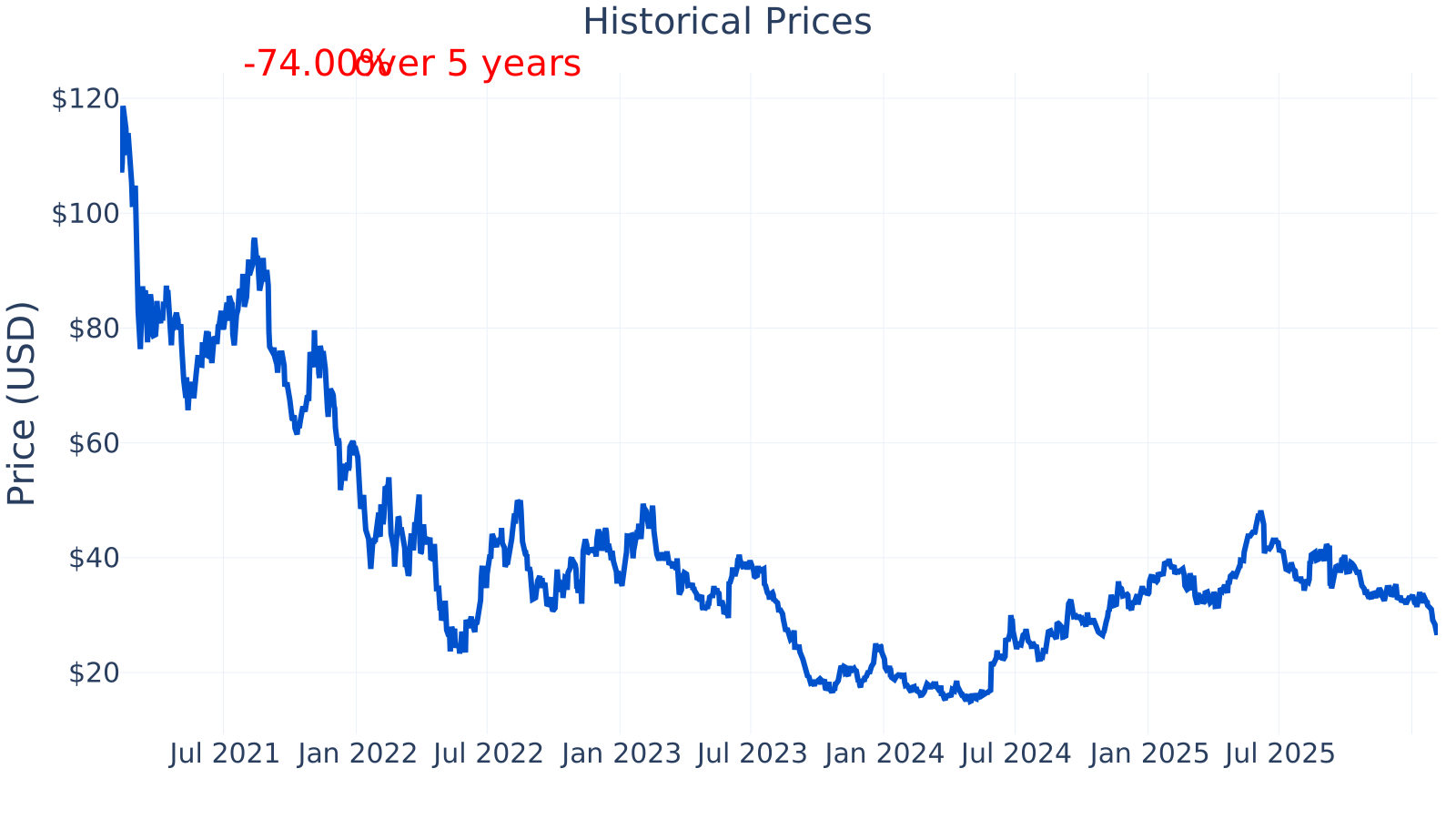
Chewy’s market capitalization is about $11.6B. The stock’s beta is about 1.60, which commonly indicates higher price swings than the broader market. Profit margin is about 1.64% versus an industry median near 6.32%, showing thinner profitability than many peers in the same broad industry grouping. Year-over-year revenue growth is about 8.3% versus an industry median near 11.35%, suggesting growth that is positive but below the median at this point in time. Debt-to-equity is about 111% versus an industry median near 34.8%, which indicates heavier use of leverage than the median peer. Free cash flow over the trailing twelve months is about $487M, a notable positive figure that can matter for funding operations and potential strategic initiatives.
Growth (Medium)
The pet industry tends to have supportive long-term characteristics because spending on pets includes many non-discretionary items (food and health). This can make demand more stable than some other consumer categories, even though discretionary categories (toys, accessories, upgrades) can be more sensitive to economic conditions. Chewy’s focus on repeat purchase behavior (for example, recurring deliveries) fits well with the everyday-needs nature of pet care, and the company’s expansion into pet health offerings is consistent with a strategy to increase customer lifetime value through higher-frequency and higher-importance categories.
The year-over-year revenue growth pattern shows a clear slowdown from the high-growth period earlier in the timeline (above 20–30% in parts of 2021) to low single digits in parts of 2024, followed by a rebound into the high single digits and a spike around early 2025. More recently, growth appears to have stabilized around the 8–9% range. For a long-term view, this type of trajectory can imply that the company is operating in a more mature phase than during its earlier rapid expansion, with results increasingly dependent on customer retention, wallet-share gains, and efficiency improvements rather than purely new-customer growth.
Free cash flow improved substantially over the period shown, rising from roughly $8.6M (FY2022) to about $452.5M (FY2025), with the latest trailing twelve months around $487M. For an e-commerce retailer, sustained free cash flow can be an important internal source of funding for fulfillment capabilities, technology, and customer experience initiatives without relying as heavily on external financing.
Potential catalysts (in a neutral, business-focused sense) typically relate to: deeper penetration of repeat-order programs, scaling pet health offerings, improving shipping and fulfillment economics, and maintaining strong customer service differentiation. Because pet ownership and pet care demand are structurally recurring, performance often comes down to execution: service levels, pricing competitiveness, and unit economics.
Risks (High)
This article is for informational purposes only and does not constitute financial advice. Some content is AI-generated. See Disclaimer


