Stock Analysis · The Cheesecake Factory (CAKE)
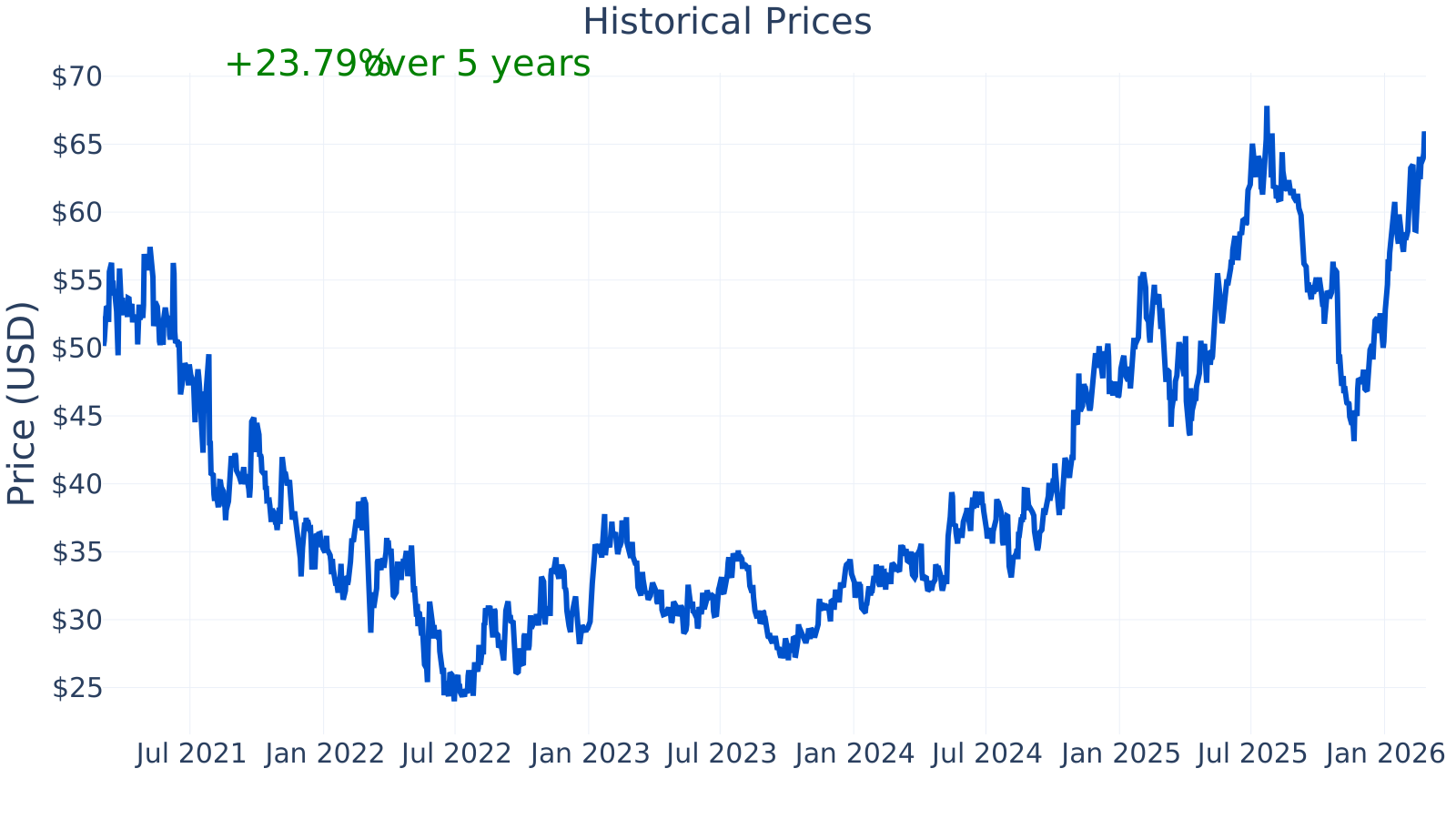
Overview
The Cheesecake Factory Incorporated (NYSE: CAKE) is a U.S.-based restaurant company best known for its full-service casual dining brand, The Cheesecake Factory. It operates large-format restaurants with extensive menus and dessert offerings, and it also participates in other restaurant concepts. Like most restaurant businesses, its day-to-day performance is heavily influenced by guest traffic, menu pricing, labor availability and wages, and food and commodity costs.
At a high level, revenue comes primarily from selling food and beverages to guests in company-operated restaurants. The business also has smaller contributions from other concepts and channels (such as additional restaurant brands and related operations), which can help diversify results but still typically remain secondary to the flagship brand.
Main revenue sources (largest to lowest, percentages depend on the latest annual filing segment detail):
- Company-operated restaurants (food & beverage sales) – the core driver of revenue and profits
- Other restaurant concepts / operations – smaller contribution relative to the flagship restaurants
- Other revenue streams (as applicable in filings) – may include items such as licensing/royalties or other operating revenue, depending on how the company reports segments
From a long-term perspective, this is a consumer-facing operating company: results depend more on restaurant-level execution and cost control than on owning patented technology or having recurring subscription revenue.
Over the period shown, total revenue rises from about $2.93B (2021) to about $3.75B (2025), while net income increases from about $72M to about $148M. Operating income also grows meaningfully versus earlier years, which suggests improved operating performance compared with the immediate post-pandemic period, even as operating expenses remain a large portion of the cost structure (typical for full-service restaurants).
Key Figures
| Metric | Value | Industry ⓘ |
|---|---|---|
| Date | Mar 02, 2026 | |
| Context | ||
| Sector | Consumer Cyclical | |
| Industry | Restaurants | |
| Market Cap ⓘ | $3.23B | |
| Beta ⓘ | 0.98 | |
| Fundamental | ||
| P/E Ratio ⓘ | 19.69 | 27.73 |
| Profit Margin ⓘ | 3.96% | 7.24% |
| Revenue Growth ⓘ | 4.40% | 7.35% |
| Debt to Equity ⓘ | 793.32% | 99.20% |
| PEG ⓘ | 1.34 | |
| Free Cash Flow ⓘ | $155.08M | |
The company’s market capitalization is about $3.23B and its beta is about 0.98, which is close to the overall market’s volatility level in simple terms. The latest P/E ratio is ~19.7 versus an industry median of ~27.7. Profitability is positive but relatively thin: the latest net profit margin is about 4.0% versus an industry median of ~7.2%. Recent year-over-year revenue growth is about 4.4% compared with an industry median of ~7.4%. Leverage stands out: debt-to-equity is about 793% versus an industry median of ~99%. Trailing twelve-month free cash flow is about $155M, indicating the business is generating cash after operating needs and capital spending.
Growth (Medium)
The company operates in the restaurant industry, which is generally a mature category tied to population growth, consumer discretionary spending, and dining-out habits. That means long-term growth typically comes from a mix of new restaurant openings, gradual menu price increases, and improving restaurant-level economics (for example, better labor productivity or more efficient sourcing).
Strategically, a full-service chain like The Cheesecake Factory often focuses on sustaining brand relevance, maintaining consistent guest experience, and managing costs in an environment where wage and food inflation can move quickly. Because the base business is already large, growth is often steadier rather than explosive, and the most important “catalysts” are usually operational: traffic trends, same-restaurant sales, margin improvement, and disciplined expansion where returns justify new unit investment.
The year-over-year revenue growth rate was unusually high in 2021 (reflecting recovery dynamics off a depressed base), then moderated. In the most recent periods shown, growth stabilizes in the mid-single digits (around 4%–6%), which is more consistent with a mature restaurant operator than a high-growth concept.
Free cash flow trends upward overall versus earlier years, reaching about $155M in the trailing twelve months shown. In a restaurant business, sustained free cash flow matters because it can be used for reinvestment (remodels, new units), debt service, and other corporate priorities. Fluctuations can still occur due to changes in operating performance and the timing of capital expenditures.
Risks (High)
The central risks are typical for full-service dining: consumer demand can weaken during economic slowdowns; food and labor costs can rise faster than menu pricing; and competition for both customers and hourly employees can pressure performance. In addition, large-format restaurants often carry meaningful fixed costs (rent, labor scheduling needs, utilities), which can magnify the impact of traffic declines on profitability.
A key balance-sheet-related risk is leverage. Restaurants can operate successfully with debt, but higher leverage generally reduces flexibility during periods of softer demand or higher interest rates, because more cash flow must be allocated to required payments rather than optional reinvestment.
Debt-to-equity is elevated relative to the industry median across the period shown and is currently about 793% versus an industry median near 129% in the latest point shown. This is a major differentiator versus many peers and increases sensitivity to financing conditions and business volatility.
Profitability is another important risk area because restaurants often operate on thin margins even in good times. Small changes in costs or traffic can have an outsized effect on net income.
Net profit margin improves from negative territory in early 2021 to around 4% recently, showing a recovery and better earnings power than the earlier period. However, it remains below the industry median (roughly 6.9%–8.1% in many of the periods shown), suggesting peers on average are converting a higher portion of sales into bottom-line profit.
On competitive positioning, The Cheesecake Factory is a well-known national brand with a differentiated menu breadth and dessert identity, which can be a brand advantage. At the same time, it competes in a crowded landscape that includes large casual-dining chains and other “occasion” dining options. Key competitors commonly include other large U.S. casual-dining operators and restaurant groups with multiple concepts. In such a competitive market, leadership is often local and concept-specific rather than absolute; sustained advantage typically comes from execution, consistent guest experience, and cost discipline rather than exclusivity.
Valuation
The company’s current P/E ratio is about 19.7, below the industry median of about 27.7. Over the historical period shown, the P/E multiple moves substantially, with periods where it was above the industry median and more recent points where it is below. A lower P/E than peers can reflect differences in expected growth, perceived risk, profitability, or balance-sheet structure.
In context, several fundamentals help frame how a market multiple could be interpreted:
- Growth is currently mid-single digit on a year-over-year revenue basis (around 4%–6% recently), which is steady but not high.
- Profit margins have improved but remain below the industry median, which can weigh on valuation if the market expects margins to stay structurally lower.
- Leverage is significantly higher than the peer median, which can increase perceived risk and affect how much investors are willing to pay per dollar of earnings.
As a result, the valuation picture is mixed: the multiple is lower than the peer median, while profitability and leverage metrics are also less favorable than the typical peer benchmark shown. Whether the multiple looks “high” or “low” depends heavily on future execution—especially maintaining traffic, sustaining pricing power without losing demand, and keeping costs controlled while managing the balance sheet.
Conclusion
The Cheesecake Factory is a scaled, brand-recognized full-service restaurant operator whose results are driven primarily by restaurant sales and operational execution. Recent years show higher revenue and improved profitability versus the early-2021 period, and free cash flow is positive, which supports ongoing business needs.
At the same time, the company faces the standard cyclical and cost risks of the restaurant industry, and its leverage stands out as materially higher than the industry median in the metrics shown. Profit margins have recovered but remain below the peer median, which keeps the long-term narrative focused on continued operational improvement rather than purely industry tailwinds.
On valuation, the P/E ratio is below the industry median, which can be consistent with the company’s mix of moderate growth, below-median margins, and higher leverage. The long-term investment profile therefore depends mainly on whether the company can sustain steady sales growth, protect margins through cost and pricing discipline, and maintain financial flexibility despite higher debt levels.
Sources:
- SEC EDGAR — The Cheesecake Factory Incorporated filings (Form 10-K, Form 10-Q)
- The Cheesecake Factory — Investor Relations materials (annual report content, press releases, and company-hosted earnings materials where available)
- Wikipedia — “The Cheesecake Factory” (basic company background only)
This article is for informational purposes only and does not constitute financial advice. Some content is AI-generated. See Disclaimer


