Stock Analysis · Charter Communications Inc (CHTR)
Overview
Charter Communications Inc. (CHTR) is a U.S. broadband connectivity company best known for its Spectrum brand. It provides residential and business customers with high-speed Internet, video (pay TV), and voice services, and it also sells mobile service as an add-on by using another carrier’s wireless network (an MVNO model). Its business is built around owning and operating a large cable network (“last-mile” infrastructure) that connects homes and businesses to the Internet.
In simple terms, Charter’s day-to-day economics are driven by (1) how many customer relationships it has, (2) how much each customer pays per month for Internet, mobile, video, and voice bundles, and (3) how much it must spend to maintain and upgrade its network while also paying interest on its debt.
In Charter’s reporting, revenue is primarily organized around customer types and product lines. The largest revenue stream is typically Residential services (especially Internet), followed by Commercial services (small and mid-sized businesses), with Advertising and other categories as smaller contributors. Exact percentages can vary by year and are detailed in the company’s annual report segment disclosures.
Across the recent annual view shown, total revenue is fairly steady around the mid-$50B range, while interest expense remains a large, persistent cost item (over $5B in the most recent years shown). This highlights a business that can generate meaningful operating income, but where financing costs are a significant ongoing claim on profits.
Key Figures
| Metric | Value | Industry ⓘ |
|---|---|---|
| Date | Apr 28, 2026 | |
| Context | ||
| Sector | Communication Services | |
| Industry | Telecom Services | |
| Market Cap ⓘ | $24.65B | |
| Beta ⓘ | 1.03 | |
| Fundamental | ||
| P/E Ratio ⓘ | 4.72 | 14.35 |
| Profit Margin ⓘ | 9.03% | 7.29% |
| Revenue Growth ⓘ | -1.00% | 4.10% |
| Debt to Equity ⓘ | 585.96% | 105.78% |
| PEG ⓘ | 0.30 | |
| Free Cash Flow ⓘ | $4.03B | |
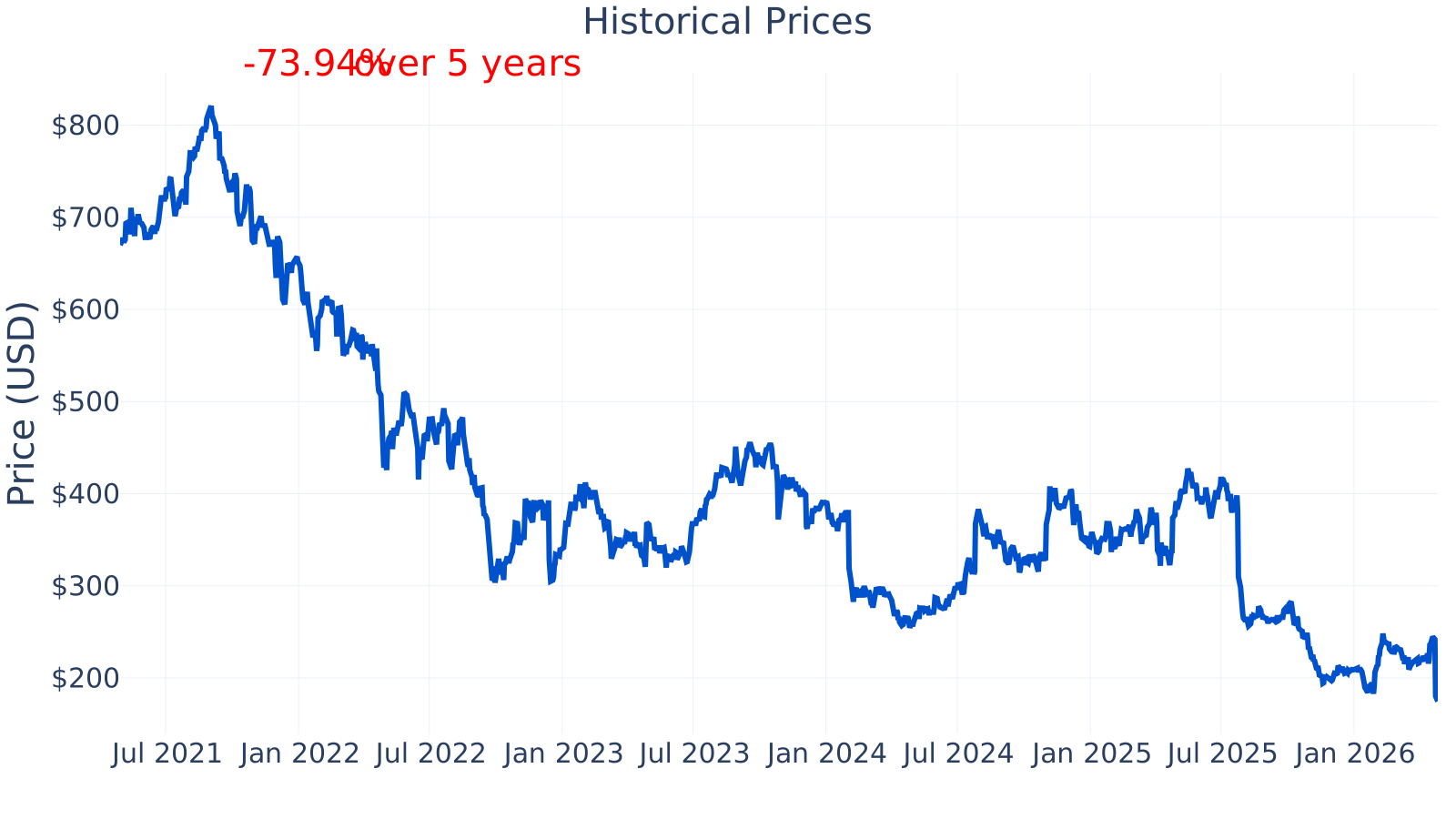
At the latest snapshot, Charter’s market capitalization is about $24.7B and the stock’s beta is near 1.03, which is close to the broader market’s typical day-to-day volatility. The company’s profit margin is about 9.0%, above the industry median shown (~7.3%). Revenue growth year over year is about -1.0%, below the industry median (~4.1%), indicating recent top-line pressure. Leverage stands out: debt-to-equity is ~586% versus an industry median near 106%, reflecting a capital structure that relies heavily on debt. The trailing twelve-month free cash flow is about $4.03B, which is a key resource for debt service, network investment, and other corporate uses.
Growth (Medium)
Broadband demand is supported by long-term trends that are easy to see in everyday life: more video streaming, more connected devices per household, remote/hybrid work, online gaming, and cloud-based services. That said, in many U.S. markets, broadband is no longer an early-stage “new subscriber” story; it is more mature, and growth often depends on taking share from competitors, upgrading customers to faster tiers, and expanding into new service areas.
Charter’s strategy broadly centers on maintaining and upgrading its network to stay competitive on speed and reliability, while also increasing the number of products per household (for example, pairing Internet with mobile service). In mature connectivity markets, “bundle depth” (how many services a customer takes) can matter as much as raw subscriber additions, because bundles can reduce churn (customer cancellations) and lift revenue per customer.
The revenue growth pattern shown trends downward over time: from mid-single-digit to high-single-digit growth earlier in the period to roughly flat and then slightly negative (about -1% most recently). This suggests that, recently, Charter has faced a tougher environment for expanding total sales—consistent with a more competitive broadband landscape and a more mature base of connectivity customers.
Free cash flow remains substantial, though it has fluctuated meaningfully: from about $8.6B (2022) down to the $3.2B–$4.6B range in the later periods shown, with the most recent around $4.0B. For a network operator, free cash flow matters because it can support ongoing infrastructure spending while also covering interest costs and scheduled debt repayments.
Potential catalysts for improved growth typically depend on execution and market conditions rather than a single product launch: better broadband net adds, improved pricing power, successful mobile penetration within the existing customer base, and efficient network upgrades that keep service quality high while controlling costs.
Risks (High)
Competition is a central risk. Charter competes with fiber providers (including large telecom operators), fixed wireless offerings, and other cable companies in some regions. When more high-quality broadband options exist in the same neighborhood, pricing and customer retention can become more difficult. Video (traditional cable TV) also faces structural pressure as many households shift to streaming-only options, which can reduce high-margin video bundle revenue and increase churn if Internet relationships are not retained.
Charter does have competitive strengths that can function as advantages in many local markets: an established last-mile network, scale benefits in marketing and customer service operations, and the ability to upgrade speeds across a large footprint. However, it is not alone—large, well-capitalized competitors can also invest heavily, especially in fiber buildouts or wireless broadband.
Leverage and refinancing conditions are another major risk. Charter historically uses significant debt, and its financial results show large interest expense. Higher interest rates (or tighter credit markets) can raise the cost of new borrowing and refinancing, which may limit flexibility even if operating performance is stable.
The leverage ratio shown is consistently far above the industry median. Most recently, debt-to-equity is around 586% versus an industry median near 106%. While the trend has improved from peaks above 1,000% earlier in the period, the level remains high, meaning the company’s results are more sensitive to interest costs and capital market conditions than a lower-debt peer.
Profitability stability is also worth watching. Network businesses can be resilient, but they face ongoing operating costs, customer acquisition costs, and upgrade needs.
Profit margin has been relatively steady in the high single digits to around 10% over the period shown, with the latest near 9.0%. That is modestly above the industry median line shown. Stability here can be a positive sign, but it must be considered alongside the company’s high debt load (because interest expense sits below operating profit and can materially affect net results).
Valuation
The latest P/E ratio shown is about 4.7, which is below the industry median provided (~14.3). Over the period displayed, Charter’s P/E ratio trends downward from much higher levels in 2021 to mid-to-low double digits through 2024, and then into the single digits in the most recent points. A lower P/E can reflect multiple possibilities, including slower expected growth, higher perceived risk (such as leverage), or uncertainty about competitive dynamics and the durability of cash flows.
Because Charter’s business is capital-intensive and highly leveraged, valuation is often discussed alongside cash generation and debt metrics, not only earnings. In that context, the combination of (1) substantial free cash flow, (2) relatively steady profit margins, and (3) elevated leverage can help explain why the stock may trade at a lower earnings multiple than many peers: the market can place meaningful weight on balance-sheet risk and the need to keep funding network investment and interest payments.
Conclusion
Charter is a large-scale broadband operator whose core activity—delivering Internet connectivity—benefits from long-term demand for data and reliable home and business networks. At the same time, the company operates in a more mature and increasingly competitive environment, and recent revenue growth has been weak to slightly negative.
The company shows steady profitability and meaningful free cash flow generation, but it also carries very high leverage compared with the broader telecom services peer set, making interest costs and refinancing conditions especially important. Overall, the long-term picture depends on Charter’s ability to defend and grow broadband relationships, expand mobile penetration within its customer base, and sustain cash flows while managing debt and ongoing network investment needs.
Sources:
- SEC EDGAR — Charter Communications, Inc. Form 10-K (Annual Report) (business description, risk factors, segment information)
- SEC EDGAR — Charter Communications, Inc. Form 10-Q (Quarterly Report) (updates on operations, financial position, and risks)
- Charter Communications Investor Relations — SEC filings and financial reports (company-hosted copies and supplemental materials)
- Wikipedia — “Charter Communications” (general company background; non-financial overview)
This article is for informational purposes only and does not constitute financial advice. Some content is AI-generated. See Disclaimer


