Stock Analysis · Charter Communications Inc (CHTR)
Overview
Charter Communications, Inc. (Spectrum) is a U.S. connectivity company that provides broadband internet, video (pay TV), mobile service (as an MVNO), and fixed-line voice to residential and business customers. Its core business is operating a large hybrid fiber-coax (HFC) network and upgrading that network over time to deliver faster and more reliable data service.
In simple terms, Charter earns most of its money from monthly subscription fees—especially home internet. It also sells connectivity and related services to businesses, and it bundles offerings (for example, internet + mobile) to reduce customer churn and increase the total revenue per household.
Based on the company’s reporting categories, the main revenue sources are generally:
- Residential internet (monthly broadband subscriptions)
- Residential video (pay TV packages; industry-wide pressure from streaming)
- Residential voice (traditional phone service; long-term decline trend)
- Mobile service (Spectrum Mobile; typically reported within residential revenue)
- Small and medium business (SMB) services (internet, voice, managed services)
- Other revenue (advertising, equipment, and miscellaneous items)
Over recent years, Charter’s total revenue has been relatively stable with modest changes, while profitability has depended heavily on operating efficiency, customer retention, and interest costs (because the company uses meaningful debt to finance its network and capital returns).
Across the period shown, total revenue stays in a relatively narrow range (roughly the mid-$50B area). A notable recurring use of operating profit is interest expense (around $4–$5B per year in the years displayed), which highlights how financing costs can materially affect bottom-line results.
Key Figures
| Metric | Value | Industry ⓘ |
|---|---|---|
| Date | Feb 07, 2026 | |
| Context | ||
| Sector | Communication Services | |
| Industry | Telecom Services | |
| Market Cap ⓘ | $29.91B | |
| Beta ⓘ | 1.05 | |
| Fundamental | ||
| P/E Ratio ⓘ | 6.38 | 15.18 |
| Profit Margin ⓘ | 9.11% | 6.18% |
| Revenue Growth ⓘ | -2.30% | 2.10% |
| Debt to Equity ⓘ | 604.96% | 113.97% |
| PEG ⓘ | 0.41 | |
| Free Cash Flow ⓘ | $4.42B | |
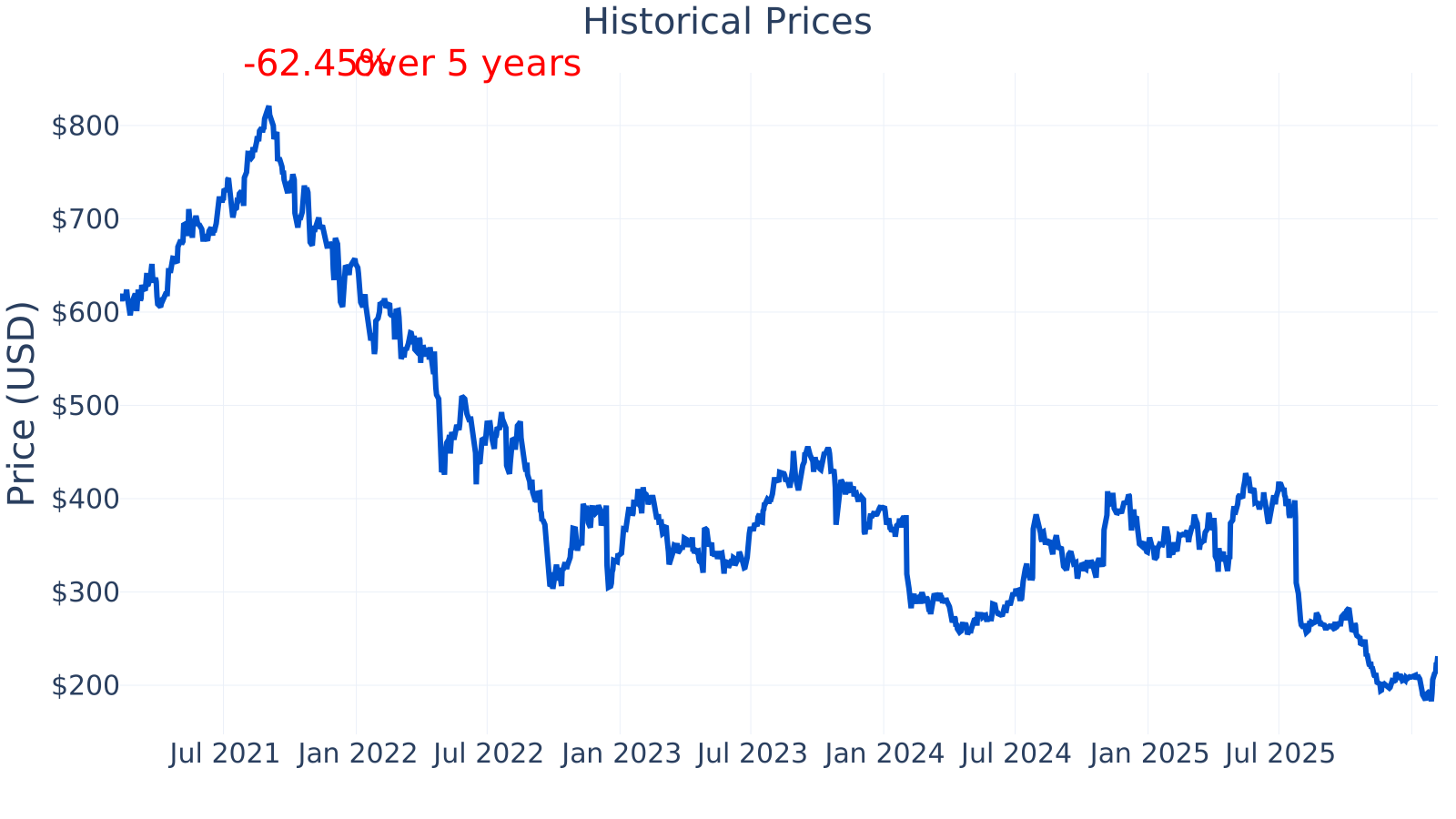
At the latest point shown, Charter’s market capitalization is about $29.9B and the stock’s beta is about 1.05, which is close to overall market volatility. The company’s P/E ratio is 6.38, below the industry median of 15.18. Profit margin is about 9.11%, above the industry median of about 6.18%. The most recent year-over-year revenue growth shown is about -2.33%, compared with an industry median of about +2.10%. Debt-to-equity is about 605%, far above the industry median of about 114%. Trailing twelve-month free cash flow is about $4.42B.
Growth (Low to Medium)
Broadband connectivity is a long-running demand trend: households keep adding connected devices, streaming shifts traffic to data networks, and businesses need reliable internet for cloud tools and security. However, in many U.S. markets, broadband is also a mature category, meaning growth often comes more from taking share, upgrading speeds, and bundling additional services than from rapid expansion of the overall customer base.
Charter’s growth strategy is largely about (1) network upgrades (to keep speeds competitive and reduce outages), (2) converged bundles (internet plus mobile), and (3) customer economics (keeping acquisition and retention costs under control). Mobile is often discussed as a way to strengthen the relationship with broadband customers rather than a standalone high-margin business from day one.
The year-over-year revenue growth trend shown cools meaningfully over time, moving from mid-single-digit growth earlier in the period to around flat, and then turning slightly negative in the most recent data point (about -2.33%). This pattern suggests that near-term expansion is being challenged, and that execution (pricing, retention, and product mix) becomes more important when topline growth is limited.
Free cash flow remains positive but has been volatile over the period shown—roughly $8.6B at a high point (2022) and closer to $3.2B at a low point (2024), before improving to about $4.6B (2025). For a capital-intensive network operator, free cash flow matters because it can support debt service, network investment, and capital returns, but swings like these show sensitivity to capital spending levels and operating conditions.
Risks (High)
This article is for informational purposes only and does not constitute financial advice. Some content is AI-generated. See Disclaimer