Stock Analysis · Dayforce Inc (DAY)
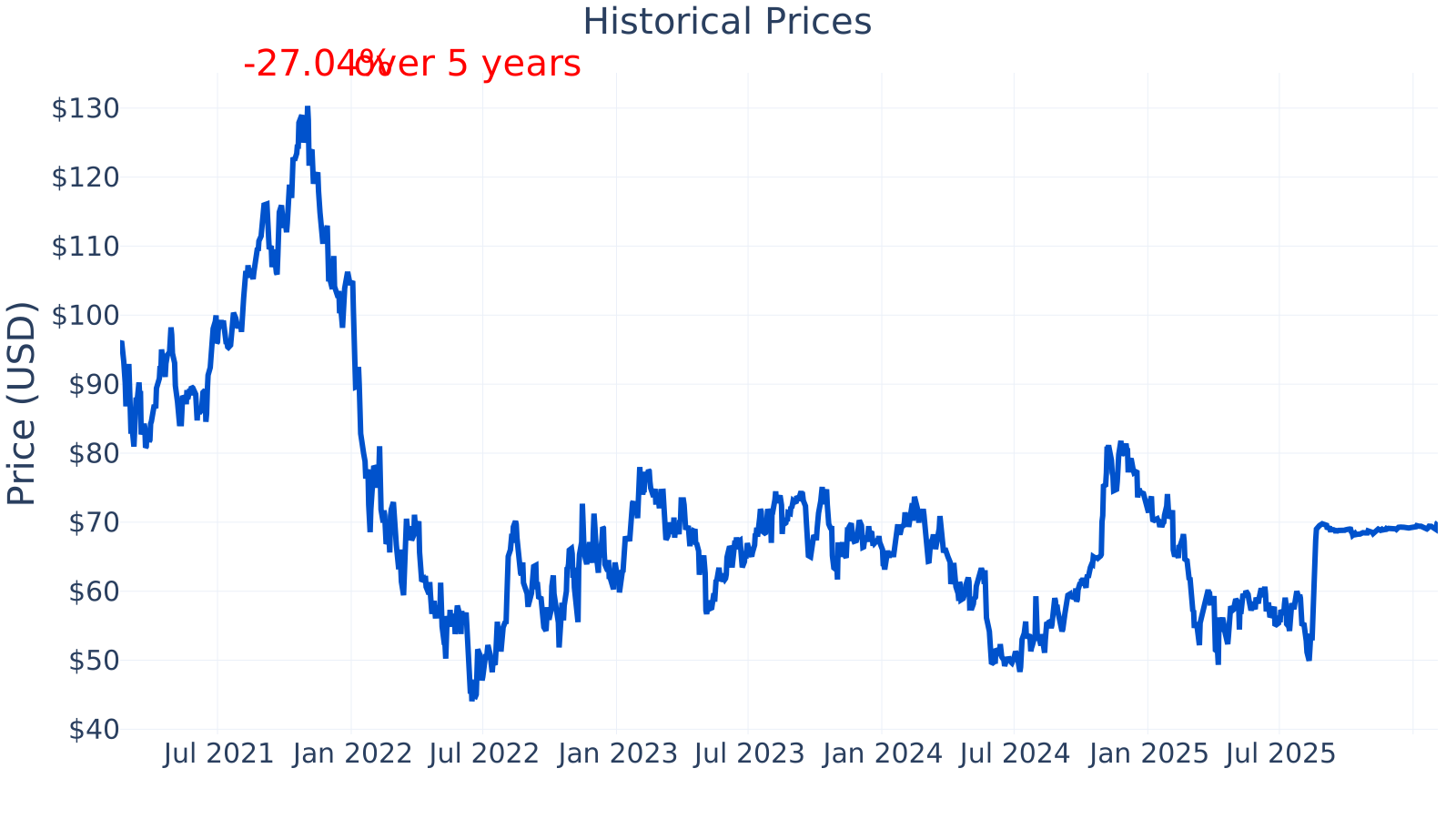
Overview
Dayforce Inc. (symbol: DAY) is a software company focused on human resources (“HR”) and workforce management. In simple terms, it sells a cloud-based platform that helps employers handle core people-related tasks such as payroll, time tracking and scheduling, benefits administration, talent management (recruiting and performance), and HR data management. The goal for customers is to run these processes in one system, reduce manual work, and improve compliance and reporting.
Dayforce’s business model is primarily subscription-based software delivered over the cloud, typically sold to medium and large organizations. In addition to software access, the company also provides services that help customers implement the platform and keep it running effectively, which can include onboarding, configuration, and ongoing support.
Main revenue sources generally fall into the following buckets (often described this way in company filings):
- Recurring software revenue (subscription fees for the Dayforce platform)
- Services revenue (implementation, consulting, and other professional services)
Depending on the period, payroll-related processing and other add-on modules can influence the mix, but the core economic engine is recurring software revenue supported by customer retention and expansion over time.
Across the last several years, total revenue rose from about $1.02B (2021) to about $1.76B (2024). Over the same span, the company moved from operating losses (2021–2022) to operating profit (2023–2024), even while continuing to invest meaningfully in research and development and sales/administration.
Key Figures
| Metric | Value | Industry ⓘ |
|---|---|---|
| Date | Feb 16, 2026 | |
| Context | ||
| Sector | Technology | |
| Industry | Software - Application | |
| Market Cap ⓘ | $11.18B | |
| Beta ⓘ | 1.17 | |
| Fundamental | ||
| P/E Ratio ⓘ | N/A | 27.48 |
| Profit Margin ⓘ | -7.91% | 7.66% |
| Revenue Growth ⓘ | 9.50% | 15.80% |
| Debt to Equity ⓘ | 45.53% | 24.71% |
| PEG ⓘ | 5.36 | |
| Free Cash Flow ⓘ | $165.80M | |
Dayforce’s market capitalization is about $11.18B and the stock’s beta is ~1.17, indicating the share price has tended to move somewhat more than the broader market. The latest profit margin shown is about -7.91%, below the industry median of about 7.66%, highlighting that profitability can still be uneven quarter-to-quarter. Year-over-year revenue growth is about 9.45%, below the industry median of about 15.8%. Debt-to-equity is about 45.5%, above the industry median of about 24.7%. Free cash flow over the trailing twelve months is about $165.8M.
Growth (Medium)
Dayforce operates in the HR software market, where long-term demand is supported by continued migration from older on-premise systems to cloud platforms, increasing complexity in payroll/tax and labor compliance, and employers’ focus on workforce productivity. These needs tend to be ongoing rather than one-time, which can support recurring revenue models.
Strategically, Dayforce is positioned around an “all-in-one” platform approach: keeping payroll, HR records, time and attendance, and talent tools connected in one system. For customers, this can reduce duplicated data entry and improve reporting. For the vendor, it can support expansion within an account as customers add modules over time.
The year-over-year revenue growth trend shows a clear slowdown from the higher growth rates seen earlier (often above 15–25%) toward more recent levels around ~9–12%. That can be consistent with a company getting larger, but it also means future results may depend more on execution (retention, pricing, sales productivity, and product differentiation) rather than rapid market expansion alone.
Cash generation has improved materially over time, with trailing twelve-month free cash flow moving from negative levels in 2021 to positive and rising levels by 2024–2025 (reaching roughly $209.8M at the 2025-03-31 point shown, and about $165.8M most recently in the table). For many software companies, improving free cash flow can be an important indicator of operating maturity, because it shows the business can fund investments and obligations with internally generated cash rather than relying as heavily on external financing.
Potential catalysts typically discussed for companies in this category include new product functionality, larger enterprise wins, international expansion, attach rates for additional modules, and operating leverage (expenses growing more slowly than revenue). Whether those show up consistently depends on competitive dynamics and the pace of customer decision-making.
Risks (High)
A central risk for Dayforce is competitive intensity in HR and payroll software. Buyers often compare multiple established vendors, sales cycles can be long, and switching systems can be disruptive. This environment can pressure pricing, require sustained spending on sales and marketing, and raise the cost of winning new customers. Another important risk is execution: payroll and workforce systems are “mission-critical,” so product reliability, implementation quality, and customer support meaningfully influence retention and reputation.
Profitability also appears volatile. While the company achieved profitable periods in recent years, the latest profit margin shown is negative, which suggests earnings can swing with items such as operating costs, non-cash accounting charges, interest expense, or other factors that affect net income.
The debt-to-equity ratio trends down over time but remains elevated relative to the industry median in the periods shown (most recently about 45.5% versus an industry median near 27.9% on the latest point displayed). Higher leverage can reduce flexibility during slower growth periods, particularly when interest expense is a meaningful line item.
Margins improved substantially from 2021–2024 (moving from negative to modestly positive), but the latest point shown drops to about -7.9% while the industry median remains positive (roughly mid-single digits). For long-term assessment, a key question is whether the company can keep operating income and net income consistently positive while continuing to invest in product development and customer acquisition.
Regarding competitive position, Dayforce is a recognized provider in HCM (human capital management), but it competes with larger and well-capitalized peers. Major competitors commonly listed in the HR/HCM space include:
- ADP (strong presence in payroll and HR services)
- Workday (enterprise-focused HCM and financials)
- Paychex (payroll and HR solutions, particularly strong in SMB)
- Paycom and Paylocity (cloud HCM platforms with strong mid-market positioning)
- UKG (workforce management and HR; private company)
- SAP SuccessFactors and Oracle (broad enterprise software suites that include HCM)
Dayforce’s competitive advantages often relate to having an integrated platform and a payroll-capable system designed to tie together time, pay, and HR records. However, “leadership” is not absolute in this category: several competitors have comparable offerings, and relative standing can vary by customer size, geography, and specific feature needs.
Valuation
Traditional P/E comparisons can be difficult to interpret for companies with fluctuating profitability. In the periods where a P/E is shown, Dayforce’s P/E ratio appears substantially higher than the software industry median (for example, readings around ~185–365 for Dayforce versus ~42–60 for the industry median in the same general timeframe on the chart). A high P/E can reflect expectations of future earnings growth, but it can also occur when current earnings are relatively low compared to the share price.
Other context from the latest metrics includes a PEG ratio of ~5.36, which is often interpreted as a sign that the price may be high relative to near-term growth expectations (noting that PEG depends heavily on how growth is estimated and can be unstable when earnings are volatile). At the same time, the company shows positive trailing free cash flow, which can support valuation more than accounting earnings alone for some software businesses.
Overall, valuation signals appear to depend heavily on whether Dayforce can deliver steady profitability and maintain healthy growth while competing in a crowded market. If profitability remains inconsistent, headline valuation multiples may remain difficult to justify using simple comparisons.
Conclusion
Dayforce is a cloud HR and payroll software provider with a business model built around recurring revenue and an integrated platform designed for mission-critical workforce processes. The company has grown revenue meaningfully over multiple years and has shown periods of improving operating performance and free cash flow generation.
At the same time, recent revenue growth is lower than earlier periods and below the industry median shown, profitability has been uneven (including a recent negative profit margin), and leverage is higher than the industry median. Competition is intense, with multiple large and specialized vendors offering alternatives.
Based on these factors, the long-term profile primarily hinges on sustained execution: maintaining customer retention, winning new deployments against strong rivals, and converting revenue into consistent profits and cash flow while managing debt levels.
Sources:
- SEC EDGAR — Dayforce Inc. Form 10-K (Annual Report)
- SEC EDGAR — Dayforce Inc. Form 10-Q (Quarterly Reports)
- Dayforce Inc. Investor Relations — Quarterly earnings materials and shareholder communications (press releases and presentations)
- Wikipedia — “Dayforce” (company background and general description)
This article is for informational purposes only and does not constitute financial advice. Some content is AI-generated. See Disclaimer


