Stock Analysis · CAVA Group Inc (CAVA)
Overview
CAVA Group Inc is a U.S. restaurant company best known for its Mediterranean-inspired fast-casual concept, CAVA. Customers typically build a meal by choosing a base (such as greens or grains) and adding proteins, toppings, and sauces. The company also operates a smaller number of Zoes Kitchen restaurants (a legacy brand acquired earlier), and it sells certain food items through consumer packaged goods and other channels described in its filings.
In simple terms, CAVA’s business model is to grow revenue by (1) operating more restaurants over time, (2) increasing sales at existing locations through traffic, pricing, and menu innovation, and (3) building a brand that can travel across new geographies while maintaining consistent food quality and speed of service.
Based on the way the company reports its business in filings, revenue is primarily generated from:
- Restaurant sales (food and beverage sold directly to guests in company-operated restaurants)
- Other revenue streams (including items such as certain packaged/consumer products and other smaller categories reported by the company)
The company’s economics are largely driven by how efficiently it can run restaurants (food costs, labor, occupancy), how much it spends to support growth (marketing, corporate overhead), and how much each new restaurant costs to build compared with the cash it can generate after opening.
Over the years shown, total revenue increases meaningfully (from about $500M in 2021 to about $1.18B in 2025). The mix of costs also shows why restaurants can be sensitive to execution: cost of revenue rises with sales, while operating costs (including corporate expenses) can move up or down depending on expansion pace and spending discipline. Net income moves from losses (2021–2022) to positive results (2023 onward), highlighting the importance of scale and cost control.
Key Figures
| Metric | Value | Industry ⓘ |
|---|---|---|
| Date | Mar 02, 2026 | |
| Context | ||
| Sector | Consumer Cyclical | |
| Industry | Restaurants | |
| Market Cap ⓘ | $9.60B | |
| Beta ⓘ | 2.43 | |
| Fundamental | ||
| P/E Ratio ⓘ | 152.72 | 27.73 |
| Profit Margin ⓘ | 5.40% | 7.24% |
| Revenue Growth ⓘ | 20.90% | 7.35% |
| Debt to Equity ⓘ | 59.80% | 99.20% |
| PEG ⓘ | N/A | |
| Free Cash Flow ⓘ | $26.14M | |
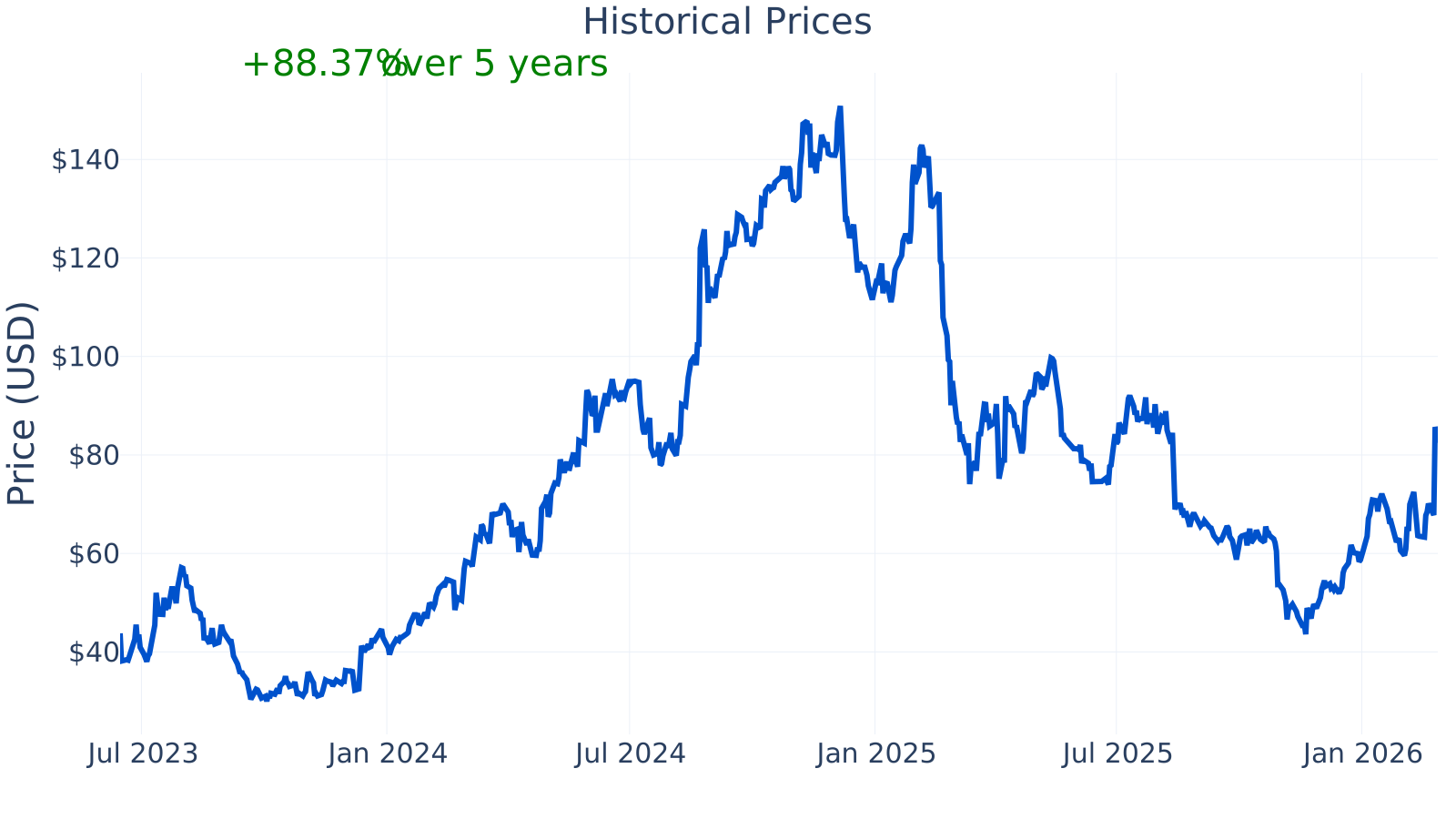
CAVA’s market capitalization is about $9.6B, and its beta of about 2.43 indicates the stock has tended to move more than the overall market (higher volatility). The company’s latest P/E ratio is ~152.7, far above the restaurant industry median shown (~27.7), which implies the market price is embedding high expectations for future growth and/or profitability improvement. Profit margin is about 5.4% versus an industry median of about 7.2%, while revenue growth year-over-year is about 20.9% versus an industry median of about 7.35%. Debt-to-equity is about 59.8%, below the industry median shown (about 99.2%). Trailing twelve-month free cash flow is about $26.1M, indicating the business is generating cash after operating costs and capital spending, though restaurant expansion can cause this number to vary over time.
Growth (medium)
Restaurants are a large, competitive category, but “fast-casual” concepts have structural tailwinds when they combine convenience with a brand customers view as higher quality than traditional fast food. CAVA’s concept is positioned around customizable bowls and pitas, which can travel well for takeout and delivery and can fit a range of dietary preferences (for example, guests seeking greens, grains, or lighter options). This positioning can support growth if the company continues to add restaurants while keeping service times, food consistency, and unit-level profitability strong.
A key long-term question for a restaurant chain is whether it can expand into new regions without diluting the guest experience. CAVA’s strategy (as described in its filings) centers on expanding its restaurant footprint, investing in operations and technology, and building brand awareness. If execution is strong, the main “engine” for growth is straightforward: more locations plus improving sales at existing restaurants.
The year-over-year revenue growth shown remains elevated, though it moderates from very high rates (around the high-20% to high-30% range in 2024) toward about ~21% by the most recent period shown. That pattern can be consistent with a company getting larger: as the revenue base grows, sustaining extremely high growth becomes harder, so the durability of demand and the pace of new restaurant openings matter more.
Free cash flow improves materially over time in the periods shown, moving from negative levels in late 2023 and early 2024 to positive by 2025. For a growing restaurant company, this can be important: internally generated cash can help fund new openings, kitchen/technology investments, and other growth initiatives without relying as heavily on outside financing. At the same time, free cash flow can fluctuate with build-out timing and other growth spending, so the trend over multiple years tends to be more informative than any single quarter.
Risks (high)
Restaurants face several persistent risks that can affect results even when demand is healthy. Food, labor, and occupancy costs can rise quickly and pressure margins. In addition, consumer spending can soften during economic slowdowns, and restaurant traffic can shift due to changing preferences or new competitive offerings. Because CAVA is still in an expansion phase, execution risk is also meaningful: opening too quickly, choosing weaker sites, or having inconsistent operations can weigh on profitability and brand perception.
The debt-to-equity level is about ~60%, which is below the industry median shown and relatively stable across the periods displayed (with a notable industry median jump in the latest point shown). This suggests the company is not unusually levered versus peers based on this measure, but leverage still matters in restaurants because fixed costs can be high and earnings can be cyclical.
Profit margin improves significantly through much of 2024 and 2025 (reaching double-digit levels in several periods shown), but the latest point shown is about ~5.4%, below the industry median (~6.9% at that point). This kind of movement can happen for several reasons in restaurant businesses (for example, changes in costs, expansion spending, or one-time items). For long-term durability, investors often focus on whether restaurant-level economics and corporate cost structure can support consistently strong margins as the chain grows.
Competition is intense. CAVA competes with other fast-casual and quick-service restaurants for the same customer occasions (lunch, dinner, takeout), including concepts focused on bowls, salads, and broadly “health-forward” meals. It also competes for real estate, labor, and ingredient supply. Competitive advantages, when present, often come from brand strength, differentiated menu and flavors, efficient operations, and a repeatable store-opening playbook. CAVA has brand differentiation in Mediterranean flavors and a customization format, but it is not the overall leader of the entire restaurant industry; it operates in a crowded field where customer loyalty can be earned—and lost—quickly.
Valuation
The P/E ratio shown is elevated relative to the restaurant industry median throughout the period displayed, even after a large decline from very high levels in 2024. The latest P/E of about 152.7 versus an industry median around 27.7 indicates the stock price is assigning a premium multiple to CAVA’s earnings. A premium valuation is not automatically “right” or “wrong,” but it does mean the market is expecting a combination of strong growth, expanding profitability, and sustained brand momentum over time.
For context, CAVA’s revenue growth is running well above the industry median while its latest profit margin is below the industry median. This combination can be interpreted as a company still balancing growth investments with profitability. When a stock trades at a high multiple, disappointments—such as slower new-store expansion, weaker same-store sales, or margin pressure from labor and food costs—can have a larger impact on sentiment and valuation than they would for a slower-growing, lower-multiple restaurant operator.
Conclusion
CAVA is a growth-oriented restaurant company that has expanded revenue substantially over recent years and moved from losses to positive net income. The business benefits from a concept positioned within fast-casual dining, where convenience and customizable menus can support expansion if execution remains consistent. The financial picture shown also includes improving free cash flow over time and a debt-to-equity level that is not higher than the industry median displayed.
At the same time, the company operates in a highly competitive category with meaningful cost pressures (food, labor, occupancy) and execution risk as it scales. The stock’s valuation, as reflected in a P/E ratio far above the industry median, suggests the market is pricing in continued strong growth and improving economics. Whether those expectations are ultimately met depends on restaurant-level performance, disciplined expansion, and the company’s ability to protect its brand and margins while growing its footprint.
Sources:
- SEC EDGAR — CAVA Group, Inc. filings (Form 10-K, Form 10-Q, Form 8-K)
- CAVA Group, Inc. Investor Relations — Press releases and investor materials
- Wikipedia — “Cava (restaurant)” (basic company background)
This article is for informational purposes only and does not constitute financial advice. Some content is AI-generated. See Disclaimer