Stock Analysis · Carvana Co (CVNA)
Overview
Carvana Co (CVNA) is an online-focused used car retailer. The company sells vehicles through a digital shopping experience and supports the transaction with services such as financing and vehicle protection products. Carvana also operates inspection and reconditioning capabilities and logistics to deliver vehicles to customers and to handle trade-ins.
At a high level, its business model combines (1) sourcing used vehicles, (2) reconditioning and pricing them, (3) marketing and selling them online, and (4) adding related products (like financing and service contracts) that can contribute meaningfully to profit per sale. In its SEC filings, Carvana reports revenue primarily across retail vehicle sales, wholesale vehicle sales, and “other” (which generally includes items such as financing-related and ancillary product revenue, depending on the period’s reporting detail).
Main sources of revenue (typical breakdown as described in filings; exact mix can shift by period):
- Retail vehicle sales (the largest source in most periods)
- Wholesale vehicle sales (sales of vehicles not sold through the retail channel)
- Other revenue (including financing-related and ancillary products/services, as defined by the company)
Across the years shown, total revenue rises overall, but profitability has moved in cycles: the cost of revenue remains the largest outflow, while selling, general and administrative costs are another major expense line. Interest expense is also a recurring and meaningful cost, which helps explain why net income can vary even when gross profit improves.
Key Figures
| Metric | Value | Industry ⓘ |
|---|---|---|
| Date | May 04, 2026 | |
| Context | ||
| Sector | Consumer Cyclical | |
| Industry | Auto & Truck Dealerships | |
| Market Cap ⓘ | $84.54B | |
| Beta ⓘ | 3.55 | |
| Fundamental | ||
| P/E Ratio ⓘ | 44.23 | 21.75 |
| Profit Margin ⓘ | 6.40% | 2.61% |
| Revenue Growth ⓘ | 52.00% | 3.25% |
| Debt to Equity ⓘ | 16.69% | 117.25% |
| PEG ⓘ | -0.13 | |
| Free Cash Flow ⓘ | $740.00M | |
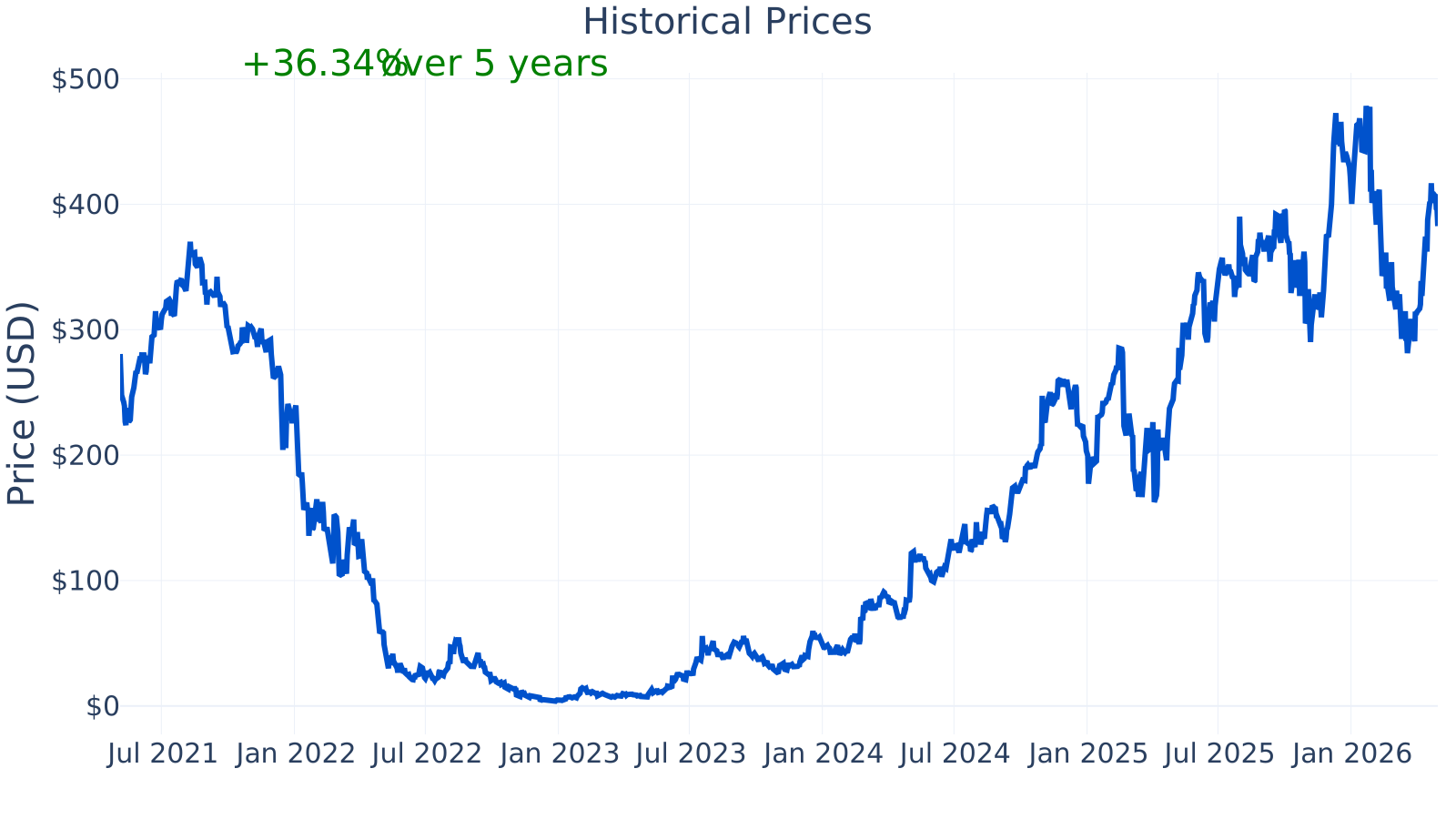
Carvana’s market capitalization is about $84.5B. The stock’s beta of 3.55 indicates it has historically moved much more than the overall market (in both directions), which matches the large swings visible in the historical price chart.
On profitability and growth, the latest figures shown indicate a profit margin of ~6.4% versus an industry median of ~2.6%, and year-over-year revenue growth of ~52% versus an industry median of ~3.3%. Leverage (as measured here) is reported at ~16.7% debt-to-equity, well below the industry median of about 117%, though this metric can change quickly depending on equity levels and financing structure.
The table also shows free cash flow (TTM) of about $740M. The P/E ratio is ~44.2 compared with an industry median near 21.8, meaning the shares trade at a higher earnings multiple than the typical peer in this industry at the time of measurement.
Growth (Medium)
The used vehicle market is large and cyclical, influenced by interest rates, consumer confidence, employment, and used-vehicle pricing. While the industry is mature, it continues to evolve toward more digital shopping, improved online merchandising, and faster fulfillment—areas that align with Carvana’s online-first approach.
Carvana’s strategy for growth centers on scaling an e-commerce-style car buying experience while improving unit economics (profit per vehicle) through tighter operations, reconditioning efficiency, and attachment of higher-margin ancillary products (for example, financing and protection products). In practice, this means long-term outcomes depend not just on selling more cars, but on doing so with disciplined costs and stable credit performance.
The year-over-year revenue trend shows a sharp slowdown and contraction in 2022–2023, followed by a clear rebound into positive territory and reaching roughly 52% in the most recent period shown. Relative to the industry median in the same timeframe (low single digits), this indicates Carvana’s recent top-line momentum has been substantially higher than many traditional dealership peers, though it is coming off a lower base after the earlier decline.
Free cash flow shifted from strongly negative (about -$3.35B in 2022) to positive in 2024–2026 (roughly $740M most recently). For a business that can require meaningful funding for inventory and infrastructure, sustained positive free cash flow can be an important signal of improved operating discipline—while also remaining sensitive to changes in used-car prices, sales volumes, and financing conditions.
Risks (High)
Carvana operates in a category with several structural and cyclical risks. Demand for used vehicles and affordability can change quickly with interest rates and credit availability. In addition, used vehicle pricing volatility can affect gross profit, and operational execution (reconditioning throughput, logistics, customer experience, and cost control) can materially change financial results from year to year.
Financial risk is also a key consideration. Even with improving profitability in some periods, the company has meaningful interest expense in its income statement, which reflects the reality that funding and capital structure can influence net results. Access to capital markets and the cost of debt can matter, particularly in weaker macro environments.
The debt-to-equity trend shows a dramatic improvement from extremely elevated levels earlier in the period to about 16.7% most recently, versus an industry median around 117%. The earlier extreme readings also suggest the metric has been affected by swings in equity levels; this is a reminder that leverage ratios can move sharply when profitability and equity change.
Profit margin has also improved materially from negative levels in 2021–2023 to positive levels in 2024–2026, reaching about 6.4% most recently (above the industry median near 2.6%). Even so, the historical pattern shows margins can compress quickly, and periods of weaker execution or unfavorable market conditions have coincided with substantial losses.
On competitive positioning, Carvana’s advantages are mainly tied to its brand in online used car retailing, its end-to-end digital purchasing workflow, and its integrated capabilities around vehicle sourcing, inspection/reconditioning, and delivery. These can be differentiators versus smaller dealerships that lack scale and technology investment.
However, it competes against well-capitalized and/or widely distributed alternatives, including:
- Traditional franchised and independent dealerships (large local footprints and service networks)
- Large national used-car retailers (scale, inventory access, established operations)
- Online marketplaces that connect buyers and sellers (often with different economics and lower inventory risk)
- OEM-certified used programs (brand-backed trust and financing offers)
In this landscape, Carvana is a well-known pure-play online used-car retailer, but it is not insulated from price competition, marketing costs, or shifts in consumer behavior. The company’s ability to sustain profitability while growing is a central competitive question.
Valuation
The P/E ratio shown for Carvana is around 44, above the industry median near 22. A higher P/E can reflect expectations for faster growth, improving profitability, or a perception of stronger long-term economics; it can also leave less room for disappointment if growth slows or margins compress.
The historical P/E series displayed is uneven, which is common when earnings have been volatile (including periods where earnings are negative or unusually low, making the P/E less meaningful). In the more recent portion of the chart where the metric is shown, Carvana’s P/E generally appears above the industry median, consistent with the idea that the market is assigning a premium multiple relative to typical auto dealership peers.
Given the company’s high stock volatility (as reflected by beta and the price history), valuation outcomes can be heavily influenced by changes in earnings power, financing costs, and sentiment around the sustainability of margins and cash generation.
Conclusion
Carvana is a consumer cyclical business centered on selling used vehicles online, with additional economics coming from financing-related and other ancillary products. The recent picture in the metrics presented is mixed but clearer than in prior years: revenue growth has re-accelerated, profit margin has moved from negative to positive, and free cash flow turned positive after being deeply negative.
At the same time, the business remains exposed to big external forces (interest rates, credit availability, used-car pricing) and internal execution demands (reconditioning efficiency, logistics, and marketing efficiency). Competitive pressure is persistent, and the stock’s historical volatility suggests outcomes have varied significantly across cycles.
From a valuation standpoint, the shares trade at a higher earnings multiple than the industry median in the data shown, which implies the market is pricing in stronger performance than a typical dealership peer. Whether that pricing remains supported over time depends on the durability of profits and cash generation through different market conditions.
Sources:
- SEC EDGAR — Carvana Co filings (Form 10-K, Form 10-Q)
- Carvana Investor Relations — SEC filings and shareholder materials (as published by the company)
- Wikipedia — “Carvana” (basic company background)
This article is for informational purposes only and does not constitute financial advice. Some content is AI-generated. See Disclaimer


