Stock Analysis · Carters Inc (CRI)
Overview
Carter’s, Inc. (CRI) is a children’s apparel company focused on clothing for babies and young kids. It designs, sources, and sells products under well-known brands such as Carter’s and OshKosh B’gosh. The company reaches customers through a mix of its own retail stores, e-commerce sites, and wholesale relationships with other retailers.
In simple terms, Carter’s makes money by selling children’s clothes across several channels. In its annual reporting, the business is commonly discussed using segments that reflect how products are sold (for example, through U.S. retail stores and e-commerce, U.S. wholesale partners, and international operations). Percentages by segment can change year to year, and the most reliable breakdown comes from the company’s latest annual report.
The company’s revenue comes mainly from selling children’s apparel through these channels (typically discussed from largest to smaller in company reporting):
- U.S. Retail (company-operated stores and U.S. e-commerce)
- U.S. Wholesale (sales to other retailers)
- International (sales outside the U.S., including partnerships and direct operations)
The longer-term picture in the company’s recent financials shows pressure on profitability compared with earlier years: total revenue moved from about $3.49B (2021) down to about $2.84B (2024), while net income declined more sharply over the same period (from about $340M in 2021 to about $186M in 2024, and about $92M in 2025 as shown in the financial flow summary).
Across 2021–2025, total revenue declined from about $3.49B to about $2.90B. Over the same period, selling, general, and administrative costs rose (from about $884M to about $1.19B), while operating income fell (from about $499M to about $148M). This combination helps explain why net income trended down meaningfully by 2025.
Key Figures
| Metric | Value | Industry ⓘ |
|---|---|---|
| Date | Mar 09, 2026 | |
| Context | ||
| Sector | Consumer Cyclical | |
| Industry | Apparel Retail | |
| Market Cap ⓘ | $1.24B | |
| Beta ⓘ | 1.05 | |
| Fundamental | ||
| P/E Ratio ⓘ | 13.40 | 14.87 |
| Profit Margin ⓘ | 3.17% | 8.32% |
| Revenue Growth ⓘ | 7.60% | 8.90% |
| Debt to Equity ⓘ | 131.03% | 92.83% |
| PEG ⓘ | 2.01 | |
| Free Cash Flow ⓘ | $68.63M | |
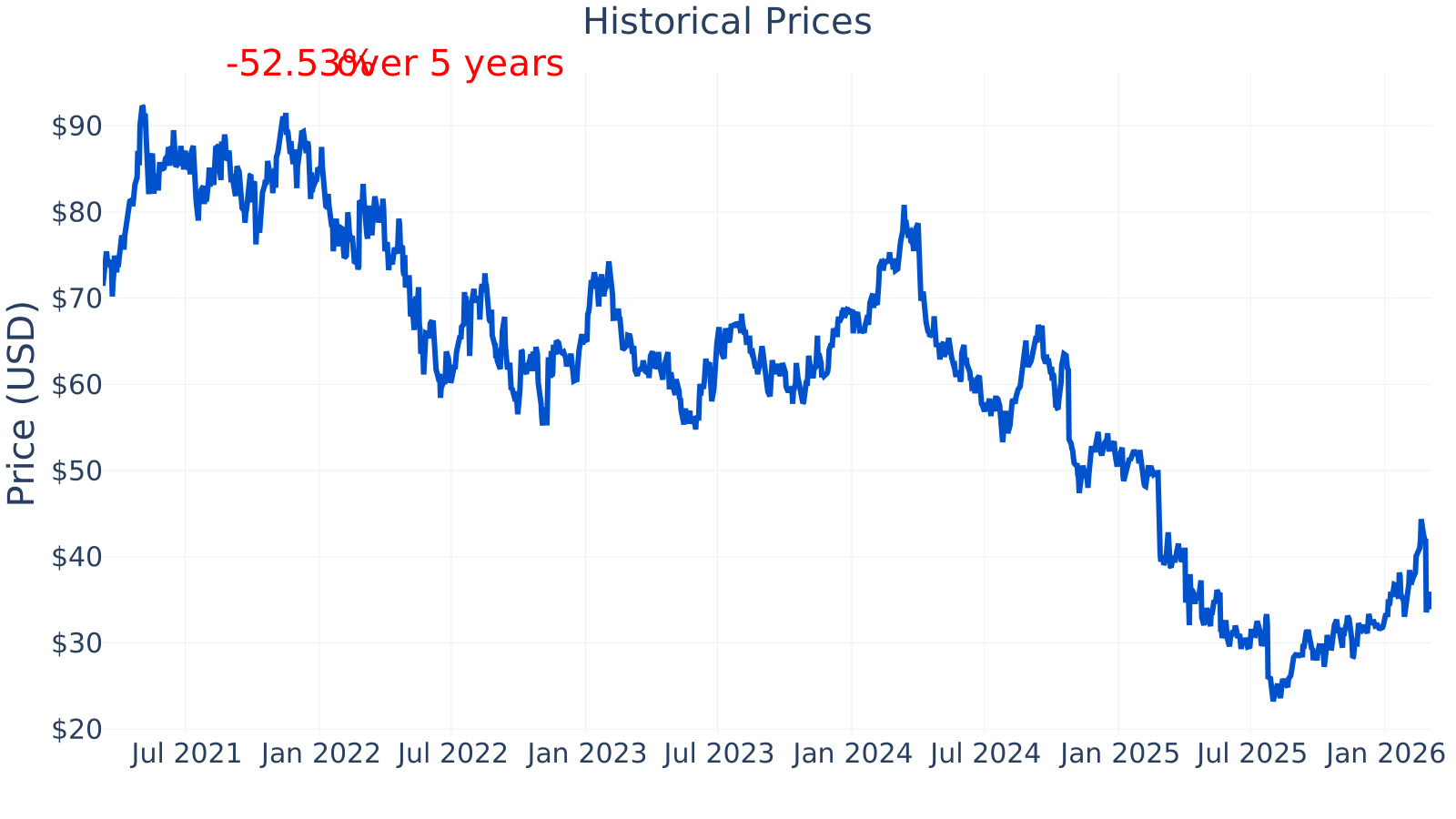
Carter’s current market capitalization is about $1.24B, and the stock’s beta is about 1.05 (often interpreted as price moves broadly similar to the overall market, though not perfectly). The P/E ratio is about 13.4 versus an industry median near 14.9. Profit margin is about 3.17% versus an industry median near 8.32%, which points to weaker recent profitability than many peers. Revenue growth (year over year) is about 7.6% versus an industry median near 8.9%. Debt-to-equity is about 131% versus an industry median near 93%, indicating higher leverage than the typical company in its peer set. Trailing twelve-month free cash flow is about $68.6M.
Growth (Low)
Carter’s operates in children’s apparel, a mature category that tends to be influenced by birth rates, consumer spending, competition, and fashion/seasonality. Because kids quickly outgrow clothing, demand is recurring, but it is also price-sensitive—especially in periods when households reduce discretionary purchases.
The recent pattern of year-over-year revenue growth has been uneven, moving through multiple quarters of contraction before returning to modest positives more recently. That variability can matter for long-term growth expectations because it suggests the company is working through a shifting demand environment rather than consistently expanding.
The chart shows that revenue growth was strong in parts of 2021, turned negative across much of 2022–2024, and then improved into positive territory more recently (ending around 7.6% in the latest period shown). This kind of rebound can be helpful, but the longer stretch of negative readings highlights how dependent results can be on the consumer cycle and promotional intensity.
Cash generation is another lens on growth capacity, since free cash flow can fund store investments, digital capabilities, and balance-sheet flexibility.
Free cash flow has been positive but volatile over the period shown (about $528M in 2021, then lower levels afterward, including about $221M in 2025, and about $68.6M on a trailing twelve-month basis in the latest metrics). This suggests the business can generate cash, but that the amount available can swing meaningfully depending on profitability and working-capital needs (such as inventory).
Risks (High)
Carter’s key risks largely reflect the realities of apparel retail: demand can shift quickly, promotions can compress margins, and forecasting mistakes can lead to excess inventory and markdowns. The company also depends on a global sourcing and logistics network, which can create exposure to freight costs, supplier capacity constraints, and broader supply-chain disruptions.
Competition is a central risk. Carter’s competes with a wide set of brands and retailers in kids and baby apparel, including large mass merchants and general apparel players with children’s lines, as well as other specialty brands. In wholesale, bargaining power can tilt toward large retail partners, while in direct-to-consumer channels, marketing efficiency and customer retention become especially important.
From a “competitive advantages” perspective, Carter’s brand recognition in baby and kids apparel and its scale in distribution are commonly viewed as strengths. However, recent profitability indicators suggest the company has had difficulty translating those strengths into peer-level margins, at least in the most recent period shown.
Balance-sheet leverage is another risk factor, because higher debt can reduce flexibility during downturns.
Debt-to-equity has generally stayed above 100% in the period shown, and the latest value is about 131% versus an industry median around 126% (and about 93% in the latest metric table’s peer comparison). In practical terms, this indicates the company uses more debt financing than many peers, which can increase sensitivity to earnings downturns and interest costs.
Profitability has also weakened compared with earlier levels, which can amplify the impact of any sales slowdown.
Profit margin declined substantially over time in the chart, ending around 3.17% in the latest period shown. Earlier periods were closer to high single digits (around 8–10%), and recent results are below the industry median (about 8.41% in the latest period shown). That gap suggests either pricing pressure, higher operating costs, or both.
Valuation
One simple way to describe valuation is the price-to-earnings (P/E) ratio, which compares the stock price to profits. Carter’s current P/E is about 13.4, slightly below the industry median around 14.9. On its own, that indicates the market is valuing the company at a modest discount to typical peers, based on recent earnings.
The historical P/E ratio has mostly stayed in a moderate band in recent years (often below the industry median), and it rose toward the most recent point shown as the stock price and/or earnings changed. Interpreting P/E requires context: if earnings are under pressure (as suggested by the margin trend), a “lower” P/E can reflect higher perceived business risk or lower expected profit stability rather than a simple bargain.
Another contextual metric is the PEG ratio (about 2.0 in the latest metrics), which relates valuation to expected growth. While this number depends heavily on growth assumptions, a higher PEG can indicate that the valuation is not especially low relative to the growth implied by consensus expectations. Separately, the company’s lower profit margin and higher leverage than peers are factors that can justify a lower valuation multiple versus the industry median.
Conclusion
Carter’s is a well-known children’s apparel company with established brands and a broad distribution model spanning retail, e-commerce, wholesale, and international channels. The business benefits from brand awareness and the recurring nature of kids’ apparel demand, but it operates in a highly competitive, promotion-driven category.
Recent fundamentals show a mixed picture: revenue growth has improved after a long uneven stretch, but profitability has fallen meaningfully from earlier levels and sits below the industry median in the most recent period shown. Leverage is also higher than many peers, which can matter if margins remain compressed or if consumer demand weakens. Valuation metrics (like P/E) appear somewhat below peer medians, which is consistent with the company’s weaker recent margins and higher balance-sheet risk.
Sources:
- U.S. Securities and Exchange Commission (SEC EDGAR) — Carter’s, Inc. Forms 10-K, 10-Q
- Carter’s, Inc. Investor Relations — SEC filings and investor materials
- Wikipedia — “Carter’s, Inc.” (basic company background)
This article is for informational purposes only and does not constitute financial advice. Some content is AI-generated. See Disclaimer