Stock Analysis · Carnival Corporation (CCL)
Overview
Carnival Corporation (CCL) is one of the world’s largest cruise companies. It operates multiple cruise brands that offer vacation travel on ships across many itineraries and homeports. In addition to ticket sales, the company earns money from activities and purchases made onboard, as well as services sold before the trip (such as shore excursions and packages).
From a business model perspective, Carnival’s results are mainly driven by three levers: (1) how many guests it carries (demand and capacity), (2) what it can charge (pricing and onboard spending), and (3) operating costs (especially fuel, food, labor, and ship maintenance). Because cruise ships are expensive assets with high fixed costs, profitability tends to improve significantly when ships sail fuller and pricing is firm—but it can also deteriorate quickly during downturns.
Main sources of revenue generally include:
- Passenger ticket revenue (the cruise fare)
- Onboard and other revenue (casino, beverages, specialty dining, shore excursions, internet, spa, and other onboard spending)
In its annual reporting, Carnival typically discusses revenue in these broad categories (rather than a long list of separate product lines). The exact split by percentage can vary by year and is best confirmed directly in the company’s latest annual report notes and segment discussions.
Across the years shown, the company’s total revenue rose substantially from 2021 to 2025, while net income moved from large losses to solid profitability. Interest expense remains a meaningful ongoing cost, reflecting the elevated debt taken on during the industry downturn—though it appears lower in 2025 than in 2023–2024 in the figures shown.
Key Figures
| Metric | Value | Industry ⓘ |
|---|---|---|
| Date | Mar 24, 2026 | |
| Context | ||
| Sector | Consumer Cyclical | |
| Industry | Travel Services | |
| Market Cap ⓘ | $35.25B | |
| Beta ⓘ | 2.46 | |
| Fundamental | ||
| P/E Ratio ⓘ | 12.60 | 24.40 |
| Profit Margin ⓘ | 10.37% | 8.78% |
| Revenue Growth ⓘ | 6.60% | 12.00% |
| Debt to Equity ⓘ | 227.88% | 93.66% |
| PEG ⓘ | 1.08 | |
| Free Cash Flow ⓘ | $2.61B | |
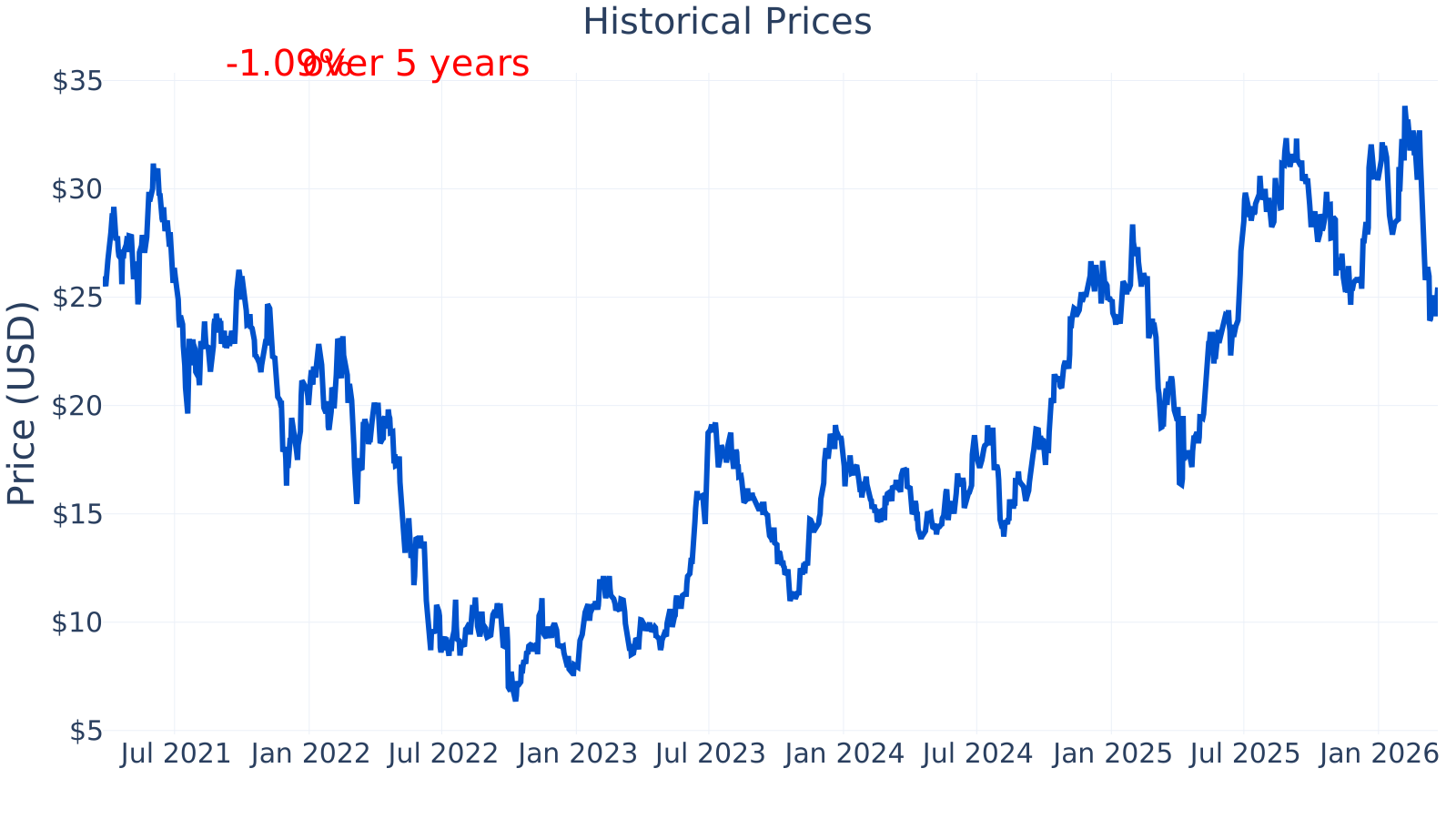
Carnival’s market capitalization is about $35.3B, and the stock has a high beta (2.46), which commonly implies larger price swings than the broader market. The current P/E ratio is 12.6 versus an industry median near 24.4, while the profit margin is 10.37%, modestly above the industry median (~8.78%). Revenue growth is positive at 6.6% year over year, but below the industry median (~12%). The most notable figure is leverage: debt-to-equity is ~228%, far above the industry median (~94%). Free cash flow over the trailing twelve months is about $2.61B.
Growth (Medium)
The cruise industry is part of the broader travel and leisure market, which tends to benefit over time from rising incomes, consumer interest in experiences, and expanding vacation options. At the same time, it is a cyclical industry: demand can fall during recessions or periods of high travel costs, and the sector is sensitive to changes in consumer confidence.
For Carnival specifically, the most important growth question is not only “more cruises,” but “better economics per cruise.” As occupancy normalizes and onboard spending remains strong, a large ship base can produce stronger operating results because many costs are fixed or semi-fixed. Another long-term growth driver is disciplined capacity management (adding ships, retiring older tonnage, and improving fleet efficiency), which can affect both customer appeal and operating costs.
The year-over-year growth trend shown is positive but has cooled compared with the unusually high growth rates that typically occur during a recovery period. Recent readings (mid-to-high single digits) look more like a maturing phase than a rebound phase, meaning future gains may rely more on pricing, onboard revenue, and cost control than on a simple return to prior volume.
Free cash flow improved markedly from deeply negative levels in 2022–2023 to positive territory in 2024–2025 (roughly $2.0B–$2.6B in the periods shown). For a capital-intensive business like cruising, sustained positive free cash flow can matter because it supports debt reduction, fleet investment, and resilience during weaker travel demand.
Risks (High)
Carnival’s risk profile is strongly influenced by leverage and the inherent volatility of travel demand. Cruise demand can be affected by economic slowdowns, changes in consumer discretionary spending, health-related disruptions, and geopolitical events that alter travel patterns or increase operating complexity.
Leverage has improved from prior peaks but remains elevated. The latest debt-to-equity reading is about 228%, which is well above the industry median shown (~94%). High leverage can amplify outcomes in both directions: it can help returns when business conditions are strong, but it can also constrain flexibility through interest costs and refinancing needs when conditions weaken.
Profitability has strengthened significantly over time, moving from negative margins to a latest profit margin around 10.37%, slightly above the industry median (~8.78%). Even with this improvement, margins can remain sensitive to fuel prices, wage inflation, dry-dock and maintenance schedules, and itinerary mix. The business also faces regulatory and compliance costs related to safety and environmental standards, which can require ongoing capital spending.
Competition is intense and mostly comes from other large cruise operators. The major publicly traded peers typically include Royal Caribbean Group and Norwegian Cruise Line Holdings. Carnival’s competitive position is often described as scale-driven: a broad brand portfolio, global itinerary reach, and purchasing leverage (for supplies, services, and distribution). However, scale alone does not eliminate industry-wide pressures (fuel, labor, port costs) and does not fully protect against pricing competition, especially if the industry adds capacity faster than demand grows.
Valuation
Based on the latest metric provided, Carnival trades at a P/E of about 12.6, below the industry median near 24.4. The historical P/E line shown becomes meaningful mainly from 2024 onward (earlier periods appear as zero due to losses or extreme values not displayed). In practical terms, that pattern is consistent with a company moving from loss-making results into positive earnings, after which the P/E becomes a more interpretable metric.
Whether a lower P/E is “cheap” or “expensive” depends heavily on durability of earnings and balance sheet risk. In Carnival’s case, the valuation picture is closely tied to (1) how stable margins and cash generation are across a full economic cycle and (2) how quickly leverage and interest burden can be reduced. The PEG ratio shown (~1.08) suggests the market price is broadly aligned with an implied growth outlook, but this type of measure can be less reliable when earnings are normalizing after a major industry disruption.
Conclusion
Carnival is a large, global cruise operator with a straightforward revenue engine (ticket sales plus onboard spending) and operating results that have improved significantly from the downturn period to solid profitability. Recent figures show positive margins and meaningful positive free cash flow, which are important signals for a capital-intensive travel business.
At the same time, the company’s fundamentals still reflect a higher-risk profile than many consumer businesses: leverage remains elevated relative to industry peers, the stock’s volatility is high, and financial performance can shift materially with economic conditions and travel demand. The current valuation metrics (including a P/E below the industry median) need to be interpreted alongside these balance-sheet and cycle-related risks, because earnings and cash flow stability are central to how such a business is typically assessed over the long run.
Sources:
- SEC EDGAR — Carnival Corporation & plc filings (Form 10-K, 10-Q, 8-K)
- Carnival Corporation & plc — Investor Relations: Annual Reports & SEC Filings
- Carnival Corporation & plc — Investor Relations: Press Releases (earnings releases)
- Carnival Corporation & plc — Investor Relations: Earnings call materials / transcripts (company-hosted where available)
- Wikipedia — “Carnival Corporation & plc” (basic company background)
This article is for informational purposes only and does not constitute financial advice. Some content is AI-generated. See Disclaimer


