Stock Analysis · CarMax Inc (KMX)
Overview
CarMax, Inc. (KMX) is a U.S. retailer focused on used vehicles, with a nationwide footprint supported by physical stores and digital tools. The company buys vehicles from consumers and other sources, reconditions and sells them, and also earns money by arranging financing for customers. In practice, CarMax operates like a large-scale used-car “platform”: sourcing inventory, reconditioning it, marketing it, and supporting the purchase with financing and optional add-on products.
CarMax’s revenue is mainly driven by retail used-vehicle sales, with additional contributions from wholesale (vehicles not kept for retail are sold through wholesale channels) and finance-related activities. In its financial reporting, these activities are typically discussed as retail vehicle operations, wholesale vehicle operations, and “other” (which commonly includes extended protection plans and service-related items), while financing income is linked to the company’s auto finance operations and its role in arranging customer loans.
In broad terms, the main revenue streams are:
- Retail used vehicle sales (largest source)
- Wholesale vehicle sales (typically vehicles sold at auction/wholesale channels)
- Other (e.g., extended protection plans and related items)
- Finance-related income (linked to auto finance operations and loan origination activities)
CarMax’s scale matters in this industry: sourcing vehicles, reconditioning efficiently, and managing pricing and inventory across many locations can influence profitability, especially when used-car supply and pricing are volatile.
Across the last five fiscal years shown, total revenue rose sharply into fiscal 2022 (about $33.2B) and then declined and stabilized around ~$28.2B in fiscal 2024 and fiscal 2025. Over the same period, operating income fell from the fiscal 2022 peak (~$1.59B) to a lower range (~$0.76–$0.78B in fiscal 2024–2025), showing that profitability did not keep pace with the earlier revenue surge. Interest expense remained a meaningful cost line, which is relevant for a business tied to vehicle inventory and financing dynamics.
Key Figures
| Metric | Value | Industry ⓘ |
|---|---|---|
| Date | Feb 07, 2026 | |
| Context | ||
| Sector | Consumer Cyclical | |
| Industry | Auto & Truck Dealerships | |
| Market Cap ⓘ | $6.93B | |
| Beta ⓘ | 1.35 | |
| Fundamental | ||
| P/E Ratio ⓘ | 15.47 | 16.79 |
| Profit Margin ⓘ | 1.64% | 2.73% |
| Revenue Growth ⓘ | -6.70% | 5.70% |
| Debt to Equity ⓘ | 274.98% | 143.50% |
| PEG ⓘ | 0.74 | |
| Free Cash Flow ⓘ | $1.95B | |
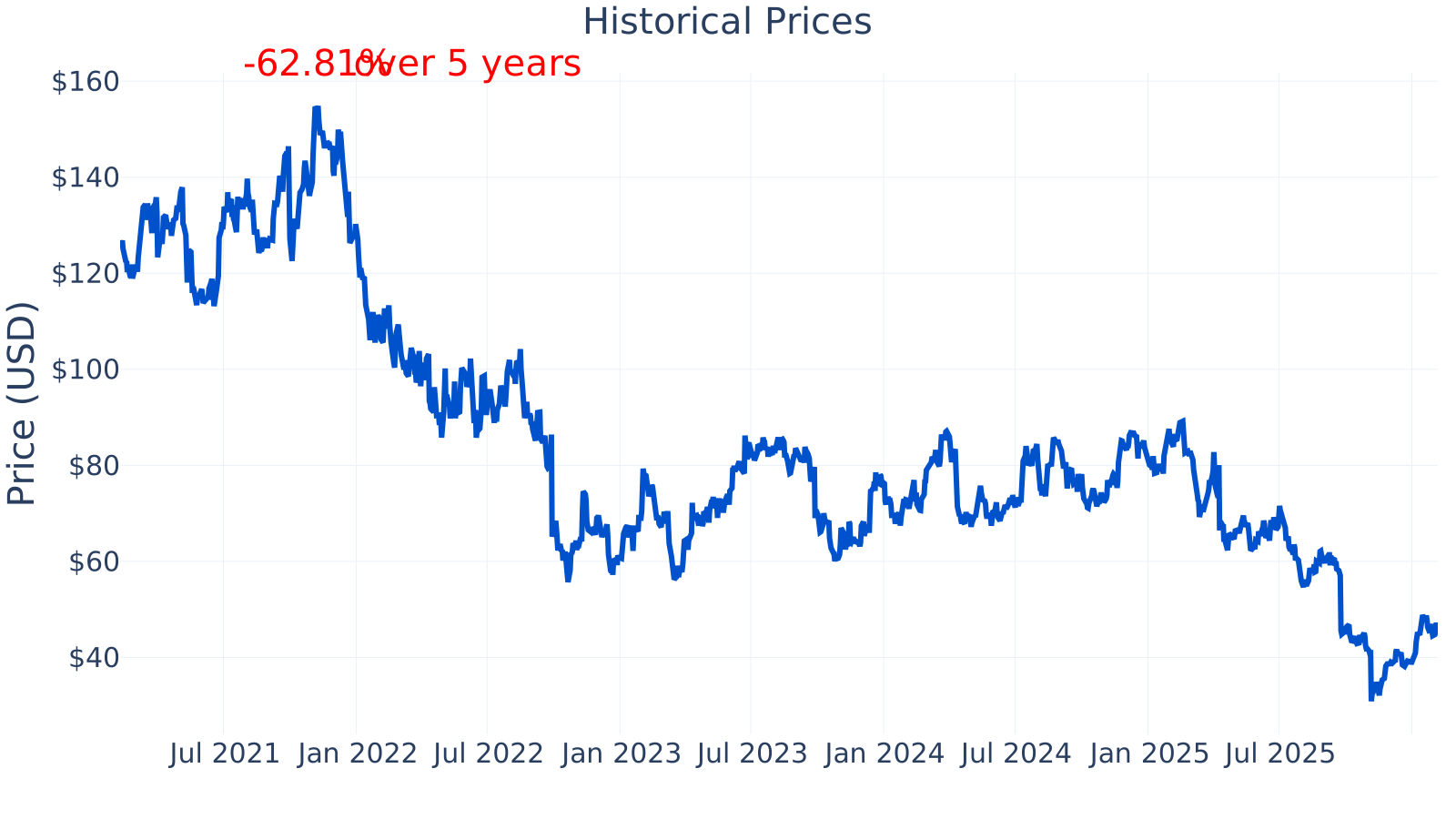
CarMax’s market capitalization is about $6.9B, and its beta of ~1.35 suggests the stock has historically moved more than the overall market. The company’s P/E ratio is ~15.5, slightly below the industry median shown (~16.8). Profitability is thin: net profit margin is ~1.64% versus an industry median around 2.73%. Recent top-line momentum is negative on the latest snapshot: year-over-year revenue growth is about -6.7%, compared with an industry median of +5.7%. Leverage is elevated: debt-to-equity is ~275%, above the industry median (~143%). Over the trailing twelve months, free cash flow is about $1.95B, which indicates meaningful cash generation in the most recent period even though profitability metrics remain modest.
Growth (Medium)
The used-car market is large and tends to be resilient over long periods because many households look for lower-cost alternatives to new vehicles. Still, it is not a straight-line growth industry; it is cyclical and heavily influenced by interest rates, vehicle affordability, and the supply of used cars (which can tighten or loosen depending on new-car production, lease returns, and consumer trade-in activity). That means CarMax’s growth profile can vary significantly from year to year.
Strategically, CarMax has emphasized an “omnichannel” approach (store + online) and operational scale (sourcing, reconditioning, logistics, and pricing). If executed well, these themes can support future growth by widening customer reach and improving efficiency. Another potential long-term catalyst is the company’s financing ecosystem: the ability to help customers obtain financing can support conversion rates, but it also ties results more closely to credit conditions.
The year-over-year revenue trend shown is volatile: very strong growth in 2021–early 2022 (including triple-digit growth at one point), followed by a sustained period of contraction through much of 2022–2024, a brief return to modest growth in parts of 2025, and then a decline again to about -6.7% most recently. This pattern is consistent with a business exposed to used-vehicle pricing cycles and shifting consumer affordability.
Free cash flow swings meaningfully over time: it moved from a positive level in 2021 (~$0.50B) to a large negative level in 2022 (~-$2.86B), then back to positive in 2023 (~$0.86B), near break-even in 2024, and positive again in 2025 (~$0.16B as of fiscal year-end). The latest metrics table also shows a much higher trailing twelve-month free cash flow figure (~$1.95B), highlighting that cash generation can change quickly depending on inventory levels, working capital needs, and market conditions.
Risks (High)
This article is for informational purposes only and does not constitute financial advice. Some content is AI-generated. See Disclaimer