Stock Analysis · Calix Inc (CALX)
Overview
Calix, Inc. is a technology company that sells platforms, software, and services that help broadband service providers (such as telecom and cable operators, co-ops, and other network operators) deliver high-speed internet and manage the customer experience. In simple terms, Calix supports companies that provide home and small-business internet by supplying the tools to run the network, connect end-users, and operate services more efficiently.
Its offering typically combines (1) network-focused products (equipment and systems used to build and operate broadband networks) and (2) software and cloud-based capabilities used for operations, analytics, and customer engagement. The business model therefore mixes product revenue with software and services revenue, and its results can be influenced by how much its customers are investing in broadband expansion and upgrades in a given year.
Main sources of revenue are generally organized around:
- Platform / systems and related products (hardware and associated components used by service providers)
- Software (including cloud-based functionality tied to operating and improving service delivery)
- Services (such as support and professional services)
In recent years, total revenue has shown meaningful swings, with a peak above $1.0B (2023), a decline (2024), and a rebound back toward $1.0B (2025). Over the same period, operating spending—especially research and development—has remained significant, reflecting an ongoing emphasis on product and software development.
From 2021 to 2025, revenue rose from about $679M to about $1,000M. Over that same span, net income was volatile (very high in 2021, then much lower, including a net loss in 2024, and a return to positive net income in 2025). This pattern highlights that profitability has not been consistent even when revenue has been sizable.
Key Figures
| Metric | Value | Industry ⓘ |
|---|---|---|
| Date | Apr 27, 2026 | |
| Context | ||
| Sector | Technology | |
| Industry | Software - Infrastructure | |
| Market Cap ⓘ | $2.77B | |
| Beta ⓘ | 1.53 | |
| Fundamental | ||
| P/E Ratio ⓘ | 88.53 | 29.35 |
| Profit Margin ⓘ | 3.20% | 6.83% |
| Revenue Growth ⓘ | 27.10% | 14.85% |
| Debt to Equity ⓘ | 1.61% | 24.49% |
| PEG ⓘ | 3.34 | |
| Free Cash Flow ⓘ | $109.13M | |
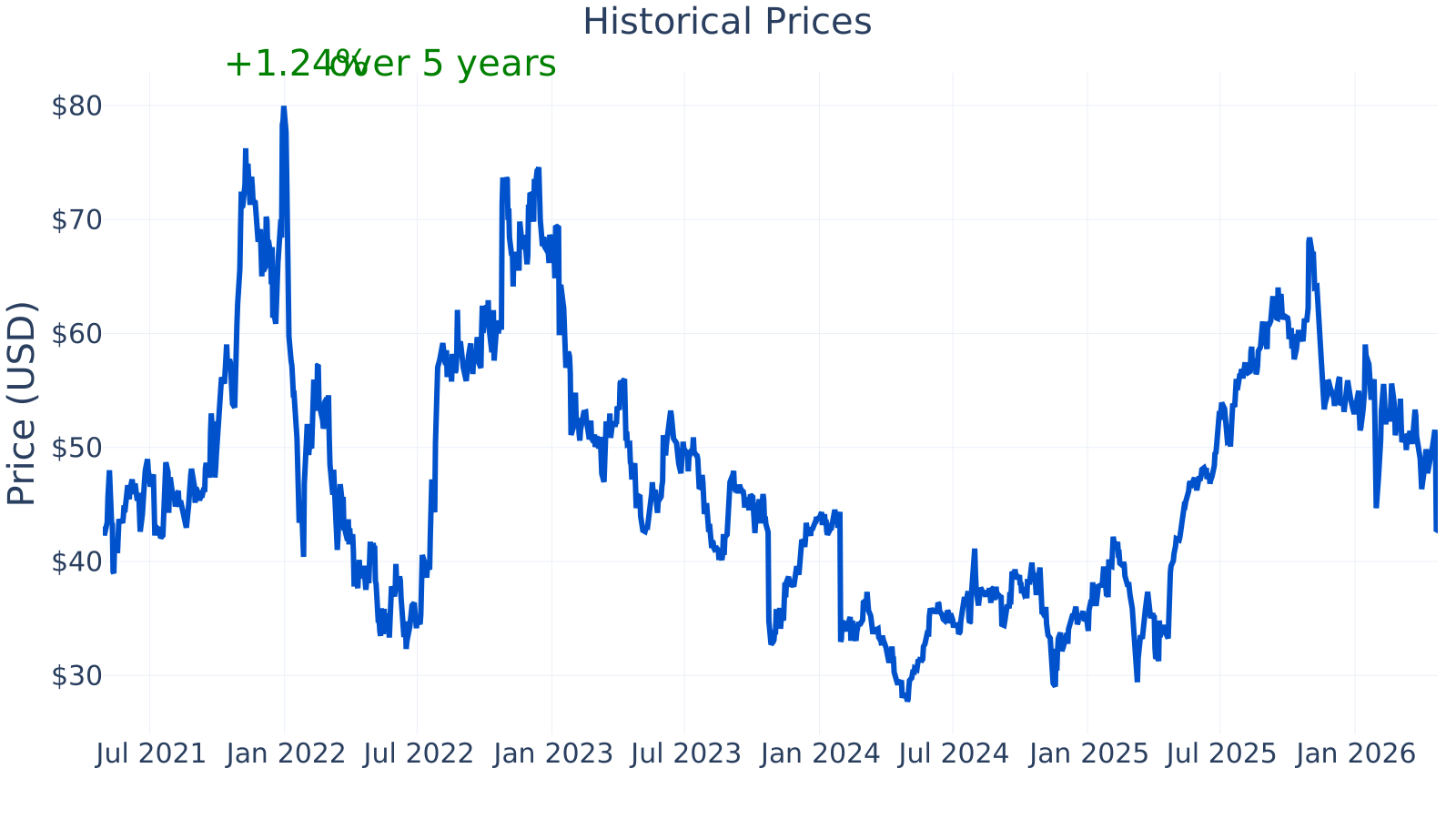
Calix’s market capitalization is about $2.77B, and the stock has shown above-market sensitivity with a beta of 1.53 (meaning it has tended to move more than the overall market). The company’s profit margin is about 3.2%, below the industry median of 6.83%, while its year-over-year revenue growth is about 27.1%, above the industry median of 14.85%. Balance-sheet leverage appears low with a debt-to-equity ratio of about 1.6% versus an industry median near 24.5%. Trailing free cash flow is about $109.1M. The reported P/E ratio is about 88.5 versus an industry median near 29.3, and the PEG ratio is about 3.34 (often interpreted as a sign that the valuation is high relative to expected growth, though PEG is sensitive to the growth assumptions behind it).
Growth (Medium)
Calix operates in the broadband access and software ecosystem, where service providers face ongoing demand for faster speeds, better home connectivity, and improved reliability. This creates a long runway for network upgrades, customer-premises deployments, and software-driven operations—areas that align with Calix’s product and software portfolio.
That said, the company’s growth has not been smooth year to year. After strong growth through 2023, revenue declined in 2024 before returning to growth more recently. This can happen in markets where customer purchasing patterns are lumpy (for example, spending that depends on project timing, upgrade cycles, and funding availability), even if the long-term demand trend remains positive.
The year-over-year growth rate turned negative through multiple quarters in 2024, then shifted back to positive territory in 2025 and into early 2026, reaching roughly 27% most recently. Relative to the broader industry median shown, Calix’s latest growth rate stands out as higher, but the prior downturn shows that growth can reverse when customer spending slows.
Free cash flow over the trailing twelve months has increased to about $109M, up from earlier periods shown (including much lower levels in 2023). For long-term business durability, sustained positive free cash flow can matter because it indicates the business is generating cash after operating needs and investment spending, providing flexibility for reinvestment and resilience during weaker demand periods.
Risks (High)
A key risk is profitability volatility. Profit margin has moved from very high levels earlier in the period shown to low single digits more recently, including negative quarters in 2024 and 2025 before turning positive again. This suggests operating results can be pressured by pricing, product mix, spending levels (including R&D), and demand cycles among service-provider customers.
The margin trend shows a sharp normalization from unusually high levels earlier in the timeline to low/negative profitability during the 2024–2025 period, with improvement back to about 3.2% most recently—still below the industry median near 7.1%. This gap can matter because lower margins typically leave less room for error if revenue growth slows again.
Another risk is customer concentration and spending cyclicality typical of selling to service providers: purchasing decisions can be tied to capital budgets, deployment timing, and broader industry investment cycles. Even if long-term broadband demand rises, annual results can fluctuate when customers pause or accelerate projects.
On financial structure, leverage appears to be a smaller risk than for many peers because reported debt levels are low relative to equity.
Debt-to-equity has remained far below the industry median across the timeline, landing around 1.6% most recently versus an industry median around 17.9% at the latest point shown. Lower leverage can reduce financial stress during downturns, though it does not eliminate operational and competitive risks.
Competition is also a major factor. Calix competes with a mix of network equipment suppliers and software/platform vendors serving broadband operators. Competitive pressure can show up through pricing, product features, vendor consolidation among customers, or customers choosing integrated solutions from larger vendors. How Calix positions itself depends on the strength of its platform, software capabilities, and customer outcomes versus alternatives; however, the market includes well-resourced competitors that can influence deal wins and margins.
Valuation
Valuation measures can look elevated relative to peers. The latest P/E ratio is about 88.5, which is well above the industry median near 29.3. A higher P/E can be consistent with higher expected growth or improving profitability, but it can also leave less room for disappointment if growth slows or margins weaken.
Historically, the P/E ratio has varied widely, including periods where it was much lower (early 2022) and periods where it was much higher (late 2022 onward, and most recently around 178.6 on the chart). The industry median shown has been far more stable (around the high 20s to low 30s in the periods displayed). This contrast suggests the market’s expectations for Calix have shifted substantially over time, which can amplify stock-price sensitivity to changes in earnings.
Conclusion
Calix is positioned in a broadband-focused market where long-term demand drivers—network upgrades, better connectivity, and software-driven operations—can support continued product and software adoption. Recent performance shows a rebound in revenue growth and a notable improvement in trailing free cash flow.
At the same time, the company’s history of uneven revenue growth and especially volatile profitability is a central feature of the story. While balance-sheet leverage appears low, competitive dynamics and service-provider spending cycles can influence both growth and margins. Valuation indicators (notably the P/E relative to the industry median) imply that the stock price has, at times, reflected substantial expectations for future performance.
Sources:
- U.S. Securities and Exchange Commission (SEC) EDGAR — Calix, Inc. filings (Form 10-K, Form 10-Q)
- Calix, Inc. Investor Relations — SEC filings and shareholder materials (company-hosted)
- Wikipedia — “Calix, Inc.” (general background)
This article is for informational purposes only and does not constitute financial advice. Some content is AI-generated. See Disclaimer


