Stock Analysis · Caesars Entertainment Corporation (CZR)
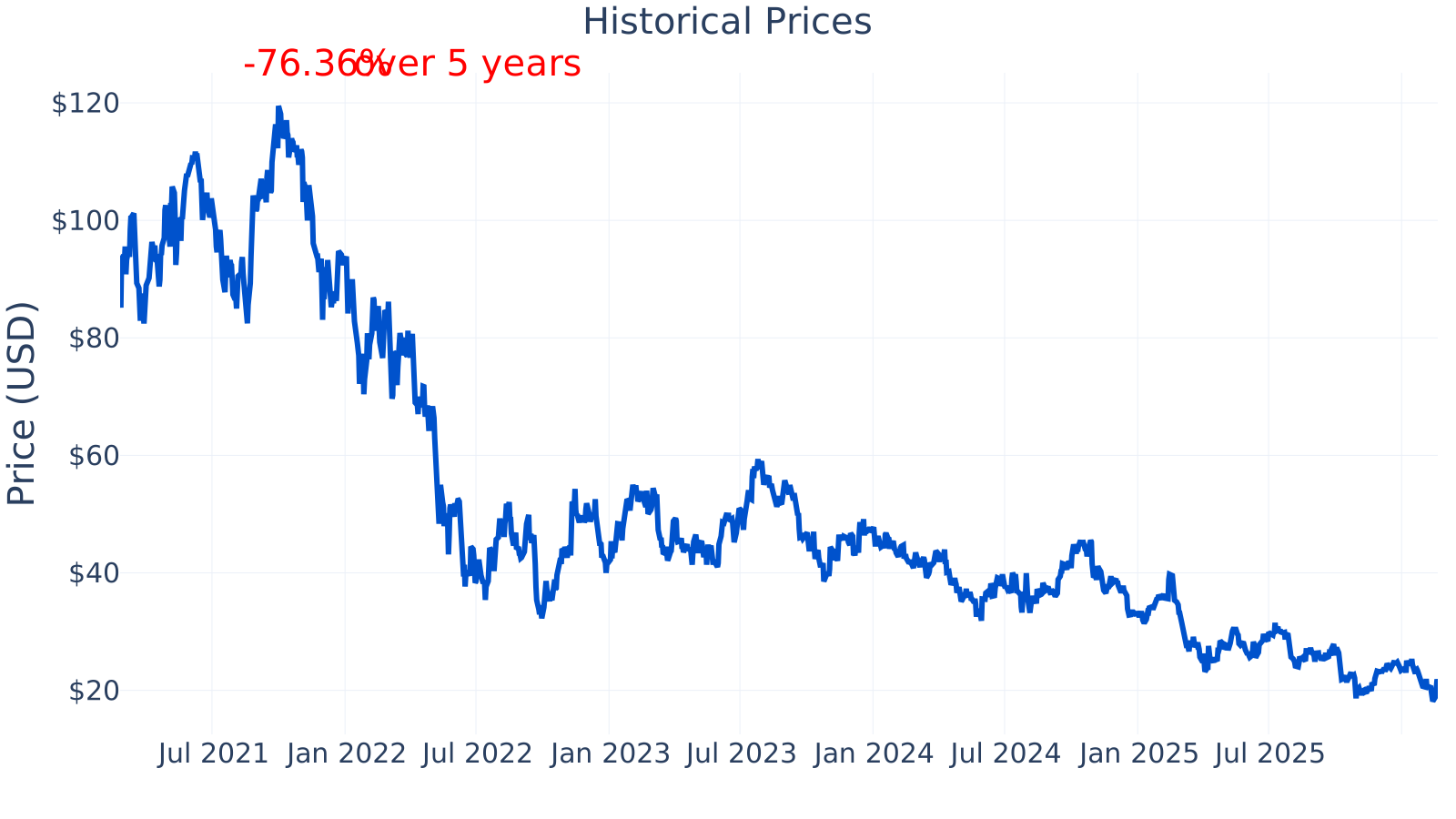
Overview
Caesars Entertainment Corporation is a hospitality and gaming company. It operates destination resorts and casinos (including hotel rooms, casino gaming floors, restaurants, entertainment venues, and meeting space) and also runs online sports betting and online casino offerings in a number of jurisdictions where those activities are legal.
At a high level, Caesars aims to monetize the same customer base across multiple channels: on-property visits (casinos/hotels/food/entertainment) and digital play (online wagering and iCasino). The company’s scale and well-known brands are designed to support this ecosystem, with customer loyalty programs used to encourage repeat visits and cross-selling between physical resorts and online products.
Main sources of revenue are typically reported by operating segments in company filings, with the largest contribution generally coming from in-person casino/resort operations and a smaller (but strategically important) contribution from digital operations.
Across the years shown, total revenue rose from about $9.6B (2021) to about $11.5B (2025). A notable recurring theme is that interest expense remains very large (roughly $2.3B per year in the years shown), which can materially influence net income even when operating income is positive.
Key Figures
| Metric | Value | Industry ⓘ |
|---|---|---|
| Date | Feb 23, 2026 | |
| Context | ||
| Sector | Consumer Cyclical | |
| Industry | Resorts & Casinos | |
| Market Cap ⓘ | $4.42B | |
| Beta ⓘ | 1.99 | |
| Fundamental | ||
| P/E Ratio ⓘ | N/A | 20.52 |
| Profit Margin ⓘ | -4.37% | 4.87% |
| Revenue Growth ⓘ | 4.20% | 4.10% |
| Debt to Equity ⓘ | 751.83% | 548.08% |
| PEG ⓘ | 3.26 | |
| Free Cash Flow ⓘ | $520.00M | |
Caesars’ market capitalization is about $4.4B, and the stock’s beta of ~1.99 indicates it has historically moved much more than the overall market (higher volatility). The latest profit margin is about -4.4%, below the industry median (about +4.9%), showing recent bottom-line pressure relative to peers. Year-over-year revenue growth is about +4.2%, roughly in line with the industry median (about +4.1%). Leverage is high: debt-to-equity is ~752% versus an industry median near 548%. Trailing free cash flow is about $520M, and the PEG ratio shown (~3.26) is commonly interpreted as implying a higher valuation relative to expected growth (though PEG depends heavily on assumptions used in growth estimates).
Growth (Medium)
Resorts and casinos are closely tied to travel and consumer discretionary spending. Over the long term, demand can benefit from population growth, rising leisure spending, and continued development of destination entertainment. At the same time, this is a mature, competitive industry in many core markets, so growth often comes from a mix of operational execution (driving higher visitation and spending per guest), disciplined investment in properties, and expansion into new or newly regulated markets.
Caesars’ strategy includes operating major destination properties while building a digital business that can scale without adding physical capacity in the same way a new resort would. Digital offerings can be a potential growth driver if the company increases market share, improves unit economics (profit per customer), and benefits from any additional legalization of online sports betting and online casino by U.S. states.
The year-over-year revenue growth pattern shows a post-pandemic surge in 2021, followed by more normalized (and at times slightly negative) growth rates in 2024, and a return to modest growth by late 2025 (about +4.2% most recently). This profile suggests that recent growth has been steady rather than rapid, with performance likely depending on consumer demand, property-level execution, and the trajectory of the digital segment.
Free cash flow improved markedly from negative levels in 2021 to positive territory in 2022–2024, but it dipped sharply by early 2025 before rebounding to a trailing level around $520M (latest metric). For a capital-intensive business, sustained free cash flow matters because it can be used for debt reduction, reinvestment in properties, and other corporate priorities.
Risks (High)
The biggest structural risk factor for Caesars is financial leverage. Casino operators often use significant debt, but high leverage can reduce flexibility during weaker consumer environments and can also keep net income under pressure when interest costs are large.
Debt-to-equity has trended high over time and stands around 752%, above the industry median near 548%. This matters because higher leverage can amplify outcomes: it can help equity returns when business conditions are favorable, but it can also intensify downside risk if revenues soften or refinancing becomes more expensive.
Profitability is another key risk area. Even if properties generate operating profit, non-operating items (especially interest expense) and one-time items can swing the bottom line.
Profit margin improved into positive territory during parts of 2023–early 2024, but moved back to negative in the periods shown afterward, ending around -4.4%. The industry median remains positive (about +4.2% to +7.9% across many of the periods shown), highlighting that Caesars has recently underperformed the typical peer on this measure.
Regulation is an ongoing operational reality. Casino gaming and online wagering depend on licenses, regulatory approvals, tax rates, and compliance requirements that vary by state and jurisdiction. Changes in gaming taxes, license terms, or advertising/marketing rules can affect profitability—particularly in digital wagering, where promotional intensity can be high.
Competition is also meaningful. In physical gaming, Caesars competes with other major U.S. operators and with regional casinos for customer visits and discretionary spending. In digital, it competes for customer acquisition, retention, and product quality in a crowded market. Competitive advantages in this industry often include brand portfolio, property locations, loyalty program scale, distribution partnerships, and the ability to invest through cycles. Caesars is one of the large U.S. operators by footprint and brand recognition, but it operates in markets where no single company controls the entire landscape, and competitive dynamics can shift by region and by digital state market.
Valuation
Valuation for casino operators is often discussed using earnings-based multiples (like P/E) and cash-flow-based measures, but interpretation can be difficult when earnings are volatile due to leverage, interest expense, and one-time items. In those cases, comparisons across time and versus peers should be treated carefully.
The P/E series shown is intermittent for Caesars (several periods are not meaningful and therefore not displayed), while the industry median has generally ranged in the mid-teens to 20s. When Caesars does show a P/E in the chart, it appears at times below the industry median (for example in parts of 2024), which can happen when the market assigns a lower multiple due to higher perceived risk, weaker profitability, or leverage concerns. The PEG ratio shown in the latest metrics (~3.26) is a separate valuation lens that compares P/E to expected growth; values above 1 are often interpreted as pricing in more than near-term growth, though the usefulness depends on the reliability of growth estimates and the stability of earnings.
Given the company’s combination of modest recent revenue growth, negative recent profit margin, and high leverage, valuation discussion typically centers on whether operating performance and cash generation can consistently outpace financing costs over time, and how resilient results are across economic cycles.
Conclusion
Caesars is a large, well-known operator in U.S. gaming and hospitality, with a business model that blends destination/regional resorts and a digital wagering presence. The company has shown the ability to generate operating income and has produced positive trailing free cash flow, while revenue growth has recently been modest and roughly in line with the industry median.
The main counterweights are the high leverage profile and the sizable interest expense, which can meaningfully affect net income and reduce flexibility during weaker demand periods. Relative to the broader resorts and casinos peer group shown here, Caesars also stands out for a weaker recent profit margin and higher debt-to-equity. As a result, long-term outcomes are likely to be influenced by sustained cash generation, competitive positioning in both physical and digital channels, and the company’s ability to manage and refinance debt through varying economic conditions.
Sources:- SEC EDGAR — Caesars Entertainment Corporation filings (Form 10-K, Form 10-Q)
- Caesars Entertainment — Investor Relations materials (public filings and releases)
- Wikipedia — “Caesars Entertainment” (basic company background)
This article is for informational purposes only and does not constitute financial advice. Some content is AI-generated. See Disclaimer


