Stock Analysis · CACI International Inc (CACI)
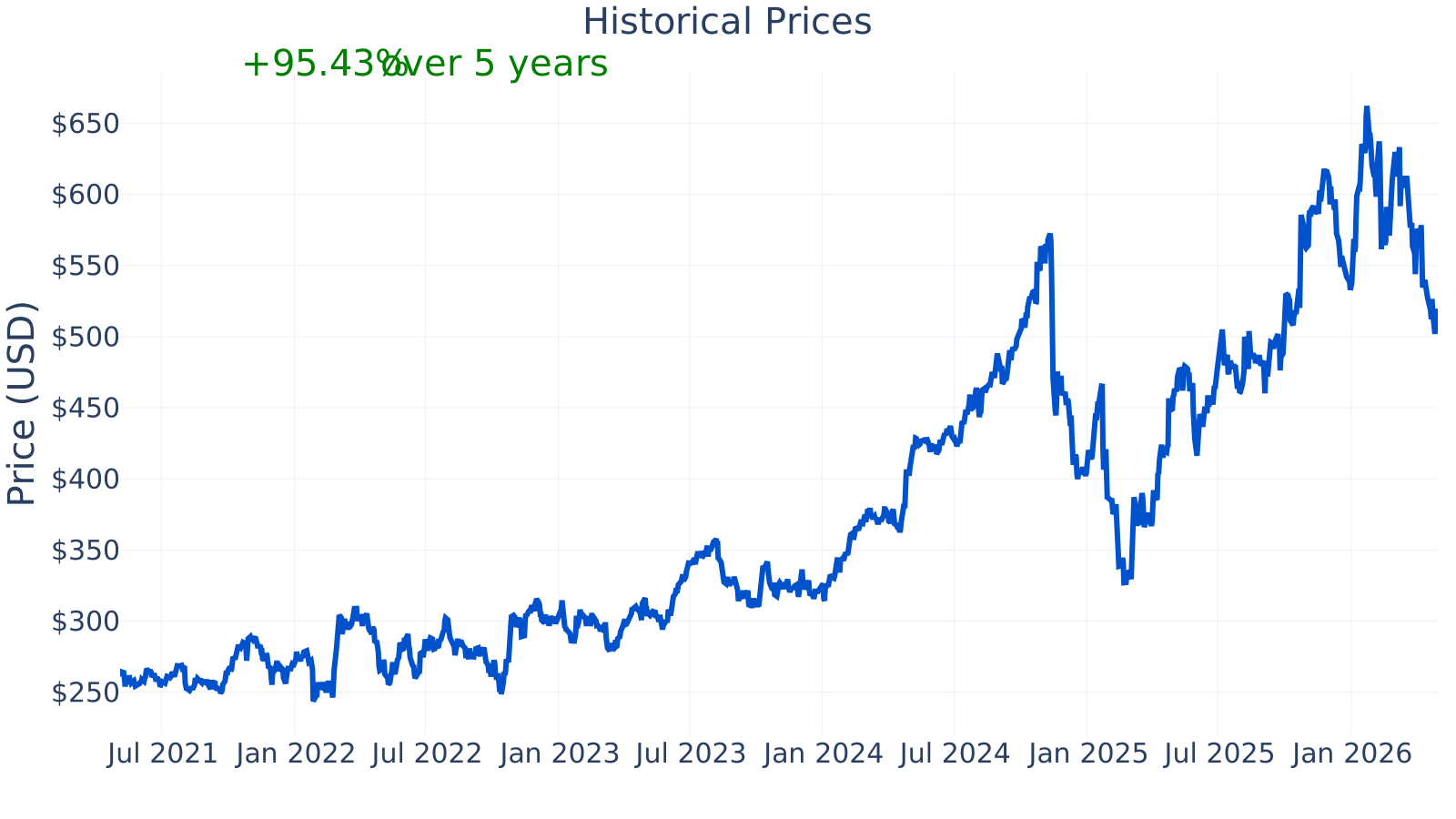
Overview
CACI International Inc. (CACI) provides technology and professional services primarily to U.S. government customers. In simple terms, it helps defense and intelligence agencies (and some civilian agencies) run complex missions by delivering software, cybersecurity, data and analytics support, engineering, and specialized operational services. The company’s work often involves long-running contracts where CACI supplies skilled teams and technical solutions that are closely tied to customer missions.
CACI reports its business through two main segments, which are also its main revenue streams:
- Domestic Operations (largest): services and solutions delivered to U.S. government agencies, including defense, intelligence, and federal civilian customers.
- International Operations (smaller): similar services delivered outside the U.S., typically supporting U.S. government missions and allied/partner needs.
At a high level, the company earns revenue by performing contract work (labor, engineering, and managed services) and delivering technology solutions that can be integrated into customer environments. The exact customer/program mix can change from year to year depending on contract awards, renewals, and program funding.
Over recent fiscal years, total revenue and net income have generally trended upward, while operating costs remain the largest share of revenue (typical for services businesses). Interest expense has also increased over time, which can matter when evaluating financing decisions and overall profitability.
Key Figures
| Metric | Value | Industry ⓘ |
|---|---|---|
| Date | May 04, 2026 | |
| Context | ||
| Sector | Technology | |
| Industry | Information Technology Services | |
| Market Cap ⓘ | $11.34B | |
| Beta ⓘ | 0.63 | |
| Fundamental | ||
| P/E Ratio ⓘ | 21.18 | 16.84 |
| Profit Margin ⓘ | 5.86% | 5.39% |
| Revenue Growth ⓘ | 8.50% | 7.15% |
| Debt to Equity ⓘ | 131.21% | 56.46% |
| PEG ⓘ | 514.23 | |
| Free Cash Flow ⓘ | $625.69M | |
CACI’s market capitalization is about $11.34B, placing it among mid-to-large publicly traded government-focused IT services providers.
The stock’s beta is about 0.63, which indicates it has historically moved less than the broader market on average (though any individual stock can still be volatile).
On profitability, CACI’s profit margin is about 5.86% versus an industry median near 5.40%. That suggests profitability broadly in line with peers, slightly higher on this snapshot.
On growth, year-over-year revenue growth is about 8.5% versus an industry median near 7.15%, indicating growth somewhat above the median at the time shown.
On leverage, debt-to-equity is about 131% versus an industry median near 56%. This indicates heavier use of debt than many peers, which increases sensitivity to interest rates and execution risk.
For cash generation, free cash flow (TTM) is about $625.7M, which can be an important support for reinvestment, debt repayment, and acquisitions.
Growth (Medium)
CACI operates in areas that are typically supported by sustained government demand, including cybersecurity, intelligence support, data analytics, software modernization, and mission-focused engineering. These priorities are often multi-year in nature, because agencies maintain and upgrade systems continuously rather than making one-time purchases.
The company’s strategy (as described in its public filings) centers on expanding capabilities aligned to national security and federal modernization needs, competing for large contract vehicles, and selectively using acquisitions to add specialized skills or customer access. For a services-heavy business, consistent contract wins, recompetes (renewals), and the ability to hire and retain cleared talent are key drivers of growth.
The revenue growth pattern shown is positive overall, with several quarters in the low double digits and a more recent reading around 8.5%. That profile is consistent with a contractor that is growing through a mix of existing program expansion and new awards, but not growing at the pace of a typical consumer software company.
Free cash flow has been positive, with an upswing to roughly $625.7M in the most recent trailing period shown (after being lower in earlier periods). For long-term business durability, sustained free cash flow matters because it can help fund internal investment and reduce reliance on external financing.
Risks (Medium)
A major risk for CACI is customer concentration: a large share of revenue is tied to the U.S. government budget environment and procurement decisions. Even when long-term priorities remain, individual programs can be delayed, scaled down, recompeted, or restructured. Contracting also comes with compliance requirements and audit risk, and some contracts have pricing structures that can pressure margins if costs rise faster than expected.
Another important risk is competition for cleared talent. Many programs require personnel with security clearances, and the labor market for those skills can be tight. Wage inflation or staffing shortfalls can affect execution, contract profitability, and the ability to take on new work.
Leverage is also a key consideration.
Debt-to-equity has risen to about 131% in the most recent period shown, well above the industry median near 56%. The series also shows significant movement over time, including a sharp increase recently. Higher leverage can amplify outcomes: it can support acquisitions and growth, but it also raises exposure to higher interest costs and reduces flexibility if contract performance or award timing weakens.
On profitability, margins are steady but not high, which is common in government services.
CACI’s profit margin has generally been in the mid-single digits over time, and the latest value shown (about 5.86%) is above the industry median (about 4.19%) at that point. Even so, small margin changes can matter because services businesses often operate with limited room for error on pricing, staffing, and execution.
In terms of competitive positioning, CACI operates in a crowded field of defense and federal IT contractors. Its competitive advantages typically come from a combination of (1) past performance on sensitive missions, (2) position on large contract vehicles, (3) relationships with agencies, and (4) the ability to deliver specialized technical capabilities at scale. The company is not the only major player in these markets; relevant competitors commonly include large, diversified contractors and IT services firms that also target defense, intelligence, and federal civilian customers (for example: Leidos, Booz Allen Hamilton, SAIC, General Dynamics’ IT-related businesses, and Northrop Grumman’s mission-focused units). Competitive outcomes are often determined contract-by-contract, meaning “leadership” can vary by agency and mission area rather than being absolute across the entire market.
Valuation
CACI’s latest P/E ratio is about 21.18, compared with an industry median near 16.84. Over the period shown, CACI’s P/E has often been below the industry median, but it has also moved above it at times. This indicates the market’s valuation of CACI has fluctuated between “in line” and “somewhat higher than” typical peers, depending on the date.
Interpreting whether the current valuation is “high” or “low” depends on context that is not captured by a single ratio. A higher P/E can be associated with expectations of stronger growth, more resilient contract performance, better cash generation, or improved margins. On the other hand, above-median valuation can be harder to sustain if revenue growth slows, if margins compress, or if higher leverage and interest expense become a larger drag on earnings.
Given the company’s mid-single-digit profit margins, moderate revenue growth profile, and higher-than-median leverage, valuation discussions typically come down to whether investors expect stable contract execution and continued demand in CACI’s core mission areas, while also monitoring balance sheet and financing costs.
Conclusion
CACI is a government-focused technology and services provider with business tied to long-duration national security and federal modernization needs. The company shows a pattern of growing revenue over time and generating meaningful free cash flow, alongside mid-single-digit profitability that is broadly consistent with a services-heavy model.
The main trade-offs visible in the fundamentals are that CACI operates in a budget- and contract-driven environment with ongoing competitive pressure, and it currently shows higher leverage than the industry median, which can increase sensitivity to interest expense and operational setbacks. Valuation, as reflected by the P/E ratio, sits above the industry median at the latest point shown, which places greater weight on continued solid execution and sustained demand in its end markets.
Sources:
- SEC EDGAR — CACI International Inc. — Annual Report (Form 10-K)
- SEC EDGAR — CACI International Inc. — Quarterly Report (Form 10-Q)
- CACI Investor Relations — SEC Filings
- Wikipedia — “CACI International”
This article is for informational purposes only and does not constitute financial advice. Some content is AI-generated. See Disclaimer


