Stock Analysis · CTS Corporation (CTS)
Overview
CTS Corporation is a technology-focused manufacturer of specialized electronic components and sensors. In simple terms, it makes parts that help machines and devices “sense” or “control” things accurately—such as position, motion, vibration, or timing—so larger systems can operate safely and reliably.
According to the company’s public filings, CTS is organized around these main product areas:
- Sensors (used in applications like vehicles and industrial equipment)
- Actuators (components that create motion or control mechanical systems)
- Electronic components (including products for timing and control)
CTS sells primarily to business customers (not consumers). Demand is typically linked to end-markets such as automotive and industrial production cycles, which can rise and fall over time. Public filings describe revenue by segments, but a simple “top revenue sources with exact percentages” breakdown is not included in the information provided here.
From 2021 to 2024, revenue moved from about $513M (2021) to $516M (2024), after peaking around $587M (2022). Over the same period, CTS shifted from a net loss in 2021 (about -$42M) to sustained profitability in 2022–2024 (roughly $58–61M per year), which points to a meaningful improvement versus 2021.
Key Figures
| Metric | Value | Industry ⓘ |
|---|---|---|
| Date | Feb 08, 2026 | |
| Context | ||
| Sector | Technology | |
| Industry | Electronic Components | |
| Market Cap ⓘ | $1.64B | |
| Beta ⓘ | 0.89 | |
| Fundamental | ||
| P/E Ratio ⓘ | 28.17 | 41.23 |
| Profit Margin ⓘ | 11.25% | 6.11% |
| Revenue Growth ⓘ | 8.00% | 13.80% |
| Debt to Equity ⓘ | 24.21% | 39.00% |
| PEG ⓘ | 2.05 | |
| Free Cash Flow ⓘ | $80.20M | |
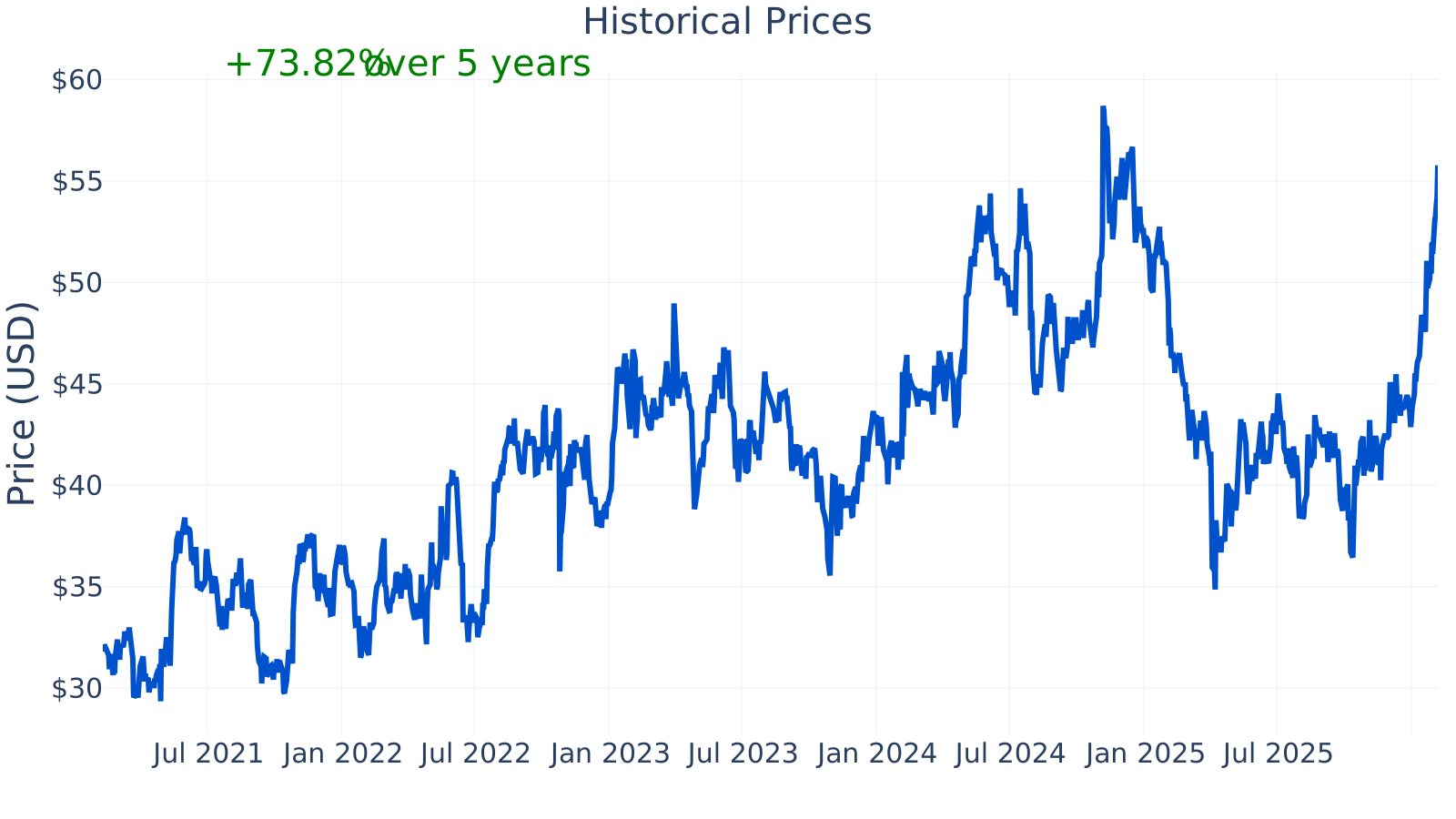
CTS has a market capitalization of about $1.64B and a beta of ~0.89, which indicates the stock has historically moved somewhat less than the broader market. The P/E ratio is ~28.2, below the listed industry median (~41.2), while the profit margin is ~11.25%, above the industry median (~6.11%). Year-over-year revenue growth is about 8% versus an industry median around 13.8%. Debt-to-equity is about 24% (industry median ~39%). Trailing twelve-month free cash flow is ~$80.2M. The PEG ratio is ~2.05, a metric often used to relate valuation to growth expectations.
Growth (Medium)
CTS operates in electronic components—an area supported over the long run by ongoing electrification, automation, and increasing sensor content in vehicles and industrial systems. However, the pace of growth can be uneven because many customers operate in cyclical markets (especially automotive and industrial), where production levels and inventory corrections can affect orders.
Recent revenue growth has been mixed. After stronger growth earlier in the 2021–2022 period, year-over-year growth turned negative through much of 2023 and parts of 2024, then improved into 2025 (reaching roughly ~8% year-over-year in the most recent quarter shown). This pattern is consistent with a company exposed to end-market cycles rather than steady, uninterrupted expansion.
Free cash flow has remained meaningfully positive over the period shown—roughly in the $68M–$98M range (TTM) from 2021 to 2025, with the latest around $80M. For a manufacturing business, consistent free cash flow can matter because it helps fund research and development, equipment investment, and potential acquisitions without relying entirely on borrowing.
Potential catalysts described in filings and investor communications for companies like CTS typically include new program wins with large customers, increased content per vehicle or machine (more sensors and controls), and operational improvements that lift profitability. Still, the timing of these catalysts is often hard to predict and can be influenced by customers’ production schedules.
Risks (Medium)
This article is for informational purposes only and does not constitute financial advice. Some content is AI-generated. See Disclaimer