Stock Analysis · CDW Corp (CDW)
Overview
CDW Corp is a large provider of technology solutions that helps organizations buy, implement, and manage IT. Instead of manufacturing most of the products it sells, CDW primarily acts as a service-focused intermediary: it sources hardware and software from many vendors, designs solutions, and supports customers with services such as configuration, lifecycle management, and managed services. Its customer base spans businesses, government agencies, schools, and healthcare organizations, which helps diversify demand across different parts of the economy.
CDW’s revenue is mainly generated by selling IT products (like devices, networking equipment, data center infrastructure, and software) and by providing services tied to those solutions (like professional and managed services). In general, this model tends to produce high sales volume with relatively modest profit margins, because a meaningful share of revenue is pass-through product cost.
Based on company reporting categories (which can vary by year), revenue is typically concentrated in these areas:
- Hardware (client devices, servers/storage, networking)
- Software (licenses and subscriptions)
- Services (professional services, managed services, and other solution-related services)
CDW also organizes its business around customer end-markets, commonly including Corporate, Small Business, Public (government), Education, and Healthcare, reflecting where demand comes from and how sales teams are structured.
Across the years shown, total revenue moves within a relatively tight band (roughly the low-$20B range), while net income stays around about $1.0B–$1.1B. A large portion of revenue flows through to product costs, which is typical for an IT solutions reseller/integrator; the business model relies heavily on scale, customer relationships, and services attach rather than very high product markups.
Key Figures
| Metric | Value | Industry ⓘ |
|---|---|---|
| Date | Feb 07, 2026 | |
| Context | ||
| Sector | Technology | |
| Industry | Information Technology Services | |
| Market Cap ⓘ | $18.69B | |
| Beta ⓘ | 1.05 | |
| Fundamental | ||
| P/E Ratio ⓘ | 17.63 | 21.13 |
| Profit Margin ⓘ | 4.76% | 4.91% |
| Revenue Growth ⓘ | 6.30% | 6.15% |
| Debt to Equity ⓘ | 163.58% | 54.49% |
| PEG ⓘ | 1.53 | |
| Free Cash Flow ⓘ | $1.11B | |
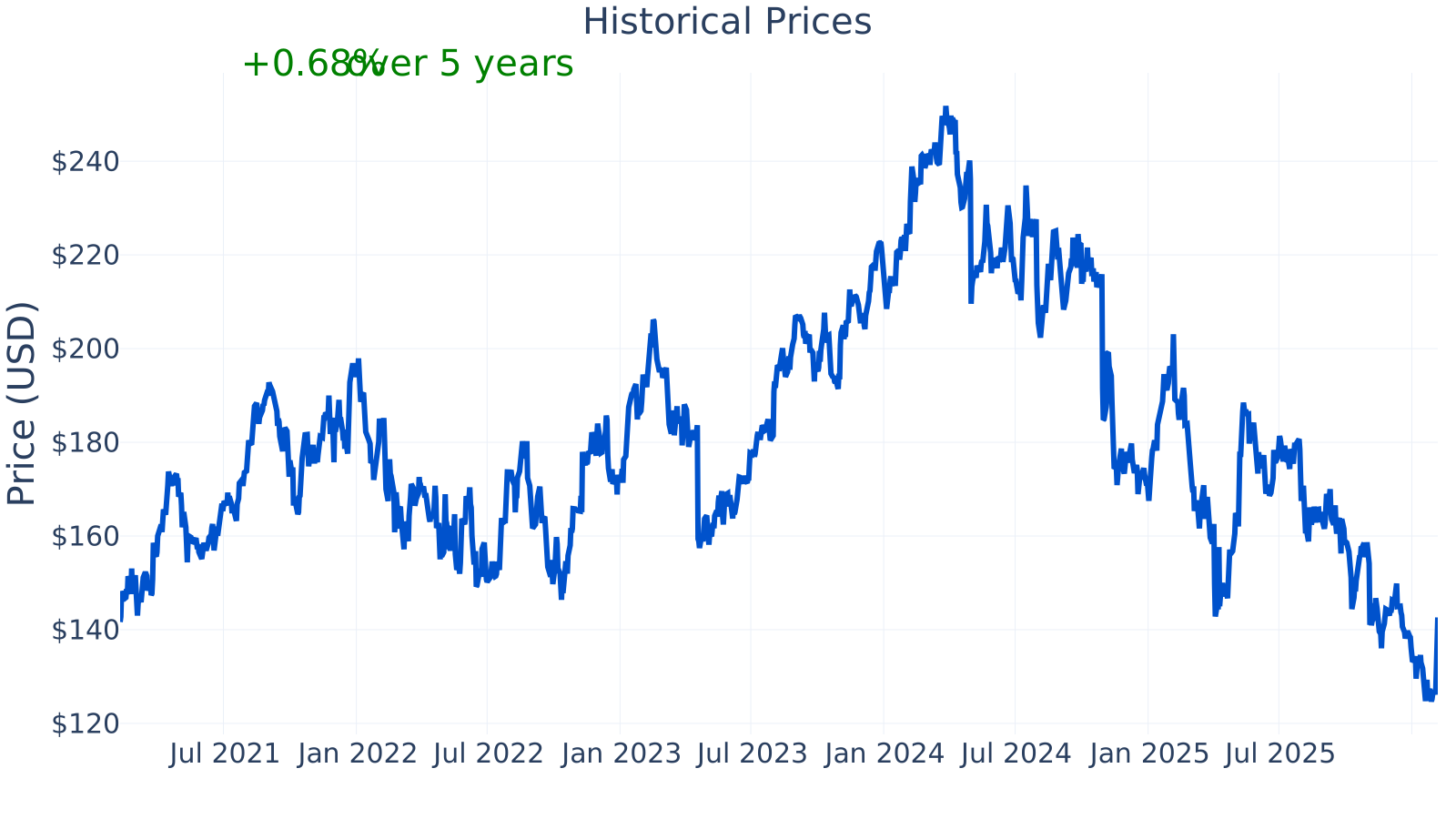
CDW’s market capitalization is about $18.7B, and the stock’s beta (~1.05) indicates price moves that have been close to the broader market historically. The company shows a P/E ratio of ~17.6 versus an industry median of ~21.1, while its profit margin is ~4.76%, close to the industry median (~4.91%). Latest year-over-year revenue growth is ~6.3%, also close to the industry median (~6.15%). One standout metric is leverage: debt-to-equity is ~164% versus an industry median of ~54%. Trailing twelve-month free cash flow is about $1.11B, and the PEG ratio (~1.53) suggests the valuation is not only about today’s earnings, but also tied to the market’s expectations for growth.
Growth (Medium)
CDW operates in the broad IT services and solutions market, which is supported by long-running demand drivers: ongoing device refresh cycles, network upgrades, cybersecurity needs, cloud adoption, and modernization of data centers and workplace tools. Many customers also prefer vendors that can combine product sourcing with design and ongoing support, which aligns with CDW’s role as a “one-stop” provider.
CDW’s strategy is generally oriented around deep customer relationships, a wide vendor ecosystem, and expanding services that can be delivered repeatedly over time (for example, managed services). Services can matter for growth because they tend to be less dependent on one-time product refresh cycles and can increase customer “stickiness,” although the company still generates most revenue from product sales.
The year-over-year revenue growth pattern is cyclical: it was strongly positive in 2021–2022, turned negative through much of 2023 and most of 2024, and then improved into late 2024 and parts of 2025 (with the most recent point near flat). This kind of swing can happen when customers pause or accelerate spending on hardware and large projects. For long-term business planning, the key question is whether services attachment and solution depth can smooth out these cycles over time.
Free cash flow has remained meaningfully positive, but it has not been linear—ranging from about $0.70B to $1.53B over the periods shown, with the latest around $1.11B. For a company like CDW, sustained free cash flow is important because it supports debt service, acquisitions, and shareholder returns, and it can help cushion periods when demand slows.
Risks (Medium)
A primary risk for CDW is that a sizable portion of its sales is tied to customer IT budgets that can fluctuate with the economy and with upgrade cycles. When customers delay device refreshes or large infrastructure projects, revenue growth can slow or turn negative, as seen in the recent cycle. Another structural risk is that product-focused revenue can be vulnerable to pricing pressure and vendor or distributor shifts, which can limit margin expansion.
Competitive position matters because many firms can resell similar hardware and software. CDW’s advantages tend to come from execution: broad vendor relationships, the ability to deliver complex multi-vendor solutions, established procurement processes for large customers, and services capabilities that can make relationships more durable. That said, it operates in a crowded landscape with strong competitors, and customers with scale may negotiate aggressively.
Key competitors typically include other large IT solution providers and integrators serving similar customers, such as Insight Enterprises, SHI (private), Softchoice (owned by World Wide Technology), WWT (private), and various systems integrators and cloud-focused consultancies. In addition, some vendors and cloud providers sell more directly, and large distributors can also influence the channel economics.
CDW’s leverage is an area to watch. The debt-to-equity ratio has trended down from very elevated levels earlier in the series, but the latest value is still about 164% versus an industry median near 54%. Higher leverage can amplify outcomes: it can support shareholder returns and acquisitions in good periods, but it can also increase sensitivity to interest costs and reduce flexibility if business conditions weaken.
Profit margin has been relatively steady around the mid-4% to low-5% range, with the latest near 4.75%, slightly below the industry median (about 5.05%). This stability suggests disciplined operations, but it also highlights that CDW’s model is not built for very high margins; maintaining profitability depends on volume, service mix, and cost control.
Valuation
CDW’s current P/E ratio is about 17.6, which is below the industry median (about 21.1) in the same broad peer set. Over the historical period shown, CDW’s P/E has generally moved between the high teens and high twenties, with a noticeable decline into the most recent points. In simple terms, the market is currently paying less for each dollar of CDW’s earnings than it did at several points earlier in the timeline, and less than the peer-group median today.
Whether that level is “high” or “low” depends on how one weighs several fundamentals discussed above: revenue growth that has recently been choppy (improving from 2023–2024 weakness but not consistently strong), steady but modest margins typical of a reseller/solutions model, meaningful free cash flow generation, and a balance sheet with higher leverage than many peers. The PEG ratio of about 1.53 also indicates that growth expectations are part of how the market is framing the valuation, rather than earnings alone.
Conclusion
CDW is a scaled IT solutions provider with diversified end-markets and a business model that blends high-volume product sales with solution and services capabilities. The company has shown resilient profitability and substantial free cash flow generation, while revenue growth has been cyclical—strong in 2021–2022, weaker in 2023–2024, and improving into parts of 2025.
The central long-term considerations tend to be operational rather than “breakthrough” driven: the ability to keep attaching higher-value services to product sales, defend relationships in a competitive channel, and manage leverage through different IT spending cycles. Valuation multiples are currently below the industry median in the figures shown, while leverage remains higher than peers, making balance-sheet discipline and cash flow consistency especially important reference points when evaluating the company over time.
Sources:
- SEC EDGAR — CDW Corporation Form 10-K (Annual Report)
- SEC EDGAR — CDW Corporation Form 10-Q (Quarterly Report)
- CDW Investor Relations — SEC Filings
- Wikipedia — “CDW” (company overview/background)
This article is for informational purposes only and does not constitute financial advice. Some content is AI-generated. See Disclaimer