Stock Analysis · CDW Corp (CDW)
Overview
CDW Corp is a large provider of technology solutions that helps organizations buy, implement, and manage IT. Instead of manufacturing most of the products it sells, CDW primarily acts as a service-focused intermediary: it sources hardware and software from many vendors, designs solutions, and supports customers with services such as configuration, lifecycle management, and managed services. Its customer base spans businesses, government agencies, schools, and healthcare organizations, which helps diversify demand across different parts of the economy.
CDW’s revenue is mainly generated by selling IT products (like devices, networking equipment, data center infrastructure, and software) and by providing services tied to those solutions (like professional and managed services). In general, this model tends to produce high sales volume with relatively modest profit margins, because a meaningful share of revenue is pass-through product cost.
Based on company reporting categories (which can vary by year), revenue is typically concentrated in these areas:
- Hardware (client devices, servers/storage, networking)
- Software (licenses and subscriptions)
- Services (professional services, managed services, and other solution-related services)
CDW also organizes its business around customer end-markets, commonly including Corporate, Small Business, Public (government), Education, and Healthcare, reflecting where demand comes from and how sales teams are structured.
Across the years shown, total revenue moves within a relatively tight band (roughly the low-$20B range), while net income stays around about $1.0B–$1.1B. A large portion of revenue flows through to product costs, which is typical for an IT solutions reseller/integrator; the business model relies heavily on scale, customer relationships, and services attach rather than very high product markups.
Key Figures
| Metric | Value | Industry ⓘ |
|---|---|---|
| Date | Feb 07, 2026 | |
| Context | ||
| Sector | Technology | |
| Industry | Information Technology Services | |
| Market Cap ⓘ | $18.69B | |
| Beta ⓘ | 1.05 | |
| Fundamental | ||
| P/E Ratio ⓘ | 17.63 | 21.13 |
| Profit Margin ⓘ | 4.76% | 4.91% |
| Revenue Growth ⓘ | 6.30% | 6.15% |
| Debt to Equity ⓘ | 163.58% | 54.49% |
| PEG ⓘ | 1.53 | |
| Free Cash Flow ⓘ | $1.11B | |
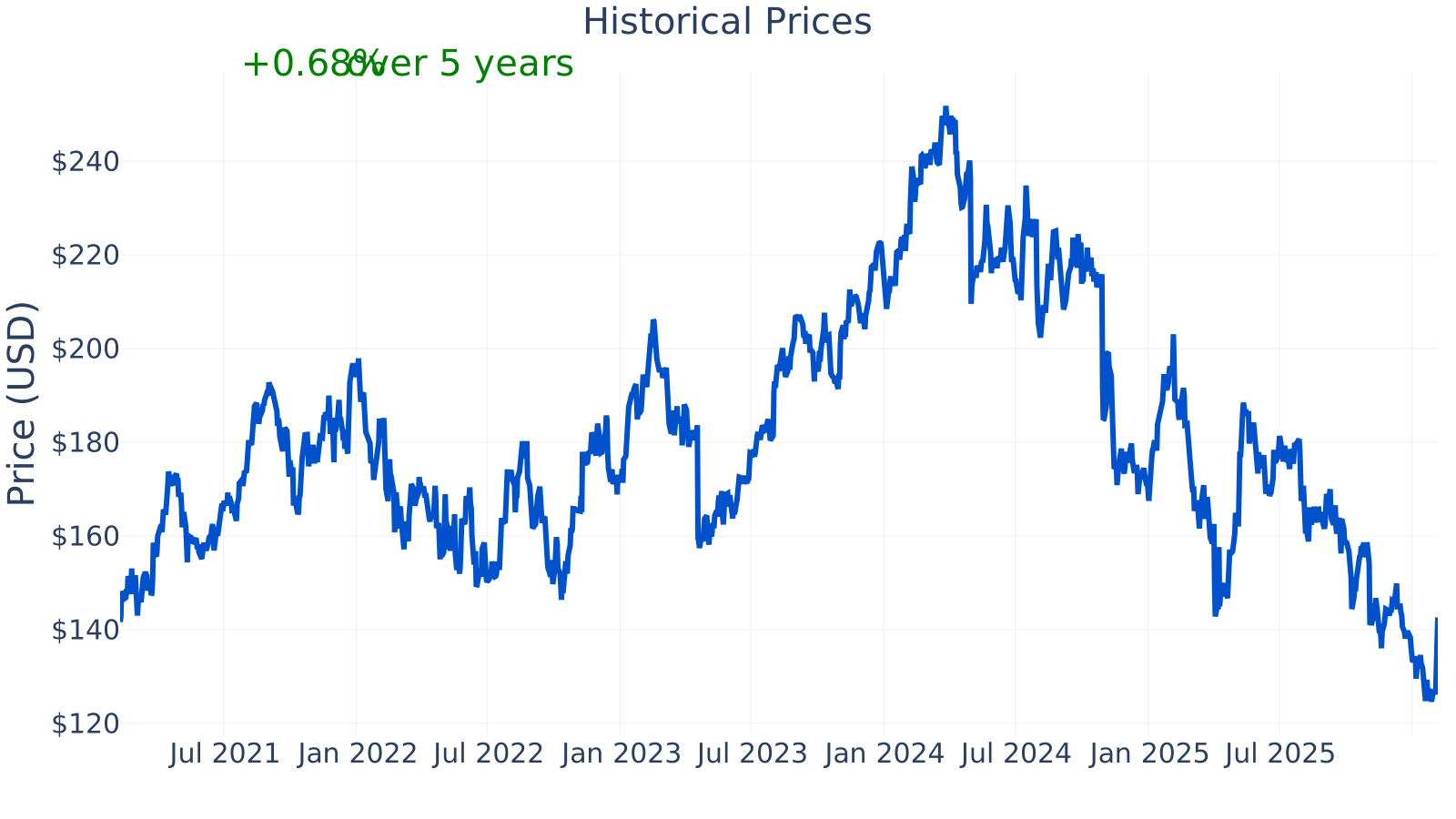
CDW’s market capitalization is about $18.7B, and the stock’s beta (~1.05) indicates price moves that have been close to the broader market historically. The company shows a P/E ratio of ~17.6 versus an industry median of ~21.1, while its profit margin is ~4.76%, close to the industry median (~4.91%). Latest year-over-year revenue growth is ~6.3%, also close to the industry median (~6.15%). One standout metric is leverage: debt-to-equity is ~164% versus an industry median of ~54%. Trailing twelve-month free cash flow is about $1.11B, and the PEG ratio (~1.53) suggests the valuation is not only about today’s earnings, but also tied to the market’s expectations for growth.
Growth (Medium)
CDW operates in the broad IT services and solutions market, which is supported by long-running demand drivers: ongoing device refresh cycles, network upgrades, cybersecurity needs, cloud adoption, and modernization of data centers and workplace tools. Many customers also prefer vendors that can combine product sourcing with design and ongoing support, which aligns with CDW’s role as a “one-stop” provider.
CDW’s strategy is generally oriented around deep customer relationships, a wide vendor ecosystem, and expanding services that can be delivered repeatedly over time (for example, managed services). Services can matter for growth because they tend to be less dependent on one-time product refresh cycles and can increase customer “stickiness,” although the company still generates most revenue from product sales.
The year-over-year revenue growth pattern is cyclical: it was strongly positive in 2021–2022, turned negative through much of 2023 and most of 2024, and then improved into late 2024 and parts of 2025 (with the most recent point near flat). This kind of swing can happen when customers pause or accelerate spending on hardware and large projects. For long-term business planning, the key question is whether services attachment and solution depth can smooth out these cycles over time.
Free cash flow has remained meaningfully positive, but it has not been linear—ranging from about $0.70B to $1.53B over the periods shown, with the latest around $1.11B. For a company like CDW, sustained free cash flow is important because it supports debt service, acquisitions, and shareholder returns, and it can help cushion periods when demand slows.
Risks (Medium)
This article is for informational purposes only and does not constitute financial advice. Some content is AI-generated. See Disclaimer