Stock Analysis · CCC Intelligent Solutions Holdings Inc (CCC)
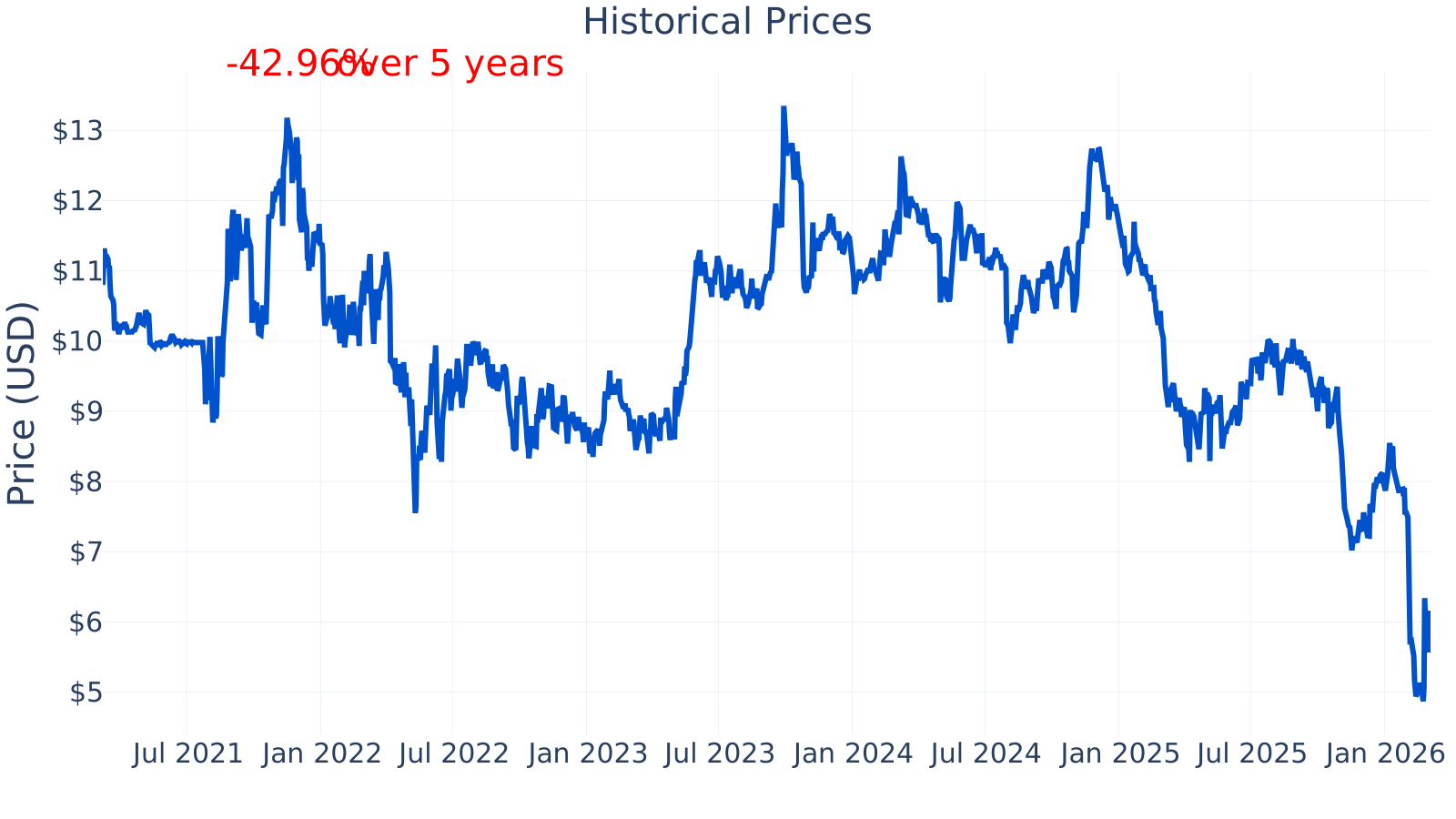
Overview
CCC Intelligent Solutions Holdings Inc. (CCC) provides software used mainly by the property & casualty (P&C) insurance ecosystem. In simple terms, its tools help insurers, collision repair shops, parts suppliers, and auto manufacturers estimate vehicle damage, manage repair workflows, handle claims, and connect different parties during a claim. The overall goal is to reduce friction (time, cost, and errors) in the end-to-end claims and repair process.
CCC’s revenue is largely tied to transaction activity and ongoing subscriptions within the auto insurance claims process. While the exact mix can change by year and product line, its revenue is generally concentrated in solutions sold to insurers and repair facilities, with additional revenue from parts and related network/marketplace services. (For precise segment percentages, the company’s annual report segment and revenue-disaggregation notes are the reference point.)
Over time, the business has scaled revenue while continuing to invest in product development (including data-driven estimation and automation) and sales coverage across the claims ecosystem.
The revenue base shown here increases from about $688 million (2021) to about $1.057 billion (2025). Gross profit also rises over that period, while operating income and net income move between profit and loss depending on operating costs and other items such as interest and taxes. This pattern is consistent with a software company investing heavily in product development and go-to-market while seeking more stable profitability.
Key Figures
| Metric | Value | Industry ⓘ |
|---|---|---|
| Date | Mar 06, 2026 | |
| Context | ||
| Sector | Technology | |
| Industry | Software - Application | |
| Market Cap ⓘ | $3.95B | |
| Beta ⓘ | 0.75 | |
| Fundamental | ||
| P/E Ratio ⓘ | N/A | 25.64 |
| Profit Margin ⓘ | 0.04% | 7.42% |
| Revenue Growth ⓘ | 12.70% | 16.65% |
| Debt to Equity ⓘ | 4.05% | 24.02% |
| PEG ⓘ | N/A | |
| Free Cash Flow ⓘ | $387.57M | |
CCC’s market capitalization is about $3.95 billion, and the stock’s beta of about 0.75 suggests it has been less volatile than the broader market in the periods measured. The latest profit margin shown is about 0.04% versus an industry median around 7.43%, indicating profitability has recently been very thin compared with many application software peers. Year-over-year revenue growth is about 12.7% (industry median about 16.7%), showing solid growth but not at the pace of the median peer in this classification. Debt-to-equity is about 4.0% (industry median about 24.0%), implying relatively low balance-sheet leverage at the latest point shown. Trailing twelve-month free cash flow is about $387.6 million.
Growth (medium)
CCC operates in a part of the insurance market that tends to be structurally important and recurring: auto claims must be handled regardless of the economic cycle, and insurers continually look for lower claim severity and faster cycle times. Digitization of claims and repair workflows is a long-running trend, and CCC’s network model (connecting insurers, repairers, and suppliers) can benefit from more participants using a shared platform.
From a top-line perspective, CCC’s year-over-year revenue growth has generally stayed in the high single digits to mid-teens in recent quarters, ending at about 12.7% in the latest period shown.
A practical growth catalyst for businesses like CCC is deeper penetration of workflow products across the claims lifecycle (not just estimating), plus more automation and analytics adoption by insurers and repair facilities. Another tailwind can be increasing claim complexity (more advanced vehicle technology and higher repair costs), which tends to raise the value of accurate estimating, parts identification, and streamlined coordination—areas where software platforms can become more central to day-to-day operations.
Cash generation is also relevant for long-term durability. Free cash flow has risen over time in the periods shown, which can support ongoing product investment and financial flexibility.
Risks (medium)
A key risk is customer concentration and buyer power in the insurance industry. Large insurers can be demanding customers, and pricing pressure or slower adoption of new modules could affect growth and margins. A related risk is that claims volumes and repair activity can fluctuate with driving patterns and accident frequency, which can influence transaction-related revenue.
Competition is another important factor. CCC participates in markets with specialized software providers and adjacent platforms used by insurers and repairers. Competitive pressure can show up as slower growth, higher sales costs, or the need to invest more in product features (which can weigh on profitability).
Profitability has also been uneven. While CCC has shown periods of positive margins, the most recent profit margin shown is about 0.04%, well below the industry median in this peer set, indicating that small changes in costs or revenue can materially impact bottom-line results.
From a balance-sheet perspective, the latest debt-to-equity ratio shown is about 4%, which is lower than the industry median shown. That said, the longer trend includes much higher levels earlier in the series and then a sharp drop late in 2025, so it is important to understand what drove the change (for example, debt reduction, equity changes, or other balance sheet movements described in filings).
On competitive advantages, CCC’s position is often described in terms of its established relationships across insurers and repair facilities, the operational “stickiness” of workflow tools, and the value of connected network participation. The durability of these advantages depends on continued product performance, integration into customer processes, and the company’s ability to innovate as claims handling becomes more automated.
Valuation
Traditional price-to-earnings (P/E) comparisons can be hard to interpret for companies with volatile or very small earnings. In the periods shown, CCC’s P/E is frequently not meaningful (displayed as 0 in several quarters), with occasional very high values when earnings were small relative to the stock price. By contrast, the industry median P/E values shown are generally far lower, reflecting that many peers have more stable profitability.
In cases like this, valuation discussions often lean more heavily on a combination of revenue growth, consistency of free cash flow, operating margin trajectory, and balance-sheet leverage rather than a single earnings multiple. CCC’s revenue growth has been solid but not the highest in its peer set, free cash flow has increased over time in the periods shown, and leverage appears low at the latest point—while profit margins have remained thin and uneven, which can complicate simple valuation comparisons.
Conclusion
CCC is a software provider embedded in the recurring, operational core of auto insurance claims and collision repair workflows. The company has grown revenue over multiple years and has shown improving free cash flow over time in the periods presented, suggesting a business model with meaningful cash-generating potential.
At the same time, profitability has been inconsistent and the latest margin shown is close to break-even, which makes valuation through standard earnings-based metrics less informative and increases the importance of monitoring operating execution. The main long-term questions are whether CCC can sustain durable growth through broader product adoption and automation while translating that scale into steadier margins in a competitive environment with powerful customers.
Sources:
- SEC EDGAR — CCC Intelligent Solutions Holdings Inc. — Annual Report (Form 10-K)
- SEC EDGAR — CCC Intelligent Solutions Holdings Inc. — Quarterly Reports (Form 10-Q)
- CCC Intelligent Solutions — Investor Relations — SEC Filings
- Wikipedia — “CCC Intelligent Solutions”
This article is for informational purposes only and does not constitute financial advice. Some content is AI-generated. See Disclaimer


